Tuesday, March 19, 2013

homily for Gwen Tyson 3-16-13


A Celebration of the Life, Death and Ministry of
Gwendolyn Speight Tyson
11-9-51 - 3-4-13
All Saints Church, Southern Shores, NC
Thomas E Wilson Rector
March 16, 2013

People do not get what they deserve and bad things happen to good people. The center of our faith is a man named Jesus, a good man who had bad things happen to him. That presented a problem for his followers because it was a scandal for in the old view of religion was that if you were nice to God, God would be nice to you. If anything happened bad to you then that was proof positive that God was turning God’s back on you.

One of the people who believed that old view of religion was a man named Saul of Tarsus; except Saul had this experience with the Risen  Lord and he saw that God was present in the middle of everything, even in the middle of the broken places of life. In the lesson for today he writes to the church in Rome to tell them what he believes and says; “Who will separate us from the love of Christ? Will hardship, or distress, or persecution, or famine, or nakedness, or peril, or sword? No, in all these things we are more than conquerors through him who loved us. For I am convinced that neither death, nor life, nor angels, nor rulers, nor things present, nor things to come, nor powers, nor height, nor depth, nor anything else in all creation, will be able to separate us from the love of God in Christ Jesus our Lord.”

One of the problems about being my age, and I am a few years older than Gwen, is that we really wanted to believe what we were being told when we were growing up in the 50’s. Our parents and grandparents would say to us, “You children have it so easy. Well back in my day ...“

In school and Sunday School we were told to believe in progress. We were told that life was going to be easier for us. Our parents had been through the Great Depression and World War II and, so the idea went, all of the hard stuff was going to be behind us. The way science was progressing we were going to be the generation that would have it easy. All the major diseases would be conquered and we would all lead healthy and long lives. We would have labor saving devises and so we would have lots of time on our hands as houses would clean themselves, meals would cook themselves, clothes and dishes would was themselves. We eventually would have flying cars that would take us wherever we wanted to go. We would have so much money we would not know what to do with it all. All we had to do was work hard, lead an honest life, be a good person, believe in God, and everything would be all right as we pass it on to a new generation and they will have it even better.

The problem is that life is not easy; it is hard. Our parents wished life to be easy for us and we wished it for our children and grandchildren; but the reality is that life can be very hard and unfair.  Jesus knew that things are rough in life so he sent out his followers two by two to help each other not to be discouraged and to walk together through whatever comes their way.  Jesus said that “Whenever two or three are gathered in my name I will be there in the midst of them.” Therefore it was not one, or two walking alone but three, for the Christ was with them. When the disciples went out two by two they had no idea that Jesus was with them and it was only after his death that the disciples realized that distance or even death does not end the connections.

Forty one years ago Mary and Gwen stood together and heard a preacher say “Those who God has joined together let no one put asunder.”  God joined them together and Jesus walked with them. In fact that is the place we seem to find where God is most real in the space between two people. The church gets so busy doing church stuff that we have to depend on people who get married to each other to show what love looks like. Gwen and Marty have demonstrated what love looks like and each step of the way there God’s living spirit giving them strength.

We gather together to give thanks for Gwen’s life and love. For those of us who are stranded on this side of the shore, we ask for the strength to place her in the arms of God who lovingly accepts her as God’s child and cradles her in the arms of Grace. We also ask for the strength for you to find God walking in the sacred space between each of you when you have been so used to seeing only Gwen.  We also ask for the strength to help guide the youngest generation to know that love does not die and Gwen’s love is still walking with each of them.


Marty has this poem that he likes called “Footprints” which he went to for strength which is a paraphrase of this chapter of Paul’s letter to the Romans. In this poem Jesus answers a dreamer’s question about where was God when things were rough?   
“The Lord replied,


"The times when you have


seen only one set of footprints,


is when I carried you."


Watching Francis


It was the Feast of St. Joseph, 19 March, Tuesday and Joseph is heavy in my thoughts today. I went in to do my work out and stepped on the elliptical to start. I plugged in my headphones and saw the Bishop of Rome in a live feed on the occasion of his installation as Pontiff. He was in the middle of a moving sermon on St. Joseph. I though how appropriate was the fact that the “Holy Father” was giving a talk about what it means to be a Father centered on love, gentleness and service. 

The Gospels are not meant to be definitive biographies but in Luke and Matthew use the Greek work “Tekton” to describe him which is a general word for anyone who makes things and can mean a carpenter, a builder, a smith, handyman, a song writer or even a poet. Justin Martyr in 135 AD, more than a century after Joseph’s death, suggests that Joseph made plows and yokes. We know very little about him and from in the mid 2nd Century a writer comes up with an  apocryphal Gospel of James which is mostly interested in legends about Mary  but suggests that Joseph was a very old widower who already had children and chosen by lot to watch over the young girl Mary.  By the 7th Century there is a popular apocryphal devotional book “History of Joseph the Carpenter” which has Joseph die at the age of 111. 

How do we know anything about Joseph?  Matthew 7:16 gives us a clue “ You will know them by their fruits. Are grapes gathered from thorns, or figs from thistles?” We are told that sons learn how to act like a man from imitating (or not) their fathers and are affirmed (or not) in that imitation by their mothers. What love there must have been between Joseph and Mary that produced a man like Jesus!  Our task as families is to provide homes (and church homes) for our children and grandchildren where we teach them by example how to care for the vulnerable, be gentle and forgiving and find power in service.

I continue in my prayers for Francis and my hope that this 76 year old child will tame  and raise the church to re-present Jesus to the world.

Saturday, March 16, 2013

reflection on abundance

A Sermon for V Lent All Saints’ Church Southern Shores, N.C. March 17, 2013 Thomas E. Wilson, Rector

One of the joys of those of us who wake up early is to experience the Outer Banks without the traffic. There are the waves that were crashing this week as the mist and the foam were buffeted inland by the wind to remind us that we live on a barrier island subject to the will and power of the one who is greater than ourselves. All the houses and streets we have constructed are put into perspective as potentially doomed human attempts to control the world we live in. The animals make their noises in the pre-dawn hours and, with the breaking of the underbrush, the deer come out to graze and remind us that every flower we think of planting they see as breakfast. There are competing calls as the birds, foxes, and coyotes remind us that we share this piece of earth. And there is not just one bird call but dozens, as if God didn’t know when to stop creating new opportunities for joyful beauty.

Here on the Outer Banks, there are abundant assaults on our senses - the feel of the misty moisture of the dew and foam; the smell and taste of the salty sea air; the sight of all of those stars, all the more luminous thanks to our lack of street lights, which make us aware that we are only one small planet, around one small sun in a universe of, as Carl Sagan guessed “maybe 100 billion galaxies and 10 billion trillion stars”. He claimed he never actually said “billions and billions” as comedians would imitate his voice. For a while he refused to say “billions and billions” if he was asked because it was an imprecise figure, until his last book when he finally wrote it down as the title. But even as he wrote it he knew that his human ability to count the stars was doomed to failure. It is part of being human that we want to exercise limits and control, and it is part of the divine to answer our push toward scarcity with a rebuff of abundance.

In the lesson from Isaiah, the exiles in Babylon are afraid to leave the relative comfort of that which they know in Babylon to attempt the strenuous trek across the wilderness from Babylon to Jerusalem. They want to live within their comfort zone in captivity and God, through the songs of Isaiah, is calling them to a new freedom. God promises abundance for the journey, but they do not trust promises of abundance for they only trust what they can hold in their hands. The promise from God is that they will find water in the desert which seems to be an impossible thing to happen. Yet, listen to the Psalm for today which the exiles sang when they got back to Jerusalem, and they witnessed that God had indeed kept God’s promise of abundance and for them had restored the water in the Negev desert and:
Those who sowed with tears *
will reap with songs of joy.

Those who go out weeping, carrying the seed, *
will come again with joy, shouldering their sheaves.

In the Epistle Paul describes his own quest for a relationship with God. Early in his life Paul had made the assumption that God’s love was based on scarcity, and only those people who earned God’s approval by following all the rules, dotting every “i” and crossing every “t”, could establish that relationship. Paul now looks at all the stuff he sweated over and all the medals and merit badges he earned and considers it all a waste of time. Paul had a change of vision on the road to Damascus, and he now lives his life out of a new vision, looking at God through the spectacles of abundance rather than scarcity. He is now ready to give himself away, to pour himself out, as Christ gave himself away for others and poured himself out for all. Paul found himself by giving himself away. 

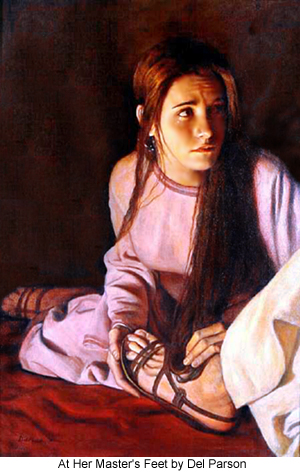
In the Gospel lesson Jesus is the guest of the family of Lazarus, and Mary takes a whole pound of fragrance, extraordinarily expensive coming all the way from India, and washes Jesus’ feet with it. Anybody with any sense knows that Jesus is running afoul of the authorities and unless he runs out of town and hides, which he has refused to do, it is only a matter of time before he is arrested and tried. Luke reports that the whole house was filled with the fragrance and wants to tell you that a drop would have done the job, but Mary went way past abundance in her gift. Her gift was foolishly extravagant, and then she compounds the gift by the promiscuous uncovering and unbinding of her hair and using it to dry Jesus’ feet. Mary throws away her reputation; the scandal would be so great that she could now not hope to have a suitable marriage. She gives herself to Jesus and pours herself out for his life and death.

Judas is appalled by the cost and the waste for he says the perfume could have been sold for a year’s wages. Now, just think of how much that might be for you - a whole year’s wages? Let’s make it easier and just make it a month’s wages. I remember a time when Pat and I had just started dating. She had gone on a business trip and while there bought a fake Rolex watch for me on the street. I didn’t know the cost of anything and don’t keep up with styles, but I thought it was a nice watch and it was a sweet gift. About a month later, one evening I was having dinner with the man who would, many months later, be my best man, and he turned to me and said, “You know Tom, your whole talk about simplicity of life just might carry a little more sincerity if you weren’t wearing a Rolex watch!” I asked him what he meant, and he gave me a guess of how much one would cost. I had more than a month of my salary strapped to my wrist! I stammered that it could not be. Pat and I had just started dating and a gift like that was way more serious than I wanted to be at that moment. I had not done anything to be worthy of such an outrageous gift. He challenged me to go to the jewelry store in the mall and I agreed. There, to my relief, the man at the counter told me it was a nice watch, but it was not a Rolex. At that time in my life I was operating out of a vision of scarcity and afraid that accepting a great gift would put me in a position that I could not get even.

Jesus accepted the gift, no stammering, no excuses, no comments about not be worthy. Jesus operated with the economy of God where he went beyond generosity and gave and received out of a sense of abundance. Mary, who had had her brother Lazarus returned to her, gave out of her vision of abundance rather than grudging scarcity.

When I do pre-marital counseling with couples, I ask them to do a budget - now, five years from now, and ten years from now. Usually they comply and do a budget. However, I am not interested in the figures but in their sense of abundance and scarcity. Most of the budgets are tight, and they start off going from paycheck to paycheck. I usually suggest that they start to think of something that is meaningful to them and make a commitment to give a percentage of their money away each month - off the top, first of the month - as an outward and visible sign of their love and thanksgiving for each other. Giving away is the only way to move to a vision of abundance and freedom from a vision of scarcity. It is one of the reasons that this church has to give money away. God knows we could use every penny we can get our hands on to keep this institution running, but if all we see is scarcity then we cannot see with the divine vision of abundance. We have to give or else we start to lose our reason for being, our very soul.

The money that we give today, the proceeds from “All Saints After Dark”, a byproduct of people giving their time and talent so that we might give it away, is part of our healing of vision. We give thanks for the opportunity to give to benefit our neighbor and to give thanks to God as our offering to this community in which we are so blessed with God’s abundance.

Thursday, March 7, 2013

reconciliation vs. being right


A Reflection for IV Lent                                            All Saints Church, Southern Shores, NC     March 10, 2011                                                 Thomas E Wilson, Rector
Joshua 5:9-12              Psalm 32          2 Corinthians 5:16-21             Luke 15:1-3, 11b-32
I had a situation come up this past week at the Forum Concert of the Vienna Boys Choir.  Pat and I are season ticket holders, and we have wonderful seats which we got after the Stricklands left town. They really are wonderful seats! Before the show began, Pat and I were doing volunteer usher duty helping people find their seats. Pat had put her wrap over the seats to indicate that they were taken so that we could fulfill our ushering obligations.  Did I mention these are wonderful seats?  The place was sold out, and extra seats had been set up for the overflow. We finally had everybody seated and headed back to our seats, our season ticket seats, our numbered season ticket seats - I did tell you they were wonderful seats? The lights start to go down.  And we find there are two women sitting in our seats - our wonderful seats! Pat’s wrap had been moved and set aside as it was in their way - in our seats. We asked them to move and they responded that they had been sitting there since they had come in. We told them that, yes, that may have been true since the reason we were not sitting in our seats, Our Seats, was that we were helping other people find their own seats, but these were our seats. They ignored us as the show began.

For a few moments, your Rector entertained enjoyable fantasies about doing grievous bodily harm to these two women who were stealing our seats.  Heck, we were ushers! I was totally within my rights to lay my hands on them and escort them out of the building. They were old and bent over, so I was pretty sure I could take them, these thieves, without breaking a sweat. I briefly wondered if tossing them into the aisle would break any bones in their hips when the show began, and if their screams of pain would get in the way of the Vienna Boys Choir hitting the right notes. I figured that, even though I was right, as right as right could be, and they were wonderful seats, it would not be a good career decision for a Priest to drop kick two little old ladies in public at the beginning of the performance of the Vienna Boys Choir.  I could picture the headlines: “Local Father Kicks Out Two (Not One, But Two) Prodigals! He proclaims he was doing God’s will, enforcing the sanctity of private property, and that thieves need to be punished!”
We saw the performance from another venue, and it took me almost all the way through the choir’s singing of  Buxtehude’s setting of Cantate Domino (“Sing to the Lord a New Song”)      before I stopped grinding my teeth. The choir kept singing, and my sense of ugly entitlement faded in the light of beauty. There is something about the pure sound of a group of innocents singing about God that tends to take the resentment out of you. But it did put me in mind of the lesson for today, about the story we call the Prodigal Son. The point of Jesus’ parable is not to focus on the Prodigal but on his Father, who represents God in the Kingdom of the Heavens.

The setting for the telling of this story is Jesus being criticized by the Pharisees for eating with the outcasts. The Pharisees understood that there were good and necessary reasons for the maintenance of a civil society based on respect for God’s law. The Pharisees understood that if one ate with sinners, one took the sin of the sinners into themselves, as one was seen to condone the sin being an accessory after the fact, an enabler, of sin. The Pharisees were right in condemning Jesus; he was taking on the sins of the sinners. Jesus does not account the Pharisees position as baseless, but instead, willingly takes the condemnation on himself in order that the lost might be found.  This is what one does in forgiveness - to pay the price for the one who is in the wrong as a way of showing love and desire for reconciliation.    

I would have been a better preacher of the Gospel if I had made a gift of those seats to the people who did not deserve them, paying the cost myself out of love. The problem was that, out of my cowardice that making a scene might reflect badly on me, I chose to sulk. I wanted to revel in being “right” and unappreciated by my Father in heaven since I did not have the better seats which were my due. In essence I became the resentful older brother in the story, the one who thought he was right. But I was more than that for in my self-pity, I was also the Prodigal who had wandered far from my Father in Heaven’s example of life. 

Jesus told parables, not fables. Parables have surprise punch lines while Fables have expected morals. Fables have as their moral some timeless truth for action in a civil society. If this had been a fable, the Prodigal son would have been kicked out, with the moral, “You reap what you sow!” Jesus tells parables to show what God is doing here and now, and the punch line is that God pays the price for what I have done so that I might be reconciled to God and neighbor.

File:Rembrandt Harmensz van Rijn - Return of the Prodigal Son - Google Art Project.jpgI listened to the boys singing and, in my mind, God’s Holy Spirit called to my memory the Rembrandt painting of the Return of the Prodigal Son which he did in the last two years before his death.  Henri Nowen wrote a book of reflections on that painting before his own death and he said, “Rembrandt is as much the elder son of the parable as he is the younger. When, during the last years of his life, he painted both sons in Return of the Prodigal Son, he had lived a life in which neither the lostness of the younger son nor the lostness of the elder son was alien to him. Both needed healing and forgiveness. Both needed to come home. Both needed the embrace of a forgiving father. But from the story itself, as well as from Rembrandt's painting, it is clear that the hardest conversion to go through is the conversion of the one who stayed home.”  

One of these days when I get rich and famous from this preaching gig, I will go to St. Petersburg, Russia to the Hermitage Museum and stand in front of that painting for hours and look at the riches of the father’s vestments sheltering the threadbare, tattered dignity of the prodigal, those strong loving hands clutching the weak back of the son who does not deserve forgiveness. The truth is that forgiveness is precisely for those who do not deserve it.  I want to look at the mouth of the father as he is speaking the words of love and forgiveness to the one in his arms. I want to feel the tears of the father who paid the price for my redemption.  I want to look at the older brother whose crossed arms speak of his resentment and the weariness of not being the only center of love of the father whose love knows no barriers - and I will ask God to open my arms to receive the blessing given to the one who is willing to let go of being right.

Tuesday, March 5, 2013

it is the song not the singer that is important

On Sunday afternoon, March 3, 2013 Chris Kypros performed  a Piano Concert on a Knabe Concert Grand Piano, a gift to All Saints Church  from Debi and Dave Adamson, refurbished with a grant from the Outer Banks Foundation  for the opening  of the Don and Catherine Bryan Cultural Series. Chris played Schubert Four Impromptus, Op. 90, D. 899, Chopin's Ballade No 1 in G Minor, Op. 23, Alberto Ginastera Sonata No. 1, Op.22 and Beethoven  Sonata, Op. 2, No. 3. The second movement, the Adagio was described in Chris' note in the program as ""exquisitely crafted phrases and harmonies that speak prayerfully to that part of the soul where language doesn't exist."

I had preached that morning giving the 3rd attempt at a final sermon for that Sunday.. I am not sure I ever was able to say what the Spirit was asking me to say. There are so many barriers to speaking the spiritual truth using words.  After the service, I did some hospital visits where I spent a lot of time keeping my mouth shut and listening to the space between the words in the conversations. However, I still had the nagging sense of the futility of words.

The night before I had worked as a volunteer usher at the Outer Banks Forum concert of the Vienna Boys Choir and  so my attempt at reflection was sandwiched between two concerts of music.  We did not tape Chris nor the Vienna Boys Choir, and there is something that is untranslatable when the music is not played live in the same room. There is an electric current between the performer and the audience where the performer is held in the hopes of the audience to bring them to the moment of the divine mystery. God knows we in the religion business try our best but we always fall short..

The following is a link to  Alice Sara Ott playing the 2nd movement- a suggestion close your eyes or else you will focus on the "singer not the song" like the line from the 1961 British movie of the same name.


3rd try - cut and paste of previous two


Sermon delivered on March 3, 2013
All Saints Church, Southern Shores, NC
Thomas E Wilson Rector

God says to Moses, “Remove the sandals from your feet, for the place on which you are standing is holy ground." The poet Elizabeth Barrett Browning reminds us of the fullness of God’s presence in Holy Ground:
Earth's crammed with heaven,
And every common bush afire with God:
But only he who sees, takes off his shoes,
The rest sit round it, and pluck blackberries,
And daub their natural faces unaware
More and more, from the first similitude.

 The founders of the three great Abrahamic religions - Moses, Jesus, and Mohammad – are each led into the desert to have an encounter with the Divine. Deserts are the edges of life, where ordinary daily life is disrupted, where business as usual is impossible, and where we are set free from petty distractions and can focus on that which is the core of life and meaning. 

Moses has come looking for Holy Ground.  He is an alien in a foreign land and he has undergone many losses. We are having a Lenten Study Series in which we look at “Living With Loss – Finding Hope”. Loss is part of life and, when we experience loss, we enter into a desert of the soul - which is a necessary journey in order for healing to begin. Without the courageous journey into the desert, we remain stuck in our loss and lead embittered or/and shallow lives dominated by the fear of other losses. The way to survive, and even thrive, in this desert is to rediscover the spiritual truth about ourselves and our changed lives in the space of Holy Ground, out of which we find hope.

Let’s take a look at the losses that Moses has had in his life. He has lost his family several times over. His Hebrew family gave him up to a privileged Egyptian family in order to save his life. He will be brought up in a family in which he feels like an alien in a foreign land, but it is the only family he knows. His confusion about where he belongs leads to a fatal attack on an Egyptian overseer abusing a Hebrew slave. He will lose the Egyptian family as well when he has to flee into exile to avoid a charge of murder. Raised in the Egyptian family he would have learned about the Egyptian Gods and the emphasis on order to maintain the status quo. Raised in the Royal Family he would have been known about the sense of “Holy Ground” in the Temple of Karnack complex, north of Luxor, and he would have lost any access to that Holy Ground ever again. 

Here was the Holy Ground for the Theban Triad of Amun-Ra, the King of the Gods and creator, Mut, the Mother Goddess, and their son, the falcon-headed Moon God which gives new life, Khonsu. The Temple complex was their home and only the Royal family - since the Pharaoh was considered Divine - and the Priests were allowed to enter these imposing collections of Temples, pylons, monuments, and the breathtaking Hypostyle Hall.

I remember 20 years ago walking through this complex and being in absolute awe of these columns, 30 to 60 feet high, with connecting beams weighing 70 tons balanced on these huge columns. When I looked up to these epistyles, I could see the decorations and art painted on the underside 60 feet in the air with the colors so vivid  it was hard to believe that they were painted more than three thousand years ago. The pollution from auto traffic in Luxor is eating away at the paint, but it was awesome. This place was not meant for peasants like me to walk through; it was meant to be Holy Ground, reserved for the God’s and their closest retainers.  

The old Egyptian religious systems were where Gods, who were forces of nature itself, operated in a cyclical system.  In the balance of different forces of nature, as you would see in an agricultural system based on the flooding of the Nile, they were committed to the maintenance of the status quo and had to be appeased by ritual, bribery, flattery, or magic or else disorder would break out. Out of the fear of disorder, these Gods were locked into doing things the way they have always done - even the Gods were not free. “Holy Space” meant space that belonged to the Gods. Gods had temples where they were housed and could interact with other Gods and Priests but from which the regular people were excluded. Gods were not all that interested in individuals but in the prevention of disorder in society and in the heavens, and for that, they needed ritual rather than relationship. Individual life was cheap and people disposable for the good of “order”.

And yet here was Moses, in the desert, the edge of regular life, filled with his sense of loss, as rumors swirled about the increased suffering of his Hebrew family, who he had never known, caused by his Egyptian family in the name of their God, from whom he was estranged. He felt deeply the loss of both the Gods of the Egyptians and the God of his ancestors’, the God of Abraham, Isaac and Jacob. Out of this desert of the soul the God of his fathers' speaks to him and tells him that in this seemingly God-forsaken place is where Moses will find God. 

 The God of his fathers’ goes even further and says the name of the God, “I am who I Am.” This is the ground of being itself, not restricted to a Temple far away, but walking with those who seek the ultimate reality of deeper being. It is this encounter with the one who defines reality that gives Moses hope and strength to meet the days ahead and challenge the forces of oppression. Moses cannot do it alone and therefore asks for the strength from the power greater than himself to change himself and to change the world he lives in.

This God, the ground of being, declares that God-forsaken piece of desert as Holy Ground. There are no Temples, no Priests, no reminders of Glory, only the claiming of intimate space between the individual and God. This God is free from the needs of an institution and will live and move and have the Divine Being with the people. This is the God who is free from the shackles of the past, free from the fate of the future, free to be in the moment where each individual life is precious and loved. This God claims the space between us and says that the Holy Space is in the space between two people and how we treat our neighbor. To follow this God is to treat each breath as a gift and to walk so lightly on the earth since all is Holy Ground.

Moses enters into the heart of God, and because of that, also enters into the heart of the oppressed. He walks with God who walks with him, and together they set the people free to start a new relationship with God where each individual life is precious and loved. Over time the Hebrew people will decide that the maintenance of order is more important than justice, that life is cheap and individuals are disposable, and Holy Space is restricted to Temples where God needs ritual rather than relationship.

Then Jesus goes out into the desert to rediscover himself and the connection with the heart of God and the oppressed. He walks with God who walks with him, and together they set the people free to start a new relationship with God in which each individual life is precious and loved. Over time the followers of Christ will move to the position that the maintenance of order is more important than justice, that life is cheap and individuals are disposable, and Holy Space is restricted to Churches where Christ needs ritual rather than relationship. 
 
And so it goes until each of us enters the desert, the edges of life, where ordinary daily life is disrupted, where business as usual is impossible, and where we are set free from petty distractions and can focus on that which is the core of life and meaning. If we are lucky we can call that a Holy Lent, when we allow ourselves to take off our shoes and walk on Holy Ground and rediscover ourselves and the connection with the heart of God and the oppressed. Shoeless in the desert, we can walk with God who walks with us and together set people free to start a new relationship with God where each individual life is precious and loved.

The story is true for religious institutions as well. Christian religious institutions, of which All Saints’ is one, have undergone great losses. It used to be that Sunday mornings was when families went to church in order to find Holy Ground on which to stand in a world in which loss was always a threat. But churches have squandered that trust of being places of Holy Ground as we became apologists for the status quo and trying to keep everybody happy. We have abdicated our responsibility to be a hospital of healing by becoming condemners of sinners, encouraging those who are seen as less than complete or who do not agree with us to not sully us with their presence. We have been complicit with predators and have refused to deal with the evil of the world as we try to protect out institutions. Part of our new task is to keep pointing to Holy Ground not as fixed to a particular place and ritual but as being at the very ground of our being. God is here, offering healing even when it doesn’t feel like it, because God’s graceful love is greater than the limits of our meager senses and broken religious institutions.
Earth's crammed with heaven,
And every common bush afire with God:
But only he who sees, takes off his shoes,
The rest sit round it, and pluck blackberries,
And daub their natural faces unaware
More and more, from the first similitude.