Thursday, July 3, 2014

On "Our lives, our fortunes and our sacred honor"


A Reflection for the Sunday following the 4th of July           All Saints’, Southern Shores, N.C. July 6, 2014                                                                                 Thomas E. Wilson, Rector
Deuteronomy 10:17-21                       Hebrews 11:8-16         Matthew 5:43-48        Psalm 145:1-9
On “Lives, fortunes and sacred honor”

A video version of thei sermon is on You tube:       http://youtu.be/Fqw6Zc-q0OQ 

Today we have moved the lessons for the 4th of July to take the place of the lessons for this Sunday. The Episcopal Church has had an ambivalent history with the 4th of July, that day in 1776 in which people pledged “with a firm reliance on the protection of divine Providence, we mutually pledge to each other our Lives, our Fortunes and our sacred Honor,” for this dream of a nation in which all are created equal. Not all the people who make up the Episcopal Church pledged their “lives, their fortunes and their sacred honor” for the cause of Independence. In 1775, when the Revolution began, there were about 300 congregations of The Church of England in the thirteen colonies. The Church of England was the established church in six of the thirteen colonies: Virginia, Maryland, North Carolina, South Carolina, Georgia and New York. 

Establishment meant that they were supported by taxes of all citizens; indeed, one of the contributing causes of the Revolution was the idea that that taxes were going to pay for the Bishop of London’s palace in England. We still have a remnant of the idea of the state as controlling religious thought in Article VI, section 8, of our state constitution which denies the ability to hold elected office to “any person who shall deny the being of Almighty God.”  


Samuel Seabury
The title “Episcopal” means having Bishops, and we started off as a church with three Bishops. 
The first, by order of consecration, the Bishop of the American Episcopal Church, was Samuel Seabury who, as a loyal Priest in the town of Jamaica, New York, a part of Queens, had written pamphlets opposing disloyalty to the British Crown. When the war began, he was jailed by the patriots for a while, and then when the British drove Washington’s Army out of the New York City area, he was appointed Chaplain to a British regiment. After the war he got out of town, moving to Connecticut, and finally swore loyalty to the American side. 
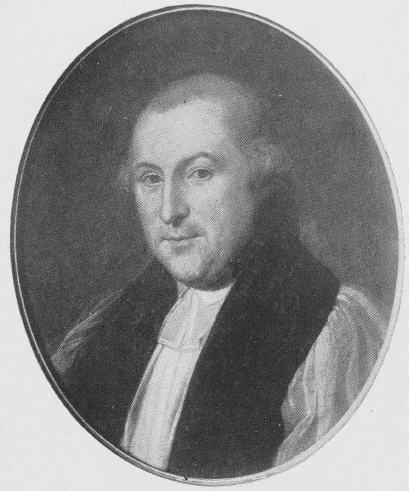
William White


The second Bishop was William White of Philadelphia, who was the only Anglican Priest in Pennsylvania to support the Patriots’ side, and he served as Chaplain to the Continental Congress. 


The third was Samuel Provoost of New York, who decided that he could not remain as Assistant at Trinity, Wall Street, and continue to pray for the King, so he stepped down for the duration of the war. While he did not join the Patriot army, he did join an armed group that chased a retreating British troop in retaliation when the British burned down a town in which he was staying. 

During the war, some states confiscated Church of England buildings, turned them into state property, and sold off church lands, and it took a while for them to be returned to use as worship spaces after the Revolutionary War. By the end of the war, 40% of the Anglican ministers left for Canada. The battered and divided remnants of the Church of England in His Majesty’s Colonies under the authority of the Bishop of London, the Anglican church, started making a slow and painful transition to the Protestant Episcopal Church in the United States with a move to celebrate the 4th of July in the lead up to the first Book of Common Prayer. The three Bishops decided against this move since many of the Priests had been on the loyalist side, and this would only rub salt in the wounds. So the Episcopal Church begins by binding former enemies together. We can assume that the Priests, and parishioners, didn’t always like each other, but they decided to love each other because they believed as the lesson from the Book of Hebrews for today tells us, that “they confessed that they were strangers and foreigners on the earth”; our true homeland is not of this earth. However much we love this land in which we live, no matter how long this earthly life, we are only passing through, and our allegiance, our deepest commitment, our highest passion is to a higher law than the Constitution and a higher Judge than the Supreme Court. 

We may, some should, none must, have a passion for our earthly country. Passion comes from the Latin “patere” which means “to suffer” and means having a very strong commitment to a person, place, or thing and being willing to undergo suffering for the commitment to that person, place, or thing. That suffering of the heart and soul and mind in devotion to God’s Kingdom was the basis of Jesus’ earthly mission and ministry, and it culminates in his last days during what we call Passion Week.

There are two levels of passion - one for God and the other for those people, places, and things that are in our lives. I remember a conversation over our family supper table almost 50 years ago. I was home from college and my older brother, Paul, was home from Marine Boot Camp. Paul was talking about being a real “Gyrene” and going to Vietnam and “kill some Cong”. I opined that I could never kill another human being. My father, who had been a Major in the Marine Corps during World War II fighting in the South Pacific turned to me and, pointing his finger at me, said, “If you don’t want to kill someone - aim high; you don’t owe your country someone else’s life, but you do owe your country your life.” Then turning and pointing to Paul he said, “You owe your country your life, but not your mind.”

My father passed on that kind of passion where you accept the person, place, or thing as the gift that they are, but then look deeper than just the outside persona and see the potential in who or what they are created to be. The saying is true - the opposite of love is not hate, it is indifference. We can love someone but hate the things they do, whereas indifference means that they are not worth expending the energy to feel anything toward them.  Love is the way I look at my family, my country, my friends, my church, and myself. I love my family, my country, my friends, my church and myself, but I do not see them as perfect with a “My country right or wrong, love it or leave it” kind of mindless mentality. I love these all, faults and all, as works in progress, and I love them enough to stay and help. Our task for our country is to have passion and spend time, energy, and money to help it grow into the dream which called it into being. It means being honest about its failings when we as a nation fall so short of the divine vision for us.  

Today we remember this nation and, as we give thanks for it, we also commit ourselves to be in the image of God who, as the reading of Deuteronomy reflects, “is not partial and takes no bribe” (which suggests that we may need to do better work about tax breaks, lobbying, and funding of elections), “who executes justice for the orphan and the widow” (which suggests that we have work to do on caring for the poor), “and who loves the strangers, providing them food and clothing” (which suggests that we may need to do more work on how we deal with immigrants). “You shall also love the stranger, for you were strangers in the land of Egypt” (we here on the Outer Banks know more than a little about being from somewhere else). 

When I was growing up in the Episcopal Church, after we shook people down for money with the offering plates, we would all sing the doxology and then the organ would crank up for the last verse of “America”. I used to harrumph about it because it seemed a response to the McCarthy era, but it seems appropriate for us to go to the past and proclaim our passion for our country with the greater passion for our God. Our country has a past and is always in transition to the future, and while we are on this passionate road committing “our lives, fortunes and sacred honor” to our country, we also are in transition to a different homeland. Let’s sing the last verse of Hymn 717 as a sung closing prayer, to be followed by a spoken prayer:
Our fathers' God to Thee,
Author of liberty,
To Thee we sing.
Long may our land be bright,
With freedom's holy light,
Protect us by Thy might,
Great God our King.

The spoken prayer was given to me by one of our members who used it to open a meeting of the Worship Focus Committee. It is by the Reverend Canon Kristi Philip of the Diocese of Spokane, and it is called “A Prayer for Transition”:
Ever-present God,
You call us on a journey to a place we do not know.
We are not where we started.
We have not reached our destination.
We are not sure where we are or who we are.
This is not a comfortable place.
Be among us, we pray.
Calm our fears, save us from discouragement,
And help us to stay on course.
Open our hearts to your guidance so that our journey to this
Unknown place continues as a journey of trust.
Amen
 

Thursday, June 26, 2014

All Are Created Equal (Part two and three)

All Are Created Equal


For the You Tube Video of this  go to:
http://youtu.be/PvSWfd74ymg


A Reflection for III Pentecost (Proper 8)       All Saints’ Episcopal Church, Southern Shores, NC    June 29, 2014                                                    Thomas E. Wilson, Rector
Genesis 22:1-14                      Psalm 13         Romans 6:12-23          Matthew 10:40-42
           
All Are Created Equal (part two)
Today we continue the reflection from last week looking at the myths in the Genesis stories. A reminder that a myth is not a lie, but a story which may or may not be factually correct and which people tell in order to understand the way things are. Myths are usually about speaking a deeper truth about relationships between God and humans, humans with other humans, and humans with their own true self. They are like dreams in that they are more meant to shed light and understanding than they are to pass on facts. Dreams and myths give meaning not about surface events in the dream/myth but about the symbolic interaction within the dream.

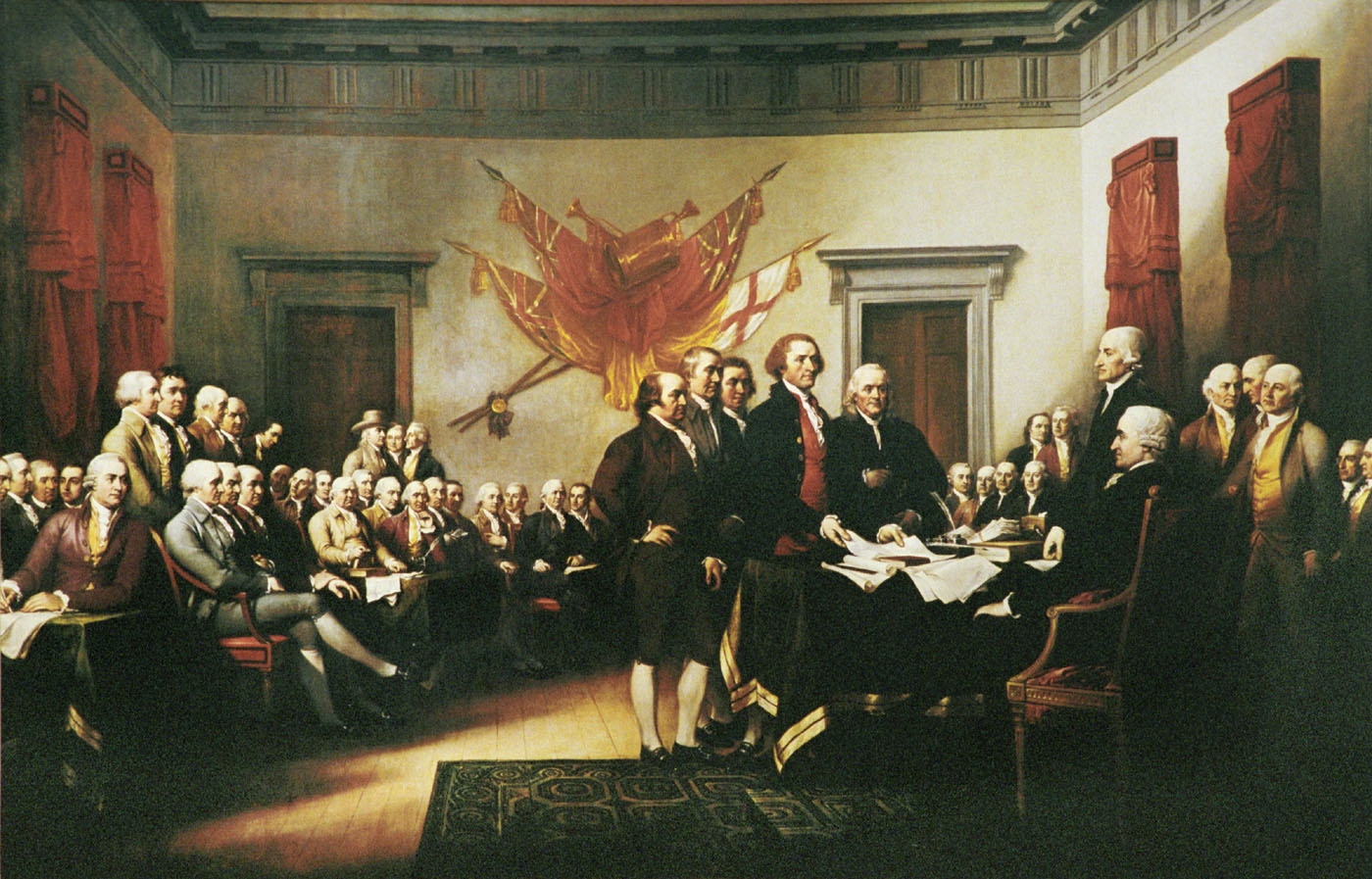
John Trumbull's painting 40 years after the event
Let me give you an example about myths using the commemoration of the 4th of July coming up next week. These are the facts:  representatives from the colonies met and, on the 2nd of July, they came up with a Declaration of Independence from England. The myths that came forth out of that meeting have been told many different ways, including elements about John Hancock’s signature, the mass signing on the fourth, the cracked Liberty Bell, and other details which are based on the belief systems of the people looking back at the event over the passage of time. Since it has been only 238 years since that day in 1776, the myth has not yet fully developed or reached its final form. This American myth is told, retold, and re-interpreted based on the needs of the later generations to remember who we really are. 

Here are the facts of the Abraham story of the binding of Isaac: in ancient times, there were many deities that required parental sacrifice of a child in order to thank those gods as a quid pro quo for good things happening or to influence the deity to a future course of action.  That is all we know, and scripture has stories of Israelite rulers and warriors sacrificing their children and prophets denouncing the practice, as well as many stories of the slaughter of innocent women and children to their God. I think this is a myth about who God is and who we are in relation with God and others by writers at least a thousand years after the Abraham/Isaac stories were first told. There is a remnant of sacrifice in the offering at the Temple as a payment for the acknowledgement of blood being shed during the birth of a child, which could be a left-over from the earlier sacrificial practice.  Jesus’ parents went of Jerusalem to pay a sacrifice of thanksgiving for his birth.

The Rabbis in the Talmud used to embroider this myth with some extra dialogue.  For instance, in one variation, God asks for a volunteer angel to go down to Abraham to tell him to kill Isaac. All the angels refuse and tell God that if God wants to have this horrible deed done, God alone is going to have to do it. Apparently the Rabbis wanted to pass on the myth with another dimension - that even angels don’t use the “I was only following orders” excuse, and we are all responsible for our actions.

While both the Bible and the Muslim Quran agree that the sacrifice was to be done on Mount Moriah, which they also agree is the present site of the Temple Mount and Dome of the Rock in Jerusalem, the Quran tells this myth with Ishmael taking the place of Isaac.

However, I don’t think the myth is about child sacrifice once upon a time. Rather, I think that the public dream that is the myth goes deeper, speaking to our conscious and unconscious tendencies to treat people as objects for our own agendas. What does the myth tell us?
 Two things: (1) God is the giver, not the taker and 
                   (2) we are to treat God’s gifts as subjects of awe, not as objects of malice. 

In this myth God indeed is the giver of all things, even the child Isaac. While Isaac is a gift, he is still created equal with Abraham, and God loves and cares for them both equally. God still owns the gift, but we are asked to be stewards of that gift. The responsibility of Stewardship means any gift is given by God and is to be honored for the betterment of the community of faith. Our children do not belong to us to do what we want to meet our needs; they are to be loved for who they are and helped to grow into who they were created to be. Our spouse is not an object to be used for our needs but to be loved and helped to grow into who s/he was created to be and for the mutual creation by the couple of an icon of forgiveness, respect, honor and self-giving care. Our neighbors are gifts from God and are not to be manipulated or exploited for our profit, but we are to work together to create a community of grace. As the Gospel lesson for today reminds us, we are to be welcoming of all gifts from God.  Even our enemies are gifts from God in order to grow in that love which overcomes all differences, creating a commonwealth of peace and justice - “thy will be done on earth as in heaven.”

I think that the myth tells us that the God who continues creating the universe, who continues to walk beside us and live within us, this God sees no real purpose in answering petitions for taking sides about national boundaries or in religious squabbles or in party affiliations or in financial schemes or in generational power struggles whose main purpose is to take advantage of another person. This God laments the divisions we tend to engender between the gifts God has given us. We were not created to consume people, places, and things for our own selfish gains. We are the equal gifts of God given to the world. When we live into that truth, we are able to love the giver of the gifts, we are able to love ourselves as precious gifts from the divine, and we are able to be in awe and wonder over all the other gifts given to us in this world that are placed in our collective stewardship.

Part three is in the Tomes in the July Trumpeter.

Which I am including now : Parson Tom’s Tomes
“All People Are Created Equal” (Part 3)
This continues the reflections in the sermons for June 22 and 29. It starts with a dream. When God created the entire universe, God gave a dream to all of creation which became part of our collective unconscious as human being. The dream said that we, all the atoms of creations, are all connected to each other and all persons are created equal.

From the beginning of written though all peoples have written this dream for their communities. From Ancient China Confucius said; “"Never impose on others what you would not choose for yourself.".
In India, the Hindu centered their moral laws on Dharma; “One should never do that to another which one regards as injurious to one’s own self. This, in brief, is the rule of dharma. Other behavior is due to selfish desires.”  

In Ancient Egypt the Goddess Maat weighted the souls of the dead so they might enter the afterlife and at the center of the Code of Maat was “"Now this is the command: Do to the doer to cause that he do thus to you.”  

The Hebrew people enshrined in their law about the treatment of strangers: “But treat them just as you treat your own citizens. Love foreigners as you love yourselves, because you were foreigners one time in Egypt. I am the Lord your God.” 
 
The Buddha spoke against violence of any kind: “Hurt not others in ways that you yourself would find hurtful.”

Jesus took the whole of the law and summarized it in his encounter with a lawyer: “And one day an authority on the law stood up to put Jesus to the test. “Teacher,” he asked, “what must I do to receive eternal life? ‘What is written in the Law?” Jesus replied. “How do you understand it?” He answered, “Love the Lord your God with all your heart and with all your soul. Love him with all your strength and with all your mind.’ And, ‘Love your neighbor as you love yourself.’ “You have answered correctly,” Jesus replied. “Do that, and you will live.”

And so it goes, as people in every land have encountered the dream and either followed it or shaped it to their culture, or ignored it.

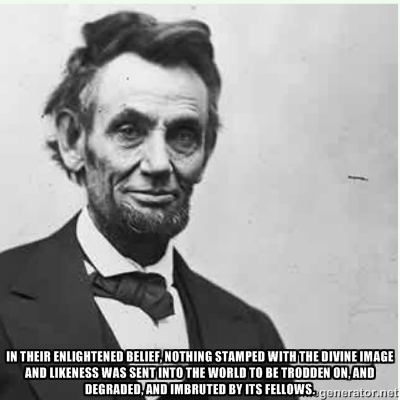
Lincoln 80 + years after the event
On July we remember the events in Philadelphia 1776 when it was written in the Declaration of Independence:  “We hold these truths to be self-evident, that all men are created equal, that they are endowed by their Creator with certain unalienable Rights, that among these are Life, Liberty and the pursuit of Happiness “  Again they encountered the dream and shaped it to their culture because their interpretation meant men and not women, they meant adults not children, they meant allies not enemies, they meant men with property and not men without property, they meant white men and not black nor native American, they meant English speaking who were already there  and not Hispanic, nor Eastern and  Southern European, nor Asiatic who would come “yearning to be free”, they  meant straight men and not gay men.

Our History show that  in the 238 years since that  day in Philadelphia  we continue to encounter the dream anew in every generation and re-interpret it as “All People are Created Equal” This month let us dream the dream again.

Shalom


Thursday, June 19, 2014

All Are Created Equal (Part 1)


A Reflection for 2nd Sunday after Pentecost (Proper 7)         All Saints’ Church, Southern Shores 
June 22, 2014                                                                           Thomas Wilson, Rector
Genesis 21:8-21          Psalm 86:1-10, 16-17              Romans 6:1b-11          Matthew 10:24-39
“All People are Created Equal” (part one)


A Video of this sermon is found on You Tube : http://youtu.be/j4mPER86J44


This is the first of three reflections which will be spread out over the next Sunday and the Parson Tom’s Tomes for July. The plan is that they will be shorter than my usual sermons or homilies because I believe that a preacher should stop talking before the people begin to wish s/he would.

It starts with a dream.  When God created the entire universe, God gave a dream to all of creation, which became part of our collective unconscious. Over centuries the dream kept coming to people all over the world. The message of the dream from the Divine Dream-maker was "All people are created equal." The problem is that, when we wake up from that dream, we forget it.   We look around and see all the inequality. We see the rich getting richer, we see the powerful consolidating their own power, we see lines drawn more brazenly between race, color, language, gender, sexual orientation; you name it, and we devise a reason why some people are less equal than others. Our rational minds look at the evidence of what passes for normal and say, "I guess that is the way it is supposed to be." Our egos, which have the function of interpreting how to get along best in the world, take the message from the rational mind’s evaluation of reality and say, “Let’s find ways to use it for our advantage. After all, if equality is only a dream, therefore it is not really real, and we need to live in the real world.” We accept the inequality but the dream keeps coming back over the eons because, in God’s reality - and God is the ultimate reality - dreams are incredibly real, and our perceptions are only self-serving opinions.

Dreams are how God speaks to our personal, cultural, and collective unconscious free from the tyranny of the rational mind. Individuals gather together and share their dreams within the context of their culture and, out of those cultural dreams, we create stories, sort of like jazz riffs, off the themes of the dreams. What we notice is that myths from one culture seem to have similar themes with myths from other cultures, and we think that all of these different myths have their beginnings in the dreams that God planted in the collective unconscious of all humans.

In today’s lesson from the Genesis collection of stories is the mythic story of the struggle between Hagar and Sarah, who both have sons from the Patriarch Abraham. Hagar’s son is named Ishmael and Sarah’s son is named Isaac. Since this is a myth, the names provide some commentary about the outline of the story. The name “Sarah” means something like “Princess”. Hagar means something like “Stranger”. Ishmael means something like “God has listened”. Isaac means something like “the one who laughs”. So what do the names tell us? Sarah, the princess, the one who feels as if she is entitled, is in opposition to the Stranger, Hagar, who was from Egypt and was originally the slave of Sarah. Both the Princess and the Stranger want a son. The Stranger has the first born son and names the child as “God has listened”. God has been faithful to the Stranger and that irritates the Princess. However, the Princess has a son much later and that son is called “the one who laughs”.   I tend think of that in the context of Proverb 1:26, “I also will laugh at your calamity; I will mock when panic strikes you,” a variation of the more familiar proverb of “the one who laughs last, laughs best”, and all I can think of is that he probably had a nick name like “Na -Nya-Na- Nya –Nya”.

There is an earlier chapter in this myth when Sarah, who had agreed to this option of Abraham fathering a child through Hagar, got really resentful as Hagar sashayed around showing off her pregnancy. Sarah turns brutal and Hagar tries to run away, but an angel convinces her to return. If any one of us has been in a blended family – heck, even a family where everybody has the same parents - we can imagine the infighting that usually goes on for dominance. The Gospel also has Jesus remind the disciples that families can be snake pits as competing claims for dominance are played out. He tells the disciples that even a sparrow which is sold two for a penny is precious in the sight of God. 

There is also another clue in the Hebrew word that this chapter uses when Sarah sees Ishmael “playing” with Isaac. This word can be, and has been, translated several different ways. The word can mean playing with, or laughing (with or at), or mocking, or even fondling. Each choice of translation puts all sorts of different interpretations for Sarah’s reactions. I can imagine that Ishmael, who is 14 years older that Isaac, probably bullied the little pest during this great feast to celebrate the weaning of Isaac.

So the fight is set up over who has the most equal part of Abraham’s love and promise, of which son was the more equal. Sarah pushed the weak Abraham to acknowledge what she interpreted as the truth. Ishmael, the son of the slave Hagar, has to go; he had to die so that Sarah's son Isaac could have the bigger portion of the blessing. Now if this were an historical account, then there would be historians and theologians arguing over who was more equal than the other, who was the victor. This is what we see in the fight between Muslims and Jews, and by extension, Christians. The Jews see themselves as descendants of Isaac, while the Muslims see themselves as descendants from Ishmael. But this is not a history, it is a myth, and so listen to what God does in this story. God will bless both of them. God is with Hagar as she is afraid she and her son will die, and God is with her enemy Sarah and her son Isaac. The myth tells us that God’s dream is that both Ishmael and Isaac are equal in the eyes of the Divine Dream-Maker. In this myth no-one is cast out of the presence of God.

The Psalmist for today underlines that message when the Psalmist sings “For you God are good and forgiving, and great is your love to all who call upon you.” I look at this message and I think if the dream is “All are created equal”, then what does God think of my enemy? If God is the definer of all things, then how do I define my enemy? Do I believe that All Persons are created Equal?”