Thursday, September 11, 2014

The Old Man Walking Through the Water

Video of this reflection is on : http://youtu.be/OrP1DZ_OgiE


A Reflection and Poem for XIV Pentecost (Proper 19)   All Saints’ Church, Southern Shores, NC   September 14, 2014                                                           Thomas E. Wilson, Rector
Exodus 14:19-31       Psalm 114        Romans 14:1-12           Matthew 18:21-35

The Old Man Walking Through the Water
The Old Man, whose name “Moses” meant “Pulling out of the water”, felt like he was really living into his name as he was walking through where the water used to be. The water was standing like a wall on either side of him, almost 50 feet high.  The ground underneath his feet was hard and solid; he thought it would be soft and sandy, as when the tide goes out, but this was like pavement. 

He was alarmed and wondered what would happen if Pharaoh’s army of chariots caught up to that long line of people following him who were carrying all of their possessions on their backs and in makeshift carts as they left Egypt. Pharaoh had lost face in the battle with the Old Man’s God, and while he had given permission for the Hebrews to leave, he had to reassert his authority and wring some sort of revenge on the former slaves. Pharaoh knew that many of the former slaves did not really want to leave, for it is human nature to want to stay in whatever condition you are rather than risk an unknown future. Maybe, Pharaoh thought, if he could just kill the ringleaders of the slave revolt, he could force the rest of the slaves back to bondage.


Moses also knew that most of the people walking the path out of Egypt did not really want to go. Yes, they had been miserable in Egypt, grunting and sweating under a weary life, but there is always a difference between complaining and changing. They were afraid that, if they changed, they would have to give up much of what defined them. 


Moses looked up at the wall of water. He got his name by being pulled out of the water and here he was again. He imagined remembering what it was like being a baby picked up out of that watertight basket. Had he been comfortable in that basket, with the feel of that familiar blanket which held the comforting smell of his mother? Had he cried when the hands with the smell unlike his mother brought him out into the fresh air?


He looked at the water wall again and imagined remembering what it was like for the baby he had been to have gone through that first wall of water as he had been born. Had he been comfortable in the womb and not wanting to leave? Had he cried when his body had been so rudely interrupted from what he had known for 9 months? Had he complained about the assault on his body as he squeezed through the opening into a new kind of life? Had he been startled by the noise and light and having to learn a new way of breathing and getting nutrition?  Had he complained that he had not been asked to be born as the water gushed out and he was pulled from that water? He had not asked to be born, but he was learning how to treasure every moment after.


Moses looked again at the wall of water and saw the monsters of the deep peering out through the clear water. He had been a man of the desert so long that he had never been face to face with such curious creatures like sharks and whales. He looked in the eyes of the whale and saw that they looked back at him with curiosity. Moses instinctively put his hand into the wall in order to touch this creature, and the whale pulled away. The whale had been afraid of him. “Imagine that”, he thought, “here the whale is scores bigger than me and yet the whale is the one afraid. Is it part of being a created being that we share the curse of fear?” 


The Old Man thought, “Maybe the reason the animals recoil in fear has to with the fact that they sense the violence in the humans, and they run away from what they do not understand. Animals understand the food chain as part of existence, but they do not understand senseless violence.” The Old Man knew that humans are part of the same creation of which the whale is a part.  All of the creatures of God share curiosity, but is there something about humans where violence is always under the surface. 


The Old Man still had his hand in the wall of water, and he realized he was touching the depth of the sea with his hand and the depth of his being with his soul. He had killed a man years before, and when he had run away from prosecution for that crime, he had used violence to defend the daughters of the Priest of Midian from the shepherds at the well. The Priest had been so thankful for the violence used in the protection of his daughters that he gave one of his daughters, Zipporah, to Moses as a wife. She later called him her “bridegroom of blood”. In the struggle for power against Pharaoh, Moses had excused the violence of the death of the first born of the Egyptians as a recompense for the centuries of violence done to the Hebrew children. When will the violence ever end?


He thought, “The violence will only end when there is a trust that all is being redeemed. Trust is hard as I look at these walls of water; can I trust that the walls of water will not break and drown me? I walk one step at a time, but these walls seem so threatening that my fear that I will not be able to hold these walls up threatens to break through. I can put my hand through the walls, and I know that I cannot hold them up. These walls are being held up by my relationship with the one who is greater than myself. It is the ground of my being that holds the wall, and it is my trust in Him or Her that allows me to walk one step at a time by the walls which can engulf me.”  


Moses thought, “Maybe going through the water is really important as a symbol of going through the birth trauma, of leaving a whole way of thinking and of living behind and finding a new way of life on the other side of the water after it breaks. Maybe when the walls of water break and come tumbling down, drowning the past, then I might have a life without fear in my heart.  One step with trust is followed by another step in trust, for the journey to the Promised Land is only reached one step at a time, and the point is not the destination but the journey, which I know will take all of my life.”


The Old Man chuckles,  “I know that it is only a matter of time before Pharaoh’s chariots and chariot drivers will catch up to us. But Pharaoh trusts only in himself, and trusting only in oneself does not keep the walls of water from flooding our lives. If that is the case, then the High Horse and its rider will be tossed into the sea.”


The Old Man Walking Through the Water

Pulling out of the water

Standing like a wall on either side

Carrying their heavy burdens

Differing between complaining and changing


Standing like a wall on either side

Imagining remembering what it was like
        Differing between complaining and changing
Having not been asked to be born


Imagining remembering what it was like

Creatures of God sharing curiosity

Having not been asked to be born

Horse and Rider tossed into the sea


Creatures of God sharing curiosity

Carrying their heavy burdens

Horse and Rider tossed into the sea

Pulling out of the water


Thursday, September 4, 2014

The Old Man Crosses the Nile

You Tube video is at :  http://youtu.be/MmtJrEjtdaY

I am continuing an experiment to move away from the lecturing and academic analysis of Biblical texts and move instead toward reflection on the events in the Bible and life. Jesus did not lecture, he told stories. The prophets did not do academic lectures; rather, they shared dreams, encounters, and sang songs. I will offer my reflection, and then I will take thoughts from that reflection and make a poem in the French Pontoum form. Academic lectures pass on what the lecturer thinks is the one simple true point, while reflection and poetry invite the listener to enter into a deeper interaction and response. 

A Reflection and Poem for Pentecost XIII (proper 18)   All Saints’ Church, Southern Shores, NC September 7, 2014                                                                   Thomas E. Wilson, Rector
Exodus 12:1-14                  Psalm 149                            Romans 13:8-14                Matthew 18:15-20
The Old Man Crosses the Nile

The Old Man climbed aboard the felucca in order to cross the river to the island where the bricks are made. Then the grizzled old operator of the craft said, “I know you; you are the one called Moses, the one who comes through the water. You have turned Waset, the City of the Scepter, upside down.   I am Kumat. My father named me “the one who is the black land”, after my country of the black rich fertile land of the flooding of the Nile. I am the land and you are the water. I remember you when my father used to run this craft, and you were part of the royal party that would inspect the brick works and grumble about how the Hebrew slaves were not working hard enough. How does it feel to see contempt from the other side?” 


The Old Man replied: “Now I hear the cries of the people not as complaints from the lazy but as the truth spoken out of pain when the foot of the oppressor is standing on neck of the oppressed. My God opened my ears and now I cannot get rid of it. I come to the City of the Scepter to speak truth to power.”

Kumat said, “I know those cries well, and this struggle between you and Pharaoh has increased the cries even further. Your people have had to make more bricks with less straw. Then you and the magicians of Pharaoh with your competing tricks of competing Gods have turned the economy into a disaster. Come on - do you think the people are stupid and do not remember the past? I have been on the River for decades. That bit of turning the Nile into blood is an illusion which seems to happen from time to time as the red growth in the river chokes the air out of the water and the entire fish population dies, leaving the water undrinkable. The Ibis birds die in huge numbers from eating the rotting fish and, since they usually eat frogs as well, the frog population gets out of hand and they swarm all over the place. Then they die and the land is filled with gnats and flies.  Don’t even get me started on the hail, the storms, the boils on the cattle and then the people, the locusts, and the darkness during the days and nights when the sand blows in from the desert and fills the air so we cannot see. Give me a break; all of these are natural events.”

The Old Man said: “You are right; they are natural. They are not the problem, but they are the consequence of the problem caused by your rulers who are so far removed from neighbor and nature that they no longer see themselves as stewards of the gifts of the land given by God’s hand. They simply exploit the people and land for all they can get out of them.  I remember a saying by the people on the Upper Nile: ‘when two bull elephants fight each other over control, it is the people that are trampled.’ Your leaders are the bull elephants, and blood will be the result.”

The felucca came to the island and the Old Man walked down the plank set out by Kumat. However, the boat shifted, and the Old Man fell off the plank and landed in the red mud.  His hands and robe were covered by the bloody red muck. Kumat laughed and said, “Now it looks as if you are covered with blood. You and your God create disturbances, and blood is the result of your challenge of the way things are.”

The Old Man said, “Indeed there will be blood. There have been centuries of the blood of the oppressed, and now there will be the blood of those who have benefited from the evil done on their behalf. My wife once made a joke that I was truly a bridegroom of blood for her. My hands are full of blood, for the innocent will die as well and the cries of the poor will resonate with the cries of the powerful having their hopes destroyed.”

Kumat recoiled. “So, your God is like all the other Gods who rely on horror to cow the people into following them, glorifying in terror that demands the blood of the innocent for things they never did.”

The Old Man: “My God does not cause that blood to be shed, but bloodshed is a consequence of the evil that has been done for generations. We, humans like you and I, are the ones who spend much of our lives trying to lord it over each other by physical or economic power. Is the death of a child by lack of freedom or food or medical care less horrific than a sudden death by physical violence? The second kind of death we call deplorable, and the first kind of death we call regrettable, but dead is dead either by things we have done or things we have left undone, and we are all responsible.”

Weighing of the Heart from the Egyptian Book of  the Dead
Kumat sighed, “This is true in my religion, where Anubis takes the “Ka”, the soul of the dead, to the scales and places the heart on one side and the feather of Ma’at, truth, on the other.  If the heart weighs more than the feather, the heart is fed to Ammit and the soul dies. We are indeed responsible.”

The Old Man agreed.  “In the name of my God and in the Spirit of your God, I have called on this community to repent of the evil of greed and the neglect of compassion; but you would not. It is now the moment for you to wake from your sleep, for this is the beginning of months of a new way of being. Take the blood of a lamb and place it the posts of your house tonight as a sign that you will shed no more blood by action or inaction, so the angel of death will pass over your house.”

Kumat replied, “I will not spend my life in fear of mere superstition. I am content to do my work here on the great river.  What have the Hebrews to do with me and me with them?”

The Old Man sighed. “We are all connected to each other. There will be weeping in the heavens, echoing the choices your leaders have made. You and I are different. You are of the land as you have your feet planted firmly on facts, and I am from the water and have my being in the world of the spirit.  We see the world in different ways and yet we need each other. I need your solidity and you need my ability to dream as we meet and have our being in the sacred space between us. We do not become a “one plus one equals one” - one mass of a combination of water and land and become mud - nor do we stay always separated, “a one plus one equals two”.  Rather we become “one plus one equals three” - you, me, and the sacred space between us – constantly, dynamically, giving to each other new ways of seeing. My God is this way, and I am called to be in this non-dual way of thinking with neighbor and enemy, who are both indeed, God’s people with me. When we remember this day in the ages to come, we will both drink of the tears of memory and ask for the power to compassionately forgive. There is a song my people sing: ‘For the LORD takes pleasure in the people * and adorns the poor with victory.’”

Kumat proposed: “May your God and my God find peace with each other, for we mere mortals seem never to forgive.” 

The Old Man said: “It is not for our Gods to make peace, but for us humans to gather in the name of peace and find the divine in the space between and within us as we agree to bind and set loose peace here on earth. That peace will be bound and set free by the name that is above and beyond all names.”

Kumat waved goodbye and prayed, “May the angel of death pass over your house this night.”

The Old man replied, “And may you know the peace of God on this day and forever.”

The Old Man Crosses the Nile
On the island where bricks are made
Seeing contempt from the other side
I hear the cries of the people
As the truth spoken out of pain

Seeing contempt from the other side 
Your competing tricks of competing Gods
As the truth spoken out of pain
Being an illusion which seems to happen

Your competing tricks of competing Gods
The consequence of the problem
Being an illusion which seems to happen
Meeting in sacred space between us

The consequence of the problem
I hear the cries of the people
Meeting in sacred space between us
On the island where bricks are made

Saturday, August 30, 2014

The Old Man and the Burnbing Bush


The You Tube Video of this  is    http://youtu.be/WJm1XMxcYrw


A Reflection for XII Pentecost (Proper 17) All Saints’ Episcopal, Southern Shores, N.C. August 31, 2014 Thomas E. Wilson, Rector
The Old Man and the Burning Bush
I was not here last week as Bob Morisseau was with you and in the sermon he preached to remind us that the life that does not end is the deeper life in the spirit. I was hearing in different words that same message while I was at the Dream Group Leader Intensive Training as we saw each moment, awake or asleep, as the gift of God’s spirit being present with us. It is a matter of opening one’s eyes to see all things in a different way. I wrote a reflection, and then distilled it in a poem, which I called “The Old Man and the Lake”, about taking a canoe out on the lake and looking at the event through the eyes of prayerful creative imagination. I have posted that experience on my blog: http://pasontomstomes.blogspot.com/. I want to ask your indulgence and try that process again as we look at the Moses story for this week and see it again through the eyes of prayerful creative imagination. I call this “The Old Man and the Burning Bush”.

The Old Man woke up too early in the morning, put on his sandals, went outside the tent as part of the ritual of growing older, did his business, scratched, and spit. There was still more time before having to relieve the night shepherd and, when dawn came, to move those lousy, stinking sheep to find some new pasture in God-forsaken Midian. He was never going to feel at home in this place. “Don't get me wrong”, he thought, “My father-in-law, Jethro, is a good man, even if his superstitions just rub me the wrong way.” “It is all a crock”, he thought, “for you are born, you slog through most of life, you have a few nice moments, and then you die.”  The Old Man wished he could believe the stuff that Jethro babbled about being descendants of Abraham, but he had seen plenty of religion – too much of it.

He had been born years and years ago, and the story he was told was that his mother had pulled him out of the bull rushes and called him “Moses”, which meant in Egyptian, “coming out of the water”. He actually believed that story for a while until he overheard some of the kitchen help suggest that his mother had a fling with the Babylonian Ambassador and probably came back home with a bundle and made up that story of calling him Moses to cover up the scandal. They laughed as they noted that everything that is born is coming out of the water when it breaks in labor. He had confronted her, but she kept to the story that he was a product of a chance encounter when she was taking a bath in the Nile, and he was probably a Hebrew of the tribe of Jacob or Israel. He had said, “Thanks a lot, Mom! I had seen the Israelites, and a scruffier group of misfits I have never seen before. There was one woman who was a wet-nurse that felt some affection for me, and there were two playmates, Aaron and Marian. However, when I was five your brother forbid me to associate with those ragtags. The wetnurse, Arron and Marian spoke a strange language and mumbled a lot to their God - fat lot of good that did them!”

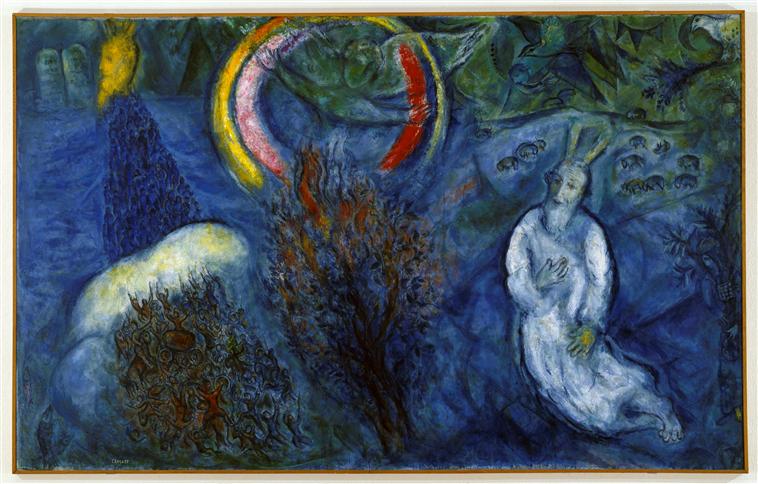
Marc Chagall's Reflection of Moses and the Burning Bush
He remembered that language was similar to what the people in Midian spoke, and they were some of the same racial stock, but the Midianites had copper and trade whereas the Israelites had nothing but sorrow. The ruling elite of Egypt had Gods and Temples, and it seemed that their God's smiled on them.

He remembered going to school where the other kids saw him as a half breed, but he learned what life was like with the elite. He was always on the fringes, the outside of the crowd, a visitor tolerantly endured for hospitality's sake. It changed that night when he had enough of being an outsider and went out to the worksites on the fringes of the palace grounds. It seemed the place for him to go, an outsider going to the fringes. There he came across an overseer whipping a man who wasn't doing enough work. He went up and stopped the beating. The overseer muttered something about not listening to a half breed. Something snapped in him and he took out all his frustrations on the overseer and ended up killing the man, then burying the body to hide the crime. Of course, nothing stays hidden and he had to run for it, ending up in God-forsaken Midian. There he tried to get by, but was always the outsider on the edge of the crowd. He had no real home, no real family, and no real God. The only place where he could kick off his sandals and relax was inside his tent out in the wilderness.

Today the herd was close to Mount Horeb, and in the predawn light he searched for the stragglers of the sheep. Suddenly, the predawn light was a lot brighter and that did not make sense, but out of the corner of his eye he caught the sight of a bush burning. “That is where the light is coming from”, he surmised. He turned aside and approached the bush; it was on fire but it was not burning up. “This does not make a lick of sense”, he thought. “Flames need energy to consume, and here the energy is not being consumed; it is like the fire is independent of needing anything else. This has to be a dream or a demon possession; no God worth its salt would be out here when it could so easily be in a Temple being worshipped with pomp and circumstance.”

Then a voice, familiar and yet hard to place, says, “Moses, the one who comes through the water.” 
 
The Old Man says, “What?” 
 
The voice replies, “Take your sandals off!” 
 
The Old Man says, “I didn’t get to be an old man by taking my sandals off where the ground is hot and scorpions hang out, just because a bush gives me advice.” 
 
The voice saiys, “I am the God of your fathers.” 
 
The Old Man asks, “Which father? The Babylonian ambassador of the one night stand, or Jethro my father-in-law, or some nameless Hebrew slave? I don’t have a father worth having!” 
 
The voice says: “I am your father; I am the ground of your being, I am Being itself. I am who I am, and I was who I was, and I will be who I will be. I have been speaking to you all of your life, but you have been so full of bitterness, that you would not listen, or even hear.”
 
Moses sighed, “I thought the voice was somewhat familiar.” 
 
The voice continues, “Wherever you have been, I have been. Every step you have taken has been on Holy Ground. You would not listen or even hear that I am your true home. You are invited to take off your sandals and make yourself at home with me. I need you to pay attention as you walk with me; each step will be a return to your deeper self and to your people and to my people and will be a walk with them in my path to a new home. I will take you again out of the water; I will walk with you through the deserts and accompany you in the wildernesses. Come follow me and I will set you free. Now, on the first step of this journey go to Pharaoh and say to him; ‘Set my people free.’”

So the Old Man left that place, walking on sacred ground wherever he went for he was now going home.

Let me distill this reflection into a poem in the French Pontoum form. I have gleaned eight phrases from the reflection and placed those eight phrases into sixteen lines in four stanzas.

The Old Man and the Burning Bush
The fire is independent of needing
Speaking to you all of your life
Coming out of the water when it breaks
But you are so full of bitterness

Speaking to you all of your life
You would not listen, or even hear
But you are so full of bitterness
That I am your true home

You would not listen, or even hear
Egypt had Gods and Temples
That I am your true home
Tell Pharaohs to set my people free

Egypt had Gods and Temples
Coming out of the water when it breaks
Tell Pharaohs to set my people free
The fire is independent of needing.

Tuesday, August 26, 2014

The Old Man and the Lake

Just got back from a Dream Group Leader Intensive and did a reflective Short Story and then did a poem in French Pontoum Form using 8 phrases from.the reflection and then
Stanza 1 A B C D
Stanza 2 B E D F
Stanza 3 E G F H
Stanza 4 G I (or A or C) H J (or A or C)

The Old Man and the Lake

A fine picture I got off web of Kanuga Lake
The Virgin Lake calls and the Old Man surrounded by people and ideas hurriedly answers as he must be with her spirit. In his haste, he forgets that long ago ritual of hardening his bare feet at the beginning of summer, but now softened by decades of shoe enclosure he feels every sharp pebble on the gravel road. But summer’s last gasp is here and he must be with her breath, her pneuma. Putting on the Life Vest as a refuting the once youthful denial, he finds it tight. The young attendant smiles as the Old Man waddles into the canoe and pushes off. The Old Man sits heavy in the stern and the bow rises up sail-like to catch the crossing zephyr which snickers as she pushes against the long remembered and unused J-stroke. The cellular memory of Northern Rivers returns on this Southern Lake, heading to new discoveries.


As a dragon fly, who will not be slain on this quest, flies by, trhe canoe spots a pink Water Lily, isolated and segregated alone away from the large while colony of White Water lilies. The pink petals of the flamboyant intruder catch the sun and are reflected in the water, as the Old Man marvels at the pale grey-blue inner petals and the bright yellow pollen laden rods promising more Pink immigrants whose roots will go deep into the dark rich mud. The Old Man thinks he hears the White Petaled ones harrumph that is the Pink is “So very –SO – You know!” in his showiness.


The paddle digs deeper coming to a downed drowned tree. The Old Man apologizes to the tree for bumping it with his paddle and asks the tree if she remembers reaching up to the sun, or praising in the light of Diana’s waning diadem as there had been last night and does she still dream of serving her Goddess in the watery sleep? She says she misses the turtles that have slipped off the sunny purchase of her broken limbs into the water, away from that hard shelled mammal mover the Old Man paddles. The turtles have left a remnant of refuse in their wake. “Refuse” is Majestic translation by Royal James Minions of that much earthier, fine old New Testament Pauline Philippian Greek word- “SKUBALA”. )" For I consider all “σκύβαλα“ that I may gain Christ (3:8))


That word bounces off the Old Man’s brain as he wonders how much Skubala is there in this Virgin Lake. There are the turtles, of course, and the geese, the fish, the dragonflies, and there was this Wedding Rehearsal party the night before. Did an over mellow Groom’s man recycle his beer? Did an embarrassed Ring Bearer relieve a remnant or frightened Flower Girl deposit her dew? The lake is not chaste but as Marion Woodman says, that the Pregnant Virgin archetype “has the courage to BE and the flexibility to be always BECOMING”. She can deal with it as she gives life and gives rich mud for the turtles, dragonflies and lilies.


The Old Man turns the canoe by the spillway and wonders if the water will reach the coast of the Great Sea. Will they meet again as all the waters return to Poseidon’s great Pond? The Old Man returns and baptizes himself in the waters of the Pregnant Virgins Lake’s Teaming beauty. He dives into the waters of the turtles resentments, the downed trees memories, the Pink Water lily’s pride. the memories of the waters of rivers and wombs gone by.


He walks back to the meeting, wincing again on the pebbles and takes the ancient Nun’s advice to offer up the pain as participation in the fullness of life. He laughs as he almost remembers “Blessed are the feet of those who bring God- News”. Tom Wilson August 2014


The Old Man and the Lake
Tom Wilson --- August 2014
The Lake calls and the Old Man answers
J-Stroke paddling to other side
Through waters of Memories
Deep dark Mud nourishes Lilly roots

J-Stroke paddling to other side
Frogs on downed drowned trees
Deep dark Mud nourishes Lilly roots
Worshipping Diana’s waning diadem

Frogs on downed drowned trees
All the waters returning
Worshiping Diana’s waning diadem
Pregnant Virgin Lake giving life

All the waters returning
Through waters of Memories
Pregnant Virgin Lake giving life
The Lake calls and the Old Man answers
   

Friday, August 15, 2014

Mary: “I’m bursting with God-news; I’m dancing the song of my Savior God.”


https://www.youtube.com/watch?v=W3b_RX7pRX0                    to watch this sermon on You Tube 


A Reflection for the Feast of Mary                                     All Saints’ Church, Southern Shores, N.C. August 17, 2014                                                                 Thomas E. Wilson, Rector
Mary:“I’m bursting with God-news; I’m dancing the song of my Savior God.”
I have moved the lessons from the Feast of Mary the Virgin on August 15th to today. Since we call ourselves All Saints, I like to recognize the patronal days of different saints when I can. Saints are not perfect people, but regular folk who have encounters with God. We are Saints, and historical Saints remind us that God chooses all sorts of folk, maybe even you and me, to bring in God’s Kingdom.

When I get off center about things, I need to center myself by breathing. I close my eyes and breathe in and breathe out; understanding that each breath in is the breath, the pneuma, the ruarch, the spirit of God, that which is greater than myself, coming in to me to give peace and to allow me to rest. This is what I call prayer; where I approach God not with anything I know in my head but with a heart full of longing. Sometimes I will add words of which two of my favorites are the Hail Mary from the Roman Tradition and the Jesus Prayer, an ancient prayer from the Orthodox Church tradition: “Lord Jesus Christ, Son of God, have mercy on me, the sinner.” 

 
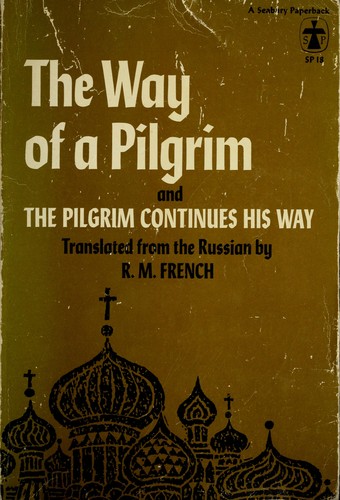
I came across that prayer in high school when I was reading the book Franny and Zooey by J.D. Salinger, the author of Catcher in the Rye. At one point in the story Franny is reading a book called The Way of the Pilgrim about a Russian Monk who is traveling across Russia reciting this prayer as a sort of mantra as part of his breathing until the prayer moves from his lips to his heart, and then he is able to see God. He no longer needs to use words. Franny’s longing for a mystical relationship caught my imagination and I went out and got the book and started to pray. One variation is to cut the prayer down every tenth repetition:
“Lord Jesus Christ, son of God, have mercy on me, a sinner.”
“Lord Jesus Christ, son of God, have mercy on me,”
“Lord Jesus Christ, son of God, have mercy.”
“Lord Jesus Christ, son of God.”
“Lord Jesus Christ,.”
“Lord Jesus.”
“Lord.”
The other prayer I got from my Roman Catholic grandmother, is the Hail Mary: “Hail Mary, full of grace, the Lord is with thee; blessed art thou amongst women, and blessed is the fruit of thy womb, Jesus. Holy Mary, Mother of God, pray for us sinners, now and at the hour of our death. Amen”
I will say this prayer quietly and calmly until the calm in my breathing, in my heart, in my soul matches the calm in my voice.


Two different prayers to the same God, but one uses the male side of my faith and the other uses the 

female side of my faith. But God is neither male nor female. One of the challenges of the western 

patriarchal tradition is that we tend to use masculine pronouns when we refer to God. What the 

Trinity tells us is that God is relational. When Michael Downey talks about God in his 

book, Altogether Gift: A Trinitarian Spirituality, he uses the terms “giver, given and gift/ing”. He 

also writes:
“The Hebrew word for a woman’s womb and the word for compassion are related, and both 

are related to the word for mercy. Thus, the mother’s intimate, physical relationship with her 

newborn is the prime image for compassion and, hence the compassion of God in Christ. To

 speak of the compassion of God is to speak of God’s quivering womb — a womb that 

trembles at the sight of the frailty, suffering and weakness of the child.” 
 

Therefore, one way I understand God is through praying with Mary. The ancient religions all had a male - female pairing of God energies; there were Osiris and Isis, Zeus and Hera, Shiva and Kali, Mars and Venus, Baal and Ishtar, Yin and Yang which were seen not as competing but as complementary forces that created a whole. The Hebrew insistence on the Monotheism of God with the patriarchal priestly caste tended to eclipse the feminine aspects of God’s mercy in daily life. Jesus tries to return that feminine of compassion when he says things like “Jerusalem, Jerusalem, the city that kills the prophets and stones those who are sent to it! How often have I desired to gather your children together as a hen gathers her brood under her wings, and you were not willing”.

When the followers of Jesus took over the family business of the church, they emphasized the masculine again. However, there was a strain that held on to the feminine and that coalesced around the icon of Mary. Over the centuries the men of the church didn’t know what to do with a full woman, so they focused in on divorcing Mary from sex with increasing doctrines like perpetual virginity, where she never had any children and remained a virgin after the birth of Jesus, to the Immaculate Conception, where Mary’s parents, an old couple, never had sex. But I like to see Mary as full of life and blessing all of life. I like to see her as Eugene Peterson translates the Magnificat in his translation called The Message:
I’m bursting with God-news:

 I’m dancing the song of my Savior God.

God took one good look at me, and look what happened—
 
    I’m the most fortunate woman on earth!

What God has done for me will never be forgotten,

    the God whose very name is holy, set apart from all others.

His mercy flows in wave after wave

    on those who are in awe before him.

He bared his arm and showed his strength,

    scattered the bluffing braggarts.

He knocked tyrants off their high horses,

    pulled victims out of the mud.

The starving poor sat down to a banquet;
 
    the callous rich were left out in the cold.

He embraced his chosen child, Israel;

    he remembered and piled on the mercies, piled them high.

It’s exactly what he promised,

    beginning with Abraham and right up to now.

from enemylove.com about the subversive Magnificat
I like to see her singing and dancing lustily. I like to see her wrapping up the baby Jesus and leaving Bethlehem just before Herod’s soldiers get there to kill the babies. I like to see her ripping Joseph a new one when he loses track of the young boy Jesus on the trip to the Temple. I like seeing her going around the wedding party at Cana of Galilee and telling her son to get busy and help the guests have a good time. I like to see her showing up at Jesus’ place and telling him that he was causing the family too much grief and he needed to get his butt home. I like to see her with a group of friends and just laughing up a storm at a bawdy joke. I like to see her hurling insults at the religious rulers and hypocrites that lined up against her son. I like to see her crying at the loss of her husband and her son because she knew how to love deeply. I like to see her, not as a white marble, perfect, patient goddess, but as a full-blooded sister, mother, wife who cares what happens to people - full of compassion. The kind of person I need on my side as she prays for us sinners now and at the hour of our death - and beyond.

Andrew Greely, a Roman Catholic Priest and storyteller, relates a tale about Mary as all compassion:
Once upon a time the Lord God went out on patrol of heaven just to make sure that it was still a city that worked. Everything was fine, the hedges trimmed, the grass cut, the fountains clean, the gold and silver and ivory polished, the mall neat (Of course they have a mall in heaven. Where else would they put the teenagers!). He stopped by to listen to the angel choirs sing and they were in great form. Then on one of the side streets he encountered people who had no business being in heaven, at all, at all. Some of them should have been serving a long sentence in purgatory, others would not get  out until the day before the Last Judgment, still others would make it into heaven only on very special appeal. So he went out to complain to St. Peter. “You’ve let me down again”, he said “and yourself with the keys of the kingdom of heaven.” “I have not”, said St. Peter. “Well, how did they get in?” “I didn’t let them in.” “Well, who did?” “You won’t like it.” “I have a right to know how they got in”. “Well, I turned them down and didn’t they go around to the back door and didn’t your mother let them in!”

“Hail Mary, full of grace, the Lord is with thee; blessed art thou amongst women, and blessed is the fruit of thy womb, Jesus. Holy Mary, Mother of God, pray for us sinners, now and at the hour of our death. Amen”

“Lord Jesus Christ, son of God, have mercy on me, a sinner.”