Thursday, May 12, 2016

Beginnings: Reflection and Poem for Pentecost 2016


A Reflection and Poem for Pentecost               
 May 15, 2016         Thomas E. Wilson       Southern Shores, NC                All Saints’ Episcopal and Emmanuel Lutheran   

Genesis 11:1-9 Acts 2:1-21      John 14:8-17, 25-27                Psalm 104:25-35, 37
Beginnings

This is the Feast of Pentecost, the end of the Easter Season and the beginning of a new season. The church year is divided into two cycles of Preparation, Celebration and Implementation.  These cycles are reflected in the progression from Advent to Christmas to Epiphany and from Lent to Easter to Pentecost. It is a little like any committed relationship where we have a courtship phase and a celebration of commitment,  followed by determining how we live a life together in this world. We see in today’s lessons stories of  different approaches to unity with God.

The Book of Genesis contains a series of stories which try to relate accounts of pre-history. Because these are pre-historic stories there is no interest in relating facts; their interest is in telling truth to explain how they dealt with everyday life. In the story of the tower of Babel, the people look up at the heavens and say “There is something about it that speaks to me. I know that it would make me more complete.” So far so good; we have an honest moment of attraction that can lead to a vision of being united. It is like the beginning of any relationship. But here is where it goes all wrong as the inner dialogue continues: “You know, we would like to live in this heaven and have it for ourselves. Let’s build a way up there and take it by force.” This was the way the culture around them always resolved opportunities for greed, by conquering and taking what they wanted by brute force. But if you want to do brutish things, you become a brute and start arguing like brutes, and leave in ruins the path that could have been created.

This basic myth of attraction descending into ruin is repeated several times in the Book of Genesis and the rest of the Bible - the Fall from the Garden, Cain and Abel, the Evil leading to the flood, Sodom and Gomorrah, Jacob and Esau, Joseph and his brothers, Pharaoh and the Hebrew children, the Golden Calf, Sampson and Delilah, David and Bathsheba, Jezebel and Ahab, and it keeps on going in the scriptures just as it does in today’s daily life.

In tension with that mythic structure of those stories, there is another theme of attraction ascending into  community - Abraham and Sarah, Moses, Ruth and Naomi, Isaiah and Jerusalem, Hosea and Gomer, Jesus, Peter and Paul to name a few. The Psalm for today is a song of awe at the mystery of God and entering into relationship with that mystery.

The story of the Pentecost experience follows that structure, with the Disciples longing for the relationship they had with Jesus, opening themselves to the deeper implications of that relationship, moving them beyond the man Jesus to openness to the God and Spirit to whom Jesus kept referring. They move from longing in the Upper Room, to move to the places outside their comfort zones and share that love that is within themselves. Their relationships with each other and the sacred space between them gives them the strength and the will to touch the lives and hearts of others. They were not interested in building an institution but in living a full life of community where differences are respected and gifts are honored.

The Pentecost story is a story of how a group of people become a church. The word church comes from the Greek word Kyrie, meaning Lord; the church is that which belongs to the Lord of all creation. There is first a longing coming from an awareness of an emptiness. We then gather together, sharing our incompleteness and the longing. The longing becomes connected to an object - a person, place or thing. If the longing is for a person, like a preacher, then the descent into ruin begins, for people will always leave or disappoint. I remember Miller Maxwell, a woman parishioner I grew to love, say to me when she first met me as her new Pastor, “I was a member of Grace Memorial long before you came here and I will be one long after you leave.” Years later I presided at her memorial service, but each time I return in the 20 + years since I left, her spirit is still there because her commitment was to something deeper - a vibrant spiritual community that made a difference in the world outside the building.

If the longing is for a thing, like a ritual or a building, then the descent into ruin begins as things always fall apart and wear out. There is an old joke about Episcopalians, and maybe Lutherans too: “How many church members does it take to change a light bulb?” “Change? My grandmother bought that bulb!” Miller Maxwell had been a member of that church before it sold its old building and moved to the suburbs in 1928, just before the depression hit, and they worked hard to pay off that mortgage. They loved the 1928 Prayer Book and they loved the 1928 Building, and we doubled the size of that physical plant and changed the liturgy because the commitment was to something deeper - the giving away to others the faith we treasured.

If the longing is for a geographic place, like the Outer Banks, then the descent into ruin begins as places change, and we could waste much of our energy trying to keep it from changing. I remember when I moved here, it only took me a couple of weeks to complain about how all the visitors coming in on Saturday were ruining the place. But this church kept reminding me that we existed to welcome and care for all who are in the larger community, for all of them are brothers and sisters of our Kyrie, our Lord.

One of the things the Vestry at All Saints is doing this year is to devise a 5 to 10 year Strategic Plan for this church, and they will want your input as they revisit the Vision and Mission statements as this church moves into the future. We have all, like Falstaff, heard the Chimes at Midnight, and there are new days coming for our churches, new days allowing us to continue making a commitment to something deeper than ourselves. Every day is a new beginning, a new Pentecost.


Beginnings (poem)

Beginning with a hint of wonder;
there is something there I want,
reminding me of what I lack,
drawing me to desire to unite.
You will fix me,
but it will be on my terms,
existing for meeting my wants,
my desires, me. 
What; no my NEEDS!
You will be MINE!
If you will not be mine;
then you will be a no one
and no one's.
Until I search in the ruins
for another something.
            OR
Beginning with a mystery of awe
There is some part of me longing
to be with you.
To listen to who you are,
sharing who I am,
who we are in each other,
who we are becoming,
creating together sacred
places and neighbors.

Sunday, May 8, 2016

Fearles Soul Reflection and Poem on David Myatt


A Reflection and Poem for the Occasion for the Memorial Service for David Myatt 
Lamentations 3:22-26,31-33            1 Corinthians 13:1-13          John 14:1-6               
May 9, 2016         All SaintsChurch         Thomas E. Wilson, Rector
The Fearless Soul 
In 1735, a Priest in the Church of England, John Wesley, was sent out to the edge of the world to the British colonies of North America. He was a significant failure, and he came back to England disillusioned and afraid he had made the wrong vocational choice. In 1738, he was persuaded to attend a Moravian service back in London. He went, and his life changed when he took an honest look at the state of his soul. As he struggled, he came to hear the words of scripture in a whole new way. He started to form groups where people would gather together and begin the meeting with the question: “How is it with your Soul?” Usually when Christians went to meeting, they were told what to think and preached to about what the state of one’s soul should be. These groups of honest people were made fun of by the established church and were derogatorily referred to as people using a “Method” and were called Methodists. In response, they formed Methodist Chapels while remaining members of the established Church of England. The power structure in the church which was afraid of things getting out of control and reacted making prospects for the ordained ministry promise to "preach the Gospel and stamp out Enthusiasm.” 
When The Church of England was on the wrong side of the American Revolution, many of the members in the former colonies used that event to move the societies to a new and separate denomination. Those left over in the ruined Church formed the Episcopal Church of America. Yet, the question remains for us to answer,How is it with your soul?” 
We do not have souls - we are souls, images of the Living God and the God of the living. And at times, we souls are troubled when the world doesn’t behave the way we would like. We like to be in control, but we find ourselves forced back to accept that which is now called the “Serenity Prayer”. God, grant me the serenity to accept what I cannot change, the courage to change the things I can and the Wisdom to know the difference.Just for today. Or just for the next hour. 
We souls also get anxious when we enter into the unknown, for we like things to remain the same. However the central message of the Gospel is “Be not afraid!”  Many of you remember when the fear of contracting AIDS hit this country. There were cries to segregate Haitians when the first report was that the disease was rampant in Haitian society. Then when it was learned that it might be contracted by contact with someone who had AIDS, I was serving at a church where there was a huge outcry from my parishioners to no longer have a common cup for Eucharist. They were afraid because there were some people who were homosexuals in the congregation. There was a joke I told my parishioners then. The young Priest asked the Bishop, Bishop, is it possible that I could contract AIDS at the altar rail during the communion service? The Bishop replied,Yes it is possible, but it would be very disruptive of the service.”  
Any of you remember the Y2K scare where people wrung themselves into knots that the entire world economy would crumble when computers would cease to function upon reaching the year 2000? One man made a mint from that fear by writing a book called “Who Moved My Cheese?”, helping people to deal with the fear of change. I remember I was at my previous church where we owned a high rise apartment building for seniors and a block of townhouses, and oh, the howls of fear. I would attend the Board of Directors meetings, and I would make sure we centered ourselves so that fear would not rule the meeting. Y2K came and went and then 9-11 came. Then the housing bubble burst, then the Market crashed, then and then and then—fill in the blanks. The fear-mongers keep coming back and we have to stop, center ourselves, and deal with the problem instead of allowing our souls to be ruled by fear. 
We don’t like feeling afraid, so sometimes we hide behind the feeling of anger so that we will feel more powerful. I remember I was 19 when my father was dying and my older brother and I were so afraid of what life would be like without our father that we decided we would spend the time picking fights with each other, trying to be angry with each other as a way of not facing our fear. Fear-mongers and others make a lot of money and get a lot of votes off that particular tactic of anger. 
Death is, as Hamlet says,that undiscovered country from whose bourne no traveler returns.” The church remembers the angels and Jesus saying,Don’t be afraid. Let not your souls be troubled.” The world changed when he died, but he and God’s Holy Spirit gave comfort to the fearful ones and gave power to move beyond hiding in an upper room and go and challenge the Empire of Rome.  
David Myatt was not ruled by fear, and he was too gentle to waste time in anger. He had more things to do than be afraid. What he could control, he did and what he couldn’t, he let go. I remember him on the Vestry of this church when he would just listen to opposing views and then calmly respond with his opinion. Life was too short for David to waste time not loving and loving in the way that Paul illustrates with his first letter to the Corinthians. 
At the end of life, all that we will have is the love that we gave and the love which we allowed ourselves to receive. Love is the true state of our soul, the image of God, as we cross the river to be joined fully and completely with the current of divine energy that flows from the throne of God. 
How is it with your soul? Don’t be afraid; for life is too short to waste, not to love. 
 
The Fearless Soul 
A lifetime ago, did we so fear coming down that birth canal, 
leaving a place we knew well to enter into God knows what? 
Over a half century ago, we were afraid of Russian Missiles 
raining down on us with only hiding under desks as protection 
Decades ago we were afraid of getting AIDS at the Altar Rail. 
A generation ago we were afraid of the power of 2000, Y2K. 
Now, we getting older see the “unknown country” draws closer 
to individual borders and gives us pause in our collective fears. 
Is it the death which we fear or is it the standing at the door,  
powerless, waiting to enter the gate? Angels say “Fear not, but  
BE; be each moment aware that you are surrounded by a loving 
energy of Being that is the true center on both sides of every door. 
Youre entering into a new canal into a different God knows what.” 

Thursday, May 5, 2016

Ascending While Descending


A Reflection for the Feast of the Ascension              All Saints Church, Southern Shores, NC May 8, 2016                                                                      Thomas E Wilson, Rector
Acts 1:1-11     Ephesians 1:15-23       Luke 24:44-53             Psalm 93
Ascending While Descending
Today I want to talk about the Ascension as the lessons from the Acts of the Apostles and Luke’s Gospel tell the story of the Ascension.  I want to move beyond trying to explain it by using the images of a literal reading. We no longer believe in a three tiered universe as the earth is the center, the heaven above and the place of the dead beneath; and we will not spend time arguing about Jesus ascending by the speed of light  and if so; is he still on his way since the center of this galaxy is 27,000 light years away?. The writers of scripture were not all that interested in putting down literal facts but attempting to get at a deeper truth through the uses of symbolic language. 

That paradox is also found in the early church identified as the place of the Ascension, which was a cave, one of the three mystic caves identified by Constantine’s mother Helena. These three were the Cave of the Birth of Jesus in Bethlehem, the Cave of Tomb of the Burial and Resurrection in Jerusalem and the Cave of the Ascension near the top of the Mount of Olives. The caves are counterintuitive in the three tired universe in that in order to be united to heaven we must go deeper in dying to the world. Later on as the church moved to more of rational and literal ways of thinking the Chapel for the Ascension was moved to the top of the Mountain open to the sky. The later when Saladin conquered the Christians it was turned into a mosque.  

I was reading a good mystery novel last week as a way of getting away from church work because mystery novels have a beginning, middle and end as opposed to church stuff which seems to have no end. Except, I find that even in the middle of mystery novels there are, at their core, theological reflections; “What is the meaning of Life? What moves people to try to take on the role of the divine over another person? How is redemption found? What are the limits of the Rational Mind?”

In this novel the protagonist is a functional atheist because his grief has taken him to a place where the childlike Bible stories seem ridiculous to his modern mindset. As part of the protagonist’s journey, he stops in a cathedral in Yorkshire and listens to the choir practice and, in an act of what he calls superstition, he lights a candle for his deceased wife. I know that spiritual place because I lived there after my father died when I was in college; the old literal stories taught me in Sunday school were hollow. However, I would have this habit and knell down in empty churches and say memorized prayers to a God, for whom I thought I had no use and had outgrown. In the novel the protagonist looks up to the cathedral ceiling and sees an artistic representation, carved into the ceiling centuries before, of the last view of Jesus the disciples saw in the Ascension; the soles of the feet of the ascending Christ. To him that was the spiritual equivalent that particular Elvis has indeed left the building

It reminded me of other artistic representations which focused on the soles of the feet especially the Salvador Dali, The Ascension of Christ. (http://www.sdmart.org/sites/default/files/dali_1_1.jpg) What Dali does is to move the Ascension from a depiction of literal event in a three tired universe of two thousand years ago to a symbolic event set in Spiritual time and place, in which Jesus is ascending into a cloud of energy, into the embrace of a heavenly woman reaching down as he enters into the nucleus of an atom, the basis of all life. The feet are dirty because they have walked on the earth. 

When I look at that painting of earth being brought into heaven, I recall the words of the 4th Century theologian Athanasius who said that “God became humanized that we might become divinized.” As God in the form of the human Jesus enters into the  full messiness of human life, love, friendship, poverty, healing, betrayal, forgiveness, death, and all of what we call human life in the incarnation; so God brings us, the everything of who we are into total union with God. Heaven is not up there somewhere but here with us if we would stop thinking with our rational mind. As the disciples could no longer see because of the cloud, or the cloudiness of their spiritual life and they had to wait for the coming of the Holy Spirit at Pentecost for them to see, and live into, their participation with the divine.

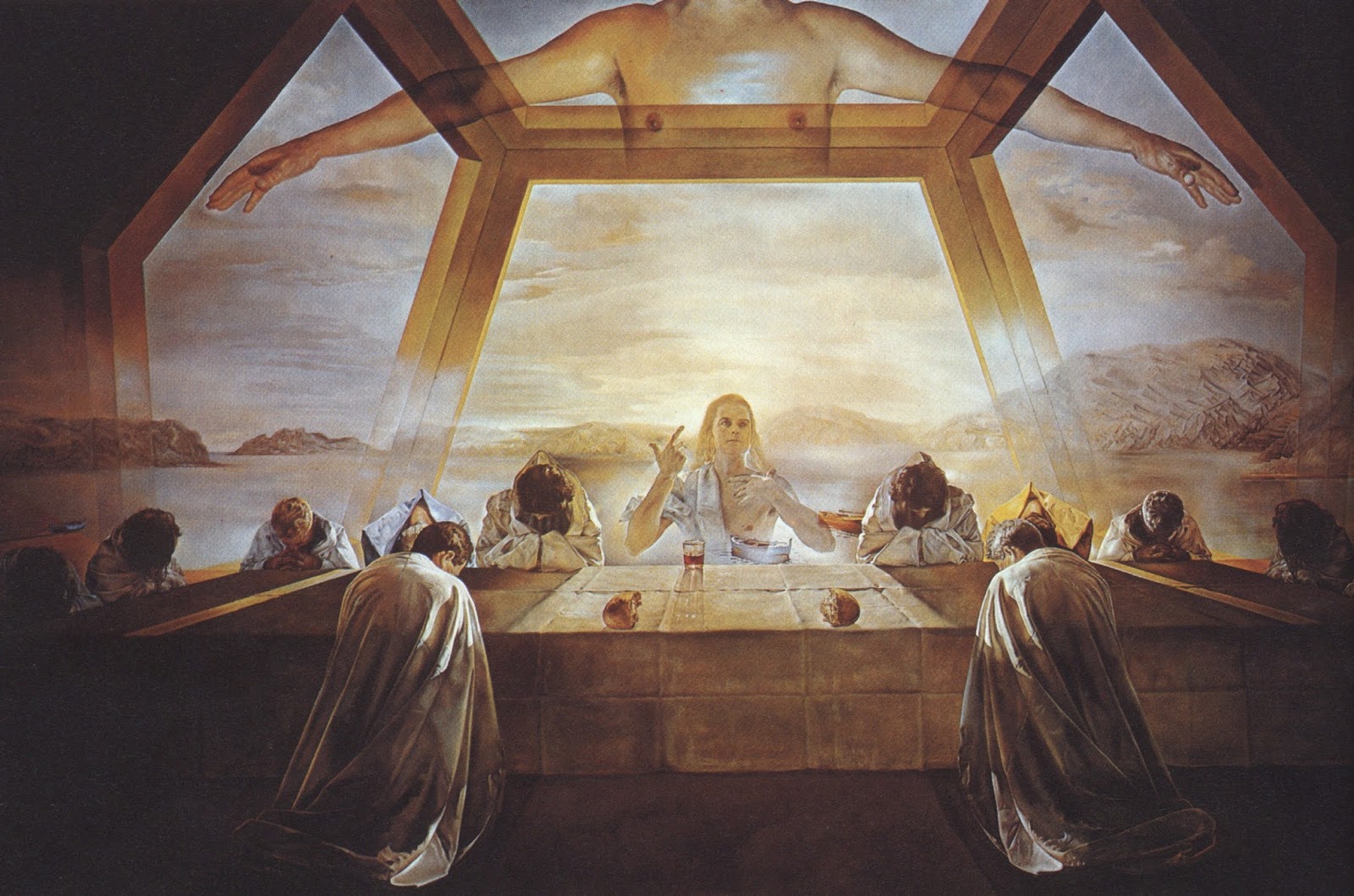
It takes a different kind of vision to see the spiritual. It was another painting by Salvador Dali that helped me to come back to a semblance of faith. I was first introduced to Salvador Dali’s Sacrament of the Last Supper ( http://www.nga.gov/content/ngaweb/Collection/art-object-page.46590.html ) when I was changing buses on trips home on school breaks from Chapel Hill.  There were several hours between connections in Washington, DC and I would go down to the National Gallery and stare with awe at how Dali was able to deconstruct the Last Supper. No copies can do it justice but I carted one around for years to get me through visits to the District. Dali wrote: “This rite is expressed with plastic means and not with literary ones. My ambition was to incorporate to Zurbarán's mystical realism the experimental creativeness of modern painting in my desire to make it classic.” Religion for me cannot stop on the familiar rational surface of facts in which we are comfortable but must go deeper into the underlying mystery which is not resolved but entered into. The beginning of true religion begins in awe, of an experience which we cannot explain in words of prose.  Mystery is irrational and speaks best in symbols and the irrational side of Art was able to speak to my Spiritual soul when words proved empty. I did not think I could tolerate another sermon asking for my rational acceptance of something irrational but with faith I do not have to.


My understanding of the Ascension is that is the other side of the spiraling circle of Divine Being entering into us and we entering into the Divine energy. When I was doing empty prayers in empty churches God was already there, waiting for me to get through my functional atheism. God is still lovingly waiting, calling each of us to enter into the center of creation as the fullness of heaven.

Ascending While Descending (Poem)
The young man pulled down the kneeler,
resting his knees on the cushion.
He jerked himself up to full prayer posture,
not any of this old people three point squat.
No, he was going to make his knees hurt.
Maybe the pain will summon the shy one,
as the knees would match the heart.
He waited  . . . then said the rituals.
Then he grumbled for the fictional one
to get moving off that far away throne.
So concerned with his own performance
that he did not leave room for listening
to Spirit, breathing around, and in, him,
vainly calling him deeper and higher.
The boy left and went to look at some art
by a weird Spaniard. paint the breath.
He wasn’t sure, but maybe it was then
he started hearing whispers again in
ascending/while descending.

Thursday, April 28, 2016

Farewell Discourse


A Reflection 
for VI  Easter                                       
  All Saints’ Church, Southern Shores, NC   
May 1, 2016                                                                  
  Thomas E. Wilson, Rector


Acts 16:9-15               Revelation 21:10, 22-22:5                   John 14:23-29             Psalm 67
Farewell Discourse
A couple weeks ago, Pat and I went to a conference put on by the Church Pension Fund called “Planning for Tomorrow”, looking at preparing for retirement and beyond. One of the “beyond” aspects is about helping the people who survive after you die, e.g. with wills, final instructions and the like. For instance, it would probably be good for me to list and locate all the documents the survivors need and all the computer programs I use to pay the bills and their passwords. I see that happen a lot when a parent or spouse dies and the family gathers together and tries to figure out where everything is.

I remember that, for years before my mother died, she would sit me down every time I visited her and she would go through all the bank accounts, wills, powers of attorney, and instructions. She didn’t use a computer, but she had different places for everything. She talked about what she wanted done and how she did not want to outlive her money because she thought that the “children” might need some. I kept telling her that the orphans would be in their 60’s and she was to spend every penny she had and write some bouncing checks for the rest. We would talk about her hopes for her children and grandchildren and said some of the things she did not want to die without saying. It was a labor of love, for she did love us and wanted her loving spirit to live within us after she died. When I would visit my mother, it was not in the places that I had ever called home, and I was a guest there. The real home was in the loving space between us regardless of any geography.

The Gospel lesson from John for today is part of what is called the “farewell discourse”, before Jesus’ arrest and after he has had the last supper with the disciples, washed their feet and given them the commandment of love. He is saying “Good bye”, saying the things he knows he wants to say to them before he is arrested and killed by the religious and political authorities. He says that he will not leave them orphaned but that he will come to them. The whole discourse is contained in Chapters 14 through 17. Today I want to focus in on one sentence: “Those who love me will keep my word, and my Father will love them, and we will come to them and make our home with them.”

“Make our home with them”. All of us are passing through, and home can mean different things. Paul in the lesson from Acts is invited by Lydia to come stay at her home. The Greek word that is used is a family dwelling, a household; so he will be a guest, but it is her “home”. I was struck with idea that both lessons mentioned “home”. But when I did Greek word studies, there were two different words. The Greek word for “home” the author of John uses is the same word he remembers Jesus saying earlier in the discourse, “In my Father’s house there are many dwelling places.” 

The King James Version will translate it as “mansions” because the translators for His Majesty King James were instructed to make everything majestic, as a way underscoring the Majesty of King James himself. James was new to the throne of England and was somewhat insecure, and he did not want to come across as a the poor relation from Scotland who was a guest King at Elizabeth’s invitation. He went to great lengths to have everything impressive and wanted to have everything, as one contemporary office seeker keeps saying, “HUGE”.

What does it mean to “make a home” with someone? It is not about the number of rooms or the furnishings, but a loving commitment of heart and spirit. It is the difference between people who are “roommates with benefits”, who only share expenses, food, and saliva for as long as it is convenient, and those who make a full life-time commitment of their whole selves with each other. To make a “home” with someone means to know and be known and yet to be aware of, and honor, the mystery in the other.

The other difficulty in many translations of the King James and many of the Western translations is that there is a tendency to interpret things in the private singular tense of “I”, “my” “his”, as in “His Faith”, My personal relationship” and “HE walks with me.” I approve of the New Revised Standard, which we use for the Sunday Lectionary, which emphasizes the corporate community - “They and “Their”. When Jesus gives his Farewell Discourse, he uses the second person plural of “You” rather than the second person singular. He is speaking to the community gathered together.  When he says, “The Father and I are one”, Jesus reminds them that he himself is part of the community of the Trinity, Father, Son and Holy Spirit, never divided but always lovingly connected, and the promise is that we will be taken into that dynamic community of being fully connected and committed, one to another. To live into the commitment of the Trinity is a cosmic commitment where we are connected to all things – past, present, and future, friends and family, neighbors, enemies, animals, the earth, the air, the stars. That is the vision of the author of the Book of Revelation where God becomes the light that shines in and through us. The home of God is in us. God is way more than the guest in our homes; God is the deep life breath of all home.

My vision of my death is that when I die, all those things that went into keeping me singular and apart and only sporadically committed will die, and I will be joined fully with the creative energy underneath all life, no longer a part time guest but now at home.

Farewell Discourse (poem)
I breathe you in deeply with each breath
that every part of me is filled with you
living into your vision of us being true
that I continue breathing you after death.