Thursday, December 18, 2014

Come On-a My House


A Reflection for IV Advent                                       All Saints’ Church, Southern Shores, NC December 21, 2014                                                            Thomas E. Wilson, Rector
Come On-a My House
Today on the Fourth Sunday of Advent we light the fourth candle on the Advent Wreath which is the symbol of love. The three other candles are symbols of hope, peace, joy, and now the fourth – Love. 

The coming of God fully into our humanity is a gift of love, and this week we prepare for the coming of Christ to live in our houses. Where is the room for Christ in your house?

How do we plan to invite Christ? I was listening to recordings of many singers -Rosemary Clooney, 
Julie London, Bette Midler, Madonna among them - singing their own version of “Come On-A 
My House, a song written by William Saroyan and Ross Bagdasarian, and I thought that theirs may 
not be the most subtle way to issue an invitation, even though the second verse has a Christmas theme:

Come on-a my house, my house, I'm gonna give you Christmas tree
Come on-a my house, my house, I'm gonna give you
Marriage ring and a pomegranate too, ah
Come on-a my house, my house a come on

In-a Pat’s and my house inside the front entrance, down the hall by the stairs, there is small dresser with the top laden down with objects like books, stones, icons, symbols, representations all jumbled up together. All these things have meaning to us for they are reminders of those times when we came into contact with the sacred. They constitute an altar of remembrance for us. Most of the time we treat it as holy space, but sometimes we just throw our keys or mail on it as we rush to do something else. For weeks at a time I will ignore that piece of furniture and then suddenly I am hit by the abundance of meaning and am called up short.

In-a the rest of my house, on every wall there are pictures and pieces of art; I think there is still about 12 square feet which is not yet covered with something with which we fell in love. We got them because they were pretty but also we kept them because they pointed to an aspect of the divine. There are many days when I will look at one piece, being lost in wonder as I remember when we got it and what it meant to us, when we saw it as a portal to the numinous. Yet, there are many days when I just walk in and my mind is so busy that I don’t notice a thing.

Lots of things are in-a our house and when we die, all of these things which have so much spiritual value will have very little material value in the marketplace of commerce, and many of these spiritually precious but commercially worthless things will end up in thrift shops, but as long as we live there, they remind us that this house is Holy Space. This is-a my home, the house in which I dwell, the place I go to know that I am loved and safe, and the place in which I invite others to come to give or receive blessings. It is my home, but it is also God’s, and I am its steward.

In the Hebrew Testament lesson from 2nd Samuel for today, King David decides that he wants to build a home for God - which is a nice sentiment - and the writer of this part of the story has fun with the Hebrew word for “house” which has four meanings in this periscope:  “palace”, “temple”, “dynasty”, and “family status”. The wordplay asks the question, “Which house of God does David want to build, and which does God want to build with David?” Looking at David’s record three chapter’s later when he enters into an adulterous affair with Bathsheba, the wife of Uriah the Hittite who a close friend, and then concocts a plan to murder Uriah after Bathsheba gets pregnant by David, and then plays the mourning friend in order to take her as his wife, it appears that David may have more interested in giving God a physical house in which to live instead of allowing God to live inside David, so that God won’t see what is going on in private. Sometimes we create spaces for God, religious buildings and shrines, and we lock the doors so God won’t get out and mess up our plans. However, if we are lucky, God will not be trapped inside religious buildings, for as the old saying goes, “God is a circle whose center is everywhere, whose circumference is nowhere.”  

In the lesson from the Gospel of Luke for today, the angel Gabriel comes in a vision to Mary and offers God’s plan to build a house within her in which the Holy may dwell. I think God’s angels are still making that same offer to us, to have God live within us so that we are God’s palace, temple, and family. The Christ event tells us that God doesn’t just live above the skies but in the core of all of our being. 

Victor Frankl, a Nazi Concentration Camp survivor, psychiatrist, and philosopher, had his own definition of God and wrote, “When I was fifteen years old or so, I came up with a definition of God to which, in my old age, I come back to more and more, I would call it an operational definition. It reads as follows: God is the partner of your most intimate soliloquies”.  God is dwelling within us  and is never far away, as Frankel found that God was also living in the hell of a death camp, as he wrote in Man’s Search For Meaning:

 We stumbled on in the darkness, over big stones and through large puddles, along the one road leading from the camp. The accompanying guards kept shouting at us and driving us with the butts of their rifles. Anyone with very sore feet supported himself on his neighbor's arm. Hardly a word was spoken; the icy wind did not encourage talk. Hiding his mouth behind his upturned collar, the man marching next to me whispered suddenly: "If our wives could see us now! I do hope they are better off in their camps and don't know what is happening to us."

That brought thoughts of my own wife to mind. And as we stumbled on for miles, slipping on icy spots, supporting each other time and again, dragging one another up and onward, nothing was said, but we both knew: each of us was thinking of his wife. Occasionally I looked at the sky, where the stars were fading and the pink light of the morning was beginning to spread behind a dark bank of clouds. But my mind clung to my wife's image, imagining it with an uncanny acuteness. I heard her answering me, saw her smile, her frank and encouraging look. Real or not, her look was then more luminous than the sun which was beginning to rise.

A thought transfixed me: for the first time in my life I saw the truth as it is set into song by so many poets, proclaimed as the final wisdom by so many thinkers. The truth – that love is the ultimate and the highest goal to which Man can aspire. Then I grasped the meaning of the greatest secret that human poetry and human thought and belief have to impart: The salvation of Man is through love and in love. I understood how a man who has nothing left in this world still may know bliss, be it only for a brief moment, in the contemplation of his beloved. In a position of utter desolation, when Man cannot express himself in positive action, when his only achievement may consist in enduring his sufferings in the right way – an honorable way – in such a position Man can, through loving contemplation of the image he carries of his beloved, achieve fulfillment. For the first time in my life I was able to understand the meaning of the words, "The angels are lost in perpetual contemplation of an infinite glory."

My prayer for us today is that we will find a place for God’s love to dwell in the houses of our souls. “Come on-a God’s house in you.”

“Come On-a My House.” (poem)
Bursting through Mary’s life the Angel sang
a version of “Come on-a my house, my house
come on.” Silent bells came to life and rang
Angelus to the vows of God and Virgin spouse,

of a version of “Come on-a my house, my house.
Home altar bells ring sets of altered, changed,
Angelus to the vows of God and Virgin spouse,
as divine shining light into our shadows ranged.

Home altars bells ring sets of altar changes,
and Mary goes to where is no set circumference
as divine shining light into our shadows ranges
covering sinners’ tower with love’s abundance.

Now, Mary enters where is no set circumference
going on as silent bells came to life and ringing
covering sinner’s towers with awe-full abundance,
bursting with Mary’s angels - love to us singing.

Thursday, December 11, 2014

"Tell Them Groucho Sent You!"


A Reflection for III Advent                           All Saints’ Episcopal, Southern Shores, N.C.  December 14, 2014                                       Thomas E. Wilson, Rector
Tell Them Groucho Sent You
On this third Sunday of Advent, we lit the third candle, the Pink Candle, and the day is sometimes called “Gaudete Sunday” from the ancient Introit to the Latin Mass for the Third Sunday of Advent quoting from Paul’s letter to the Philippians, “Gaudete in Domino semper” – “Rejoice in the Lord always”. Rejoicing is a theme that Paul will use many times. We think that Paul’s letters to the church in Thessalonica are the earliest letters we have, and in today’s Epistle reading from Paul’s first letter to the Thessalonians, he tells them “Rejoice always”.  The Hebrew Testament lesson from Isaiah recounts a song in which one of the students in the school of that Prophet sings, “I will greatly rejoice in the LORD, my whole being shall exult in my God.” In place of the Psalm for today, we hear Mary sing the Magnificat: “My spirit rejoices in God my savior.” In the Gospel lesson from John, John the Baptizer is joyfully proclaiming the coming of the Lord.

Anybody notice a theme that seems to run through these lessons? I keep getting hit with the idea of joy. It is easy to be joyful when everything is going my way, but can I be joyful when things are not going swimmingly? I think joy is a choice. 


Let’s look again at these lessons. In the passage of Isaiah, the exiles have come back from Babylon and the city of Jerusalem is a mess. The city walls had been torn down and wild animals roam the ruins. The Temple is destroyed, the farm lands in bad repair, the houses looted, and some of the returnees are going back to the old ways of exploiting the poor. Yet the song tells them to be joyful as they begin again from scratch, for God is with them and they are working on something greater than themselves. 

Mary in her song has just found out that she is now unmarried and pregnant, and yet she sings of her joy because God is with her and she is part of something greater than herself. 

Paul writes to the Thessalonians and later to the Philippians, and both of these churches are having different kinds of problems, but the Spirit of the Risen Christ is with them as they are part of something much larger than themselves, and they choose joy. 

In the Gospel lesson, John the Baptizer is out in the wilderness, not to build his own ego or to build a following for himself, but to die to himself and live to proclaim someone greater than himself. John chooses joy.

When I was growing up, Groucho had a radio show and then a television show called “You Bet Your Life.” It was a game show but “game” in name only; it was an excuse for ad-libs and interchange between Groucho and his guests. The guests would be asked questions and they might get some money or lose their winnings depending on their answers. Sometimes the losers would be asked a make-up question like, “For $50.00 - who is buried in Grant’s Tomb?”  Not everybody got that answer. 

 A 1961 Desoto
The sponsor of the show was the Desoto auto company and Groucho would always end the show by urging people to go to the Desoto dealer and “Tell them Groucho sent you!” In 1961 Groucho’s show went off the air and in that same year Chrysler stopped making Desoto. So seven years later when I bought my first car, I never got a chance to say “Groucho sent me!”

“You Bet Your Life” is another theme of these lessons we have for today. Betting Your Life is not like putting a couple bucks down on the lottery. The returning exiles are betting their lives; they could have stayed in Babylon and been safe - but miserable - so they chose a life of meaning instead of safety. Mary could have said no and ended up in a life of quiet desperation. She chose to be joyful and bet her life and heart. The churches in Thessalonica and Philippi could have passed on risking their lives in persecution and social ostracism by not entering into fellowship around Christ as their center. However, they chose to live into the Lord’s Prayer of working God’s will being done on earth as it is in heaven. They chose to be joyful and they bet their lives.  John the Baptizer literally bet his life, putting it on the line, giving up the life in his religious family’s comfortable existence; he gave up his own future.  It was a frustrating ministry, and he paid by having a mid-eastern power-mad ruler take off his head, but John lived a life filled with joy. For John and the others, death was not the worst thing to happen for they learned how to die to themselves daily as their way of living in the joy of God.

Richard Rohr in one of last week’s meditations wrote: “Death is not a changing of worlds as most imagine, as much as the walls of this world infinitely expanding. If you get love here, you have found the eternal home base, and you will easily and naturally live forever. Life is never about being correct, but only and always about being connected. Just stay connected! At all costs stay connected.”
Advent is a preparation for Christmas, and it is not about the presents we receive but about being present to the joy that is in every breath of God’s spirit in us. Choosing to be joyful is betting our lives; to die to our own egos so that we might live fully in this world and the next.
“Tell them Groucho sent you!”


Tell ’em Groucho sent you (poem)
Groucho said, “You Bet your life!”
Mary bet life, heart and hearth
each day on line, she’s her life
every moment in God’s breath.

John bet life, heart and hearth
his ego dies as if to live fully
each moment in God’s breath
to something larger than he.

Oh, die my ego, living to fully
and changing world by rejoicing
with something larger than me;
not getting but present being.

Changing world by rejoicing
on the line each day is my life,
being present to God joining,
Groucho say, “You bet your life!”


Resting in Peace


A Reflection of the Occasion of the Burial of
Eva Hitchner Wilkinson
November 6, 1917- December 5, 2014
December 11, 2014
All Saints Church- Thomas E Wilson, Rector
Psalm 23                 John 14:1-6
This is the second of four weeks of the season of Advent, the preparation for Christmas. Each week we light a candle to remember what we need to hold on to in order to welcome Christ into our hearts – for he is the example of a life of hope, the Prince of Peace, the embodiment of joy and God’s gift of love. The first week is hope, the second is peace, the third is joy and the fourth is love. Eva, the last of her generation, was born during the time when we were fighting a war to end all wars, She lived and her values were molded during the Great Depression; she was in nursing school when another war was raging; she raised her family during a cold war. All these things needed hope to get through and she died in the week of hope as she looked forward to being reunited with all those she has ever loved, who were still in her heart and in the depths of her being, but who had all made the journey to the other shore ahead of her. I was told of a dream she had before she died of continuing the conversation with the family that has gone before.

We gather together in the week of peace. Peace is not the absence of war but a deeper reality of peace inside oneself. We cannot make peace by war but by changing ourselves. Peace is a disease where we are ill at ease with the way the world works and we go deeply into ourselves to connect with the peace that passes all understanding, that begins with us and which we pass on to those lucky enough to be in the presence of a person of peace, where it turns into a communicable disease.  People I have talked to talk about her speak of her as an uncomplicated person and this service is a simple, uncomplicated service in her honor. 

Peace begins with the acceptance of the truth of the Serenity Prayer. It goes; “God grant me the serenity to accept the things I cannot change, the courage to change the things I can and the wisdom to know the difference, just for today.”

Eva was a farm girl in New Jersey who learned that sometimes the success of a crop is way beyond one’s pay grade. You can do everything right and you work very hard, but sometimes things that cannot be controlled are against success. You have a choice of feeling sorry for yourself, you can enter into blaming someone else, you can give up trying, you can be bitter and angry, or you can accept what you cannot change just for today and start over by finding a way to redeem what has happened and to give thanks for an opportunity to begin a new path.

In Nursing school, she learned that there are limits to medicine and she put that into practice by going in peace into hospice where death is not seen as a defeat but as an ending of this life and a door into another kind of existence. As a wife and mother she learned that things happen, and you work to accept and adjust.

Peace does not mean passivity where you just give up and stop fighting; it just mean that you pick your battles and pick your enemies. This is where you find what we can change and work hard nourished by hope, joy and love. When I was in seminary in 1982 I attended a series of lectures given by Elie Weisel, author, Concentration Camp Survivor, worker for Peace and Nobel Peace Prize winner in 1986. One of the stories he told was about when Father Abraham was in Sodom. He had come to Sodom to urge people to repent and at first people were interested in listening, but after a while they drifted away and ignore him. Later on they would mock him. A young boy came to him one night and said; “Father Abraham, you know you are able to change them. Why do you keep going out? You are not making a difference?” Father Abraham replied; “At first I went out to change them and now I go out so they don’t change me.”

Eva was not changed by the world; she continued to have the courage to work at making her world a better place. She knew that peace that passes all understanding that allowed her to share hope, joy and love with those who were lucky enough to know her.

Jesus in the lesson from John for today is talking about not letting our hearts be troubled; to be at peace. He says that his work is to allow people to enter dwelling places with God.  He called for us to live into God’s will on earth as it is in heaven. I don’t think he was talking about what happens after we die but about dwelling with God in this life. To “rest in peace” is not to be dead but to be fully alive knowing that the Great Shepherd is with us, giving us strength to make it through each day. A life lived in peace is where we live in the Kingdom of the Heavens right here and right now. Heaven is not a reward at the end of a good life but the reality of earth being expanded in our daily lives so that heaven is within us and that when we die in this mortal life, we continue that expansion on another plane of existence. Jesus came to show us how to live in hope, peace, joy and love with God and neighbor and to die to our own ego, our own greed, our own anger, our self-absorption, and our own resentments. Each day we learn how to die in order to live fully

Eva knew a lot of turmoil in her life but each day she rested in peace – no complaints, no excuses, and no regrets. Today we give thanks to God for a life rested in peace, walking with the Good Shepherd.

Wednesday, November 26, 2014

Being a See-er for Advent


A Reflection for I Advent                                  All Saints’ Episcopal Church, Southern Shores, November 30, 2014                                         Thomas E. Wilson, Rector

Being a See-er  for Advent

This is the first week of Advent and we lit the candle representing Hope. The Apostle Paul wrote to the church in Rome about hope (8:24-25): “For in hope we were saved. Now hope that is seen is not hope. For who hopes for what is seen?  But if we hope for what we do not see, we wait for it with patience.”


Part of being human is that we find it hard to see hope. We get so involved in doing all the things that our ego demands to be in control that we do not stop and see things with God’s eyes. The lessons for this the first week of Advent have to do with seeing hope with God’s eyes. Prophets like Isaiah are called Seers – one who sees with God’s vision. They have visions and dreams, and as they try to understand what they have seen, they translate it for the people. After prayer and meditation, Paul writes letters to churches, as in today’s selection from one of the letters to the church in Corinth, in order to tell them what he sees as God’s vision about the problems in their church. He sees hope for them as he says the church in Corinth has been given every spiritual gift they need to do God’s work. The author of the Gospel of Mark is writing what he sees in God’s vision after the Temple has been destroyed in 69 AD, and he remembers Jesus saying that bad things will happen, but God’s vision of hope is shown in the Resurrection as God shows us that nothing, even death itself, is greater than God’s love and redemption.


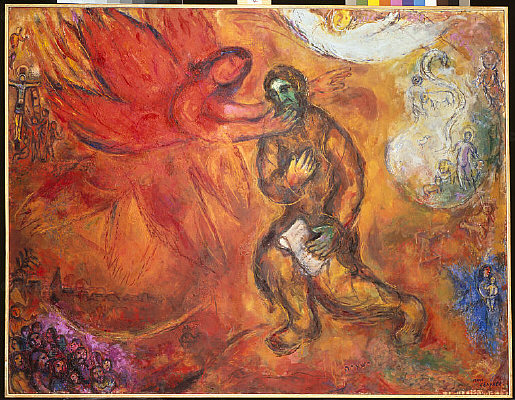
Chagall's Calling of Isaiah
Let me start off with a quick overview of Biblical prophecy. In the Hebrew Testament lesson from the Book of Isaiah, things are just not working out after the exiles come back from Babylon. This section was probably written by students in the School of Isaiah between 530-510 BC. The school was founded by the Prophet Isaiah who prophesied in Jerusalem of the Kingdom of Judah from 742 to 701 BC.  He listened to God and, in the name of God, he denounced the exploitation of the poor by the rich and the powerful. He was part of a series of Prophets in the 8th Century BC - Amos and Hosea in the Northern Kingdom of Israel, and Micah in the Southern Kingdom of Judah - all of whom railed against economic injustice. They warned that the destruction of the community of care for all the citizens would be the destruction of the very political reality of the Kingdoms. In essence, the message was that the undermining of the soul of the nation, the spiritual center based on justice and love of neighbor, would be a precursor of the destruction of the nation. 

In 721, their warnings came tragically true when the Assyrian empire conquered the Northern Kingdom and scattered the people there to other provinces of the Empire. Psalm 80 which we read today was written as a song for the Northern Kingdom (the tribes of Ephraim, Benjamin and Manasseh) as a Prayer for God’s help in facing the Assyrians. The people did not listen to what the Psalmist saw and relied on their own power. The Assyrians then tried to conquer the Southern Kingdom in Jerusalem, but a plague broke out in the besieging Assyrian army about the time of a palace coup in the Assyrian Capital of Nineveh, modern day Mosul in Iraq. The Empire fell apart, collapsing under its own weight and greed, and Isaiah saw this as God giving the Southern Kingdom a new chance to create a more just society. They sang Psalm 80 when they were in trouble, but their leaders did not seize the opportunity to change and the students of Isaiah had to continue to warn the rich and corrupt. These students keeping the tradition of Isaiah of listening to God will be joined by prophets like Nahum, Zephaniah, Jeremiah, Habakkuk and Ezekiel, all seeing the same vision of God. 

Finally in 587 BC, the Neo-Babylonian Empire, which had replaced the ruins of the Assyrian Empire, conquered Jerusalem and scattered its leaders into the different parts of the Babylonian Empire. Jeremiah was kidnapped and taken into Egypt where he would die, and Ezekiel would go into exile with his people. The students of Isaiah continued and wrote songs of encouragement to the exiles. The Babylonian Empire, as all empires do, collapsed under its own weight and greed and was replaced by the Medes and the Persians in 539 BC. As a result of learning about the collapse of the Assyrian, Babylonian, and later the Egyptian empires, the Persians decided to de-centralize their empire and allowed the exiles to return. Second Isaiah continues to record visions of encouragement to the exiles in their return. However, the reality of difficulty in coming together as a semi-autonomous province under Persian Rule would prove frustrating, and the old habits of greed and injustice did not die out. This is where the ministry of group of anonymous writers, which we lump together as 3rd Isaiah, come to the fore and will be joined by Haggai, Zechariah, Obadiah and Malachi, all calling for the people to remember that a relationship with God means a just relationship with all of God’s people.

In today’s lesson, the writer of this section of 3rd Isaiah leads a confession for the people, a confession of how they, as the old Prayer Book used to say, “had done those things they ought not to have done and not done those things they ought to have done.” He asks for God’s help in shaping a new life as they realize that they can only be who they were created to be if they allow God to be the potter of the clay of their being.

The image of us being creatures of clay comes from the second Creation myth in the Book of Genesis where God takes the humus of the earth and molds it together creating a human, named Adam, from the word Adamah meaning  ground, soil.  The message from the seers is that they see hope in the fact that God is not finished working on us yet. As God pronounced that what God created is good, so also God is helping us to work with God in making this world a good part of God’s creation. Hope is here if we can just forget about trying to have it our own way.

Some of you may ask what has happened to all the prophets, the seers who see what God is saying and sharing what they see in their soul in their conversations with God. They are still around, they are the people who listen, who stop to look at God and let their egos take a break. I go to poets a lot when I want to hear prophets who are seeing the world with God’s vision. This time I will not share a poem that I wrote but a poem by a prophet from the 19th century named Emily Dickinson who wrote this poem about Hope:

“Hope” is the thing with feathers -
Emily Dickinson
That perches in the soul -
And sings the tune without the words -
And never stops - at all -

And sweetest - in the Gale - is heard -
And sore must be the storm -
That could abash the little Bird
That kept so many warm -

I’ve heard it in the chillest land -
And on the strangest Sea -
Yet - never - in Extremity,
It asked a crumb - of me.

In this the first week of Advent, please stop and listen to the way God sees this world with hope and maybe write a poem about what your soul sees when you listen to God. My prayer for you today is that you will be a “seer” - one who sees with God’s vision.