Thursday, April 9, 2015

Robert, Bob, Bobby


A Reflection on the Occasion of the Thanksgiving for the Life and Death of Robert Strickland


Robert, Bob, Bobby

I am one of those people obsessed with movies, and I tend to think of movie metaphors when I try to make sense of people, places, and things. As I began this process of composing a reflection for Bob, I thought of the movie The Three Faces of Eve. It is an old Joanne Woodward movie about a woman who has multiple personality disorder. The tragedy of the movie is that she does not know that those different personalities exist within her, and the hope of the movie is that she is ultimately able to claim all the different parts of herself as a whole human being.

In the Christian struggle to understand the un-understandable idea of God, we have come up with this doctrine of the Trinity. We believe that there is an energy which has existed since before the beginning, and this energy of love spoke, and in that act of speaking, an explosion of love burst forth, creating suns, planets, moons, stars, galaxies, oceans, chemical elements, apes, aardvarks, great blue whales, snakes, mosquitoes, quarks, protons, humans. All the things we know about or imagine came into being. We called that energy metaphors like “Creator”, “Father”, “Great Spirit”, YHWH, Jehovah - you name it, we came up with names to name of the unnamable.   In our experience, we came across an expression of that energy which entered into human life and who we called “The Risen Christ” or “Jesus” or “Son”, which became a symbol of how this energy of love was connected to all of creation in and throughout history.  We also realized that this energy of love was able to give us strength through the very air we breathe, and we called  it “Spirit”, which was the same word for “breath”, and so we called it “Holy Breath” or “Holy Spirit”  or “Holy Ghost”. We then called it “Trinity” and made it a dogma because this is what we like to do - construct dogmas to explain the unexplainable and create divisions between people who might have different explanations.

We say that all of creation shares the same star dust from that initial Big Bang and even humans are created in the image of God. According to the doctrine of the Trinity, each person is created with these three different and yet connected parts of themselves: 1) the first “face” is “Creator”, the Worker,  who in work and love is able to build something in this life which makes the world a better place; 2) the  second “face”, the one who is able to walk with us and talk with us in daily life and use love to connect us to each other; 3) the third “face” is the one whose very being, spirit, is able to enter into the spirit of another in intimacy and change our lives.

Many of us knew the three faces of Bob, and that is who remember. This was not a disorder, as Bob knew and nurtured all three faces and integrated them into his personality.  The first we will call “Robert”. Robert was a worker.  He worked hard and saw life as a series of challenges to which he would bring his considerable talents. You could count on Robert to do things. He worked at school, after school, after graduation, in the armed forces, in America, in Asia, in Europe; Robert worked. He worked hard in his professional life and he worked hard to support his family, to keep up their homes, to raise his and Ellen’s children, and to be a good grandfather who would show up and support his grandchildren in their understandings of what it means to work and be responsible.

Now I am not as fortunate as some of you, and I only saw his work in Maine, Virginia, and North Carolina. He paid attention to detail, from planning and running worship services, writing up reports, keeping budgets, fixing properties. If there was anything that needed to be done, Robert came to mind as the person to ask. One of the saddest days of my professional life at All Saints’ Church was when I realized that Robert had moved to Westminster-Canterbury and I no longer had a Verger. I loved walking into a service and not worrying about it because Robert had been there to make sure it ran properly. Many times after Robert left, I would walk into church and find that something or someone was not there and I had to run around and try to fix things myself.  And for years after he left, we would send him the weekly bulletins to proofread and make sure we did it right.

The second face is Bob, the one who walks with us as a friend. You could count on Bob to be a friend. He was a husband, parent, fellow parishioner; yes, he was all these things, but he was also a friend to his wife, his children and grandchildren, his fellow members of committees, associations, churches, communities, neighbors, the homeless, and even, when pressed, to wayward clergy like me who entered his life. There was a phrase he would use - “let me help you with that” - and he would. He loved sharing work and play with friends, and when you played with him - and I would learn this the hard way -he would take the play VERY seriously.  But Bob would not take himself too seriously, as win (as he often did) or lose, he would laugh. He was good with friends and he was thankful for them. I remember when I saw him several hours after his surgery and he told me how good the hospital nurses and aides were being to him. He thanked them because that is what friends do, even if you don’t know everything about them, but you see them as a gift of grace in a broken world.

As a friend, Bob would be there to talk or to leave you alone. But even when Bob left you alone, he would leave, as he has this time, part of his spirit, and I call that “Bobby”. Now Bob hated to be called Bobby, but I realized that when Pat or I would call him Bobby, we were acknowledging that his spiritual presence had been part of our lives even when we were separated by miles or circumstances.  When I say Bobby was spiritual, I don’t want that to be confused with his church stuff, for the sad truth is that the Spirit has this habit of being pushed outside the religious institutions and into everyday life outside their walls.  When the Holy Spirit came on the disciples on Pentecost, it drove them out of the Upper Room in which they were hiding and propelled them into the center of town.

To me, being in the moment with the Spirit is to see the creation of God with new eyes, to hear with different ears, to taste with different faculties, and to touch with the depth of the soul rather than relying on our skin. Pierre Teilhard de Chardin, a 20th century Jesuit Priest, philosopher, paleontologist, geologist, and mystic said that “Matter is the spirit moving slowing enough to be seen.”

Let me give you some examples. I remember one day when I was on the porch of  their cabin in Maine, and Bob came out to see the fog-encased bay with the lobster boats sliding in and out of the fog bank. He stopped and looked and saw deeper than the pleasant scene.  For one brief moment, he saw with awe the mind of God.  We often get so used to seeing beauty that we don’t stop to see what the beauty points to. For that moment, we were transfixed by the wonder of God, and it was a moment of worship - without words spoken or rituals performed, but a prayer was breathed in our hearts. These minutes last only a moment before we try to analyze them, categorize them, and domesticate them.

I saw that look when I got him a bottle of expensive Scotch in New Hampshire on our way up to visit in Maine, and when he took the very first taste, there was an outward breath of wonder.  For a brief second, he was in the land of awe, but by the time he had finished the second sip, it devolved back into ordinary liquor.  We have a hard time living with  awe and wonder. It is like the first taste of the first real ripe tomato in the season or the first bite of sweet corn which contains the hints of full mystery of the divine.  

I remember times when he would talk about Ellen, or the kids, or the grandkids, and there might come a moment when he no longer saw them as nice accessories to his life but priceless gifts given by a gracious God.  You would hear a hitch in his voice and see a moisture forming in the corners of his eyes in divine thanksgiving.  

I remember when he was nailing a nail into the cross on Good Friday and he realized for a split second what it meant when the song says, “Where you there when they crucified my Lord? Oh sometimes it cause me to tremble, tremble, tremble.“  Or when he would read a note from someone who wanted to tell him that they were praying for him. Or when he would hold you in his arms for a split second longer than usual when saying good-bye or hello. It was in those moments that Bobby showed us what Jesus meant when he said, “Unless you become as a child you will not enter the Kingdom of the Heavens.” These were the moments when Bobby was alive in the Spirit, changing the world with thanksgiving, awe, and love.

Now there are many ways to remember Robert, and they involve working to make this creation a better place. Opportunities exist right outside our front doors. There are many ways to remember Bob and that is make a friend and to be a friend who can be counted on. There are many ways to remember Bobby and all of them are filled with awe and thanksgiving for the gracious God who gave us the opportunity to know and to cherish Robert, Bob and Bobby for much too short a time. Now we return him to the arms of the one who created this gift for us.


Robert, Bob, Bobby  (poem)

Triune tattered, rumpled, flawed, shining, gracious image    Rest
Robert, you tired, co-creating, and working image,
who we could count on to do work for/with us        Rest
Bob, you friend and lover, walking, listening image,
your hand, play, love, and time with us shared        Rest
Bobby, shyly hiding, empowering awe-filled image,
living Teilhard’s matter being spirit moving slowly    Rest
Brother, father, husband, friend, pilgrim journeyer
          blessedly returning to before the stardust            Rest
We left behind, holding our heart-seared memories
ask that our thanksgivings for you never            Rest

Reflection for Milt Countryman


A Reflection on the Occasion of the Celebration of the Life of Milton Emerson Countryman

April 9, 2015               All Saints’ Church, Southern Shores N.C.                Thomas E. Wilson, Rector

There is a small sign  on the front entrance of Milt and Donna's house announcing “Welcome” to all who come to visit, and then there is a smaller sign underneath it that states “ all because two people fell in love.”

It all begins with love. At the beginning of creation, God, in an act of love, spoke a loving word and that word caused an explosion which hurled debris, creating stars, solar systems with suns, and planets. Through this creative force of God, which we call Christ,  all things were made.  This flow of energy caused God's Holy spirit to be in all of creation, and being made in the spiritual image of God, spiritual beings were generated. Pierre Teilhard de Chardin, 20th Century Jesuit , Philosopher, Paleontologist, Geologist, Priest and Mystic wrote: “We are not so much Human beings who have a Spiritual experience but Spiritual beings who are having a Human experience.”

It all begins in love. Humans are conceived in love; they are born, they work, they love, and then they die.  That is the nature of being human. The Christ, God's creative energy, emptied out God-self and became human and lived, loved, and died to remind us how to be fully human. The resurrection reminds us that we are also fully spiritual and, at our death, we are set free from the limited human cocoon to be one with the energy of the universe. We believe that this life is not a test to see if we pass being human. We are what we are and we are given the opportunity to love. Some are able to love in  such a way that their human life points to a Holy Space between themselves and others. It is not about church attendance, it is not about temptations avoided, it is not about how many toys we have at the end of our lives, or honors earned; it is not even about being a nice guy - although that last one does tend to make the world a better place. The whole point of human life is to love and in loving show the nature of God.

It all begins in love. Jesus called his disciples and he gave them one commandment - that they love one another. Out of that love the disciples and apostles founded the church as the Body of Christ to bring healing and the message of God's forgiving love into the world. But, we have this unfortunate attitude in churches about needing to have impressive institutions, as if “right” theology, or staff, or buildings, or furnishings, or clerical hierarchy, rituals, and attendance is the “be all” of our existence. The church's main job is to point to the presence of Christ in all the world and the Spiritual power that is available to make the world a better place. Churches get so busy doing “church stuff” that we forget that the purpose of working with people is not to make them better church members but to help them be transformed to be loving servants of God's creation.

It all begins in love and yet love does not end. Love does not mean having a lot of liking for another person, place, or thing. Love is not approval. Love goes way beyond our simplistic definitions. When poor couples come to me to go through pre-marital counseling, I give them a series of assignments – they do all the work; I just ask them to look deeper. One of the most important exercises is to set aside one moment every day. The couple will sit in chairs facing each other and close their eyes and hold hands and breathe. Breathing in and breathing out, they breathe that which they cannot produce themselves - oxygen. The oxygen goes into their lungs, through the capillaries into the blood stream, cleaning out built-up toxins in the blood, then carbon dioxide is exhaled and a new fresh breath is brought in.

The Biblical words for breath in Hebrew (Ruach) and Greek (Pneuma) are the same words for wind and spirit. In the first chapter of Genesis, God's spirit, wind, breath, broods over the waters of creation. In the 2nd chapter of the creation myth in Genesis, God fashions human beings  from the dust of the earth.  God breaths life, spirit, into them.  When Jesus rises from the dead in John's Gospel and meets with his disciples, he breathes on them and says “Receive the Holy Spirit”. In the Acts of the Apostles on the Feast of Pentecost, the Divine Wind from God comes into the Upper Room and drives the fearful disciples into the world filled with the Holy Spirit.

The purpose of the exercise the couple is assigned is to make it a practice each day to see that there is a Holy Space between them where God is present, as Jesus said, “Whenever two or three are gathered in my name, I will be in the midst of them”. This Holy Space filled with the spirit of the divine is where they will need to go in the hard times that are ahead of them. Buddhists bow to each other to acknowledge the Holy Space. Hindus say, “Namaste” which means “Peace, tranquility, the God in me meets the God in you.” Jews say the Hebrew word “Shalom” acknowledging the connection of God's peace between them. Muslims say “Salaam” and Christians exchange the Peace of Christ. Native Americans breathed in the smoke from a Calumet, what we call a peace pipe, to be aware of the Great Spirit's presence in their lives together. It is universal to be aware of sacred space.

Erasmus had a saying: “Summoned or not, God is present.” Milton Emerson Countryman died, but the breath, the spirit, the presence of the sacred he shared with us - be it in church, on the beach, or the golf course - is still here. Today, if you want to give thanks to God for the gift of Milt, just breathe deeply and tell a story. That is what we will do after this service is over as we gather at the club to have some refreshments and  tell stories and breathe in God's presence. It all begins in love.

Sunday, April 5, 2015

Encountering the Empty Tomb Between the Two Waves of the Sea


A Reflection for the Sunday of the Resurrection All Saints’ Church, Southern Shores, NC April 5, 2015                                                             Thomas E. Wilson, Rector
Isaiah 25:6-9                 Acts 10:34-43                Mark 16:1-8

Encountering the Empty Tomb Between the Two Waves of the Sea

In Mark’s Gospel for this Sunday of the Resurrection, Mark tells us about the women who had been at the foot of the cross when Jesus died - Mary Magdalene; Mary, the mother of James and Joses; and Salome. It was sundown on Friday, the beginning of the Sabbath, when Jesus is taken from the cross, and they do not have spices to anoint the body. Jesus is dead; they understand totally and completely about that, and they know that unless he is wrapped up in spices, his dead body will stink because that is the way it is. They understand totally and completely about Sabbath Law and that they will have to wait until after sundown on Saturday to buy the spices; that is the way it is. They understand totally and completely that it is the custom in an occupied city that they as women cannot go out at night without being assaulted, and they understand totally and completely that none of the male disciples could accompany them since they run the risk of arrest as accomplices to Jesus in blasphemy and sedition; that is the way it is. On the morning after the Sabbath, the women are walking to the tomb and they are afraid because they know and understand completely that the stone rolled over the tomb is too big for them to move; that is the way it is. They know and understand completely that the center of their lives is gone, and he, like their hopes, are as dead as dead can be; that is the way it is.

As they walk to the tomb prepared to complete one last act of devotion to the body of the man they loved and to the hopes they once had, they turn the corner and see that the stone has been rolled back. They do not understand; that is not the way it is supposed to be. Their minds search for an option they can understand and the possibility of grave robbers come to mind, because that is the way the world works and there is always evil around; so that must be the answer. 

They move slowly toward the open tomb and listen for the sounds of the robbers. Straining their ears, they hear nothing unfamiliar. They can hear sounds coming from the city - the roosters crowing because, in their arrogance, they believe that only they have the power to make the sun rise and to awaken those still asleep. The women know that the roosters don’t make the sun rise, just as their prayers did not stop the death of Jesus. That is the way it is. In the sounds from the city, they hear the calls of men to their donkeys and camels as they begin the new day; life goes on.  You live, you work, you die - that is just the way it is.

They move toward the opening, and they enter into another dimension of life - the life of Holy Vision. Visions, like dreams and myths, are not explained; rather, they are encountered and experienced. Last week I met with a friend who was writing some rap music. I usually don't pay attention to rap music, but I felt that since it was poetry, and it was my friend, that I should pay attention. T.S. Eliot once said, “Genuine Poetry can communicate before it is understood.” 

My friend asked me to “empty my cup”. I understood what my friend meant - it came from an old Zen Koan about a Zen Master and a bright young pupil. The bright young pupil was perfect in every way as he understood totally and completely about the ceremonies of Zen Buddhism. The master invited him in for Chado - “the way of tea” - a tea ceremony of delicate precision of living  in the moment, and the proud pupil prepared it perfectly. But as he was about to pour, the Master stopped him and said that he would pour. The Master raised the pot and poured expertly into the cup - and kept on pouring until the tea in the overflowing cup was spreading over the table and on the floor. The startled student cried, “ Master, there is no more room in the cup for more tea.” The Master said to him: “So it is with you; until you empty yourself, there is no room for anything else.”

I realized that I had to “empty my cup” in order to really listen to my friend's rap poems and, in the same way, I have to “empty my cup” in order to encounter this Holy Vision. Let me invite you now to “empty your cup.” Close your eyes for a moment and just breathe. This is an invitatioin not a demand; “All may, some should, none must.” Just breathe and be aware of the moment as I invite you to come with me as we enter a tomb.

We are outside a carved out cave in the Place of the Skull, Golgatha.  As we center ourselves let us in our imagination bending down low to crouch through the claustrophobic opening into this skull, this tomb, dug into the womb of the earth.

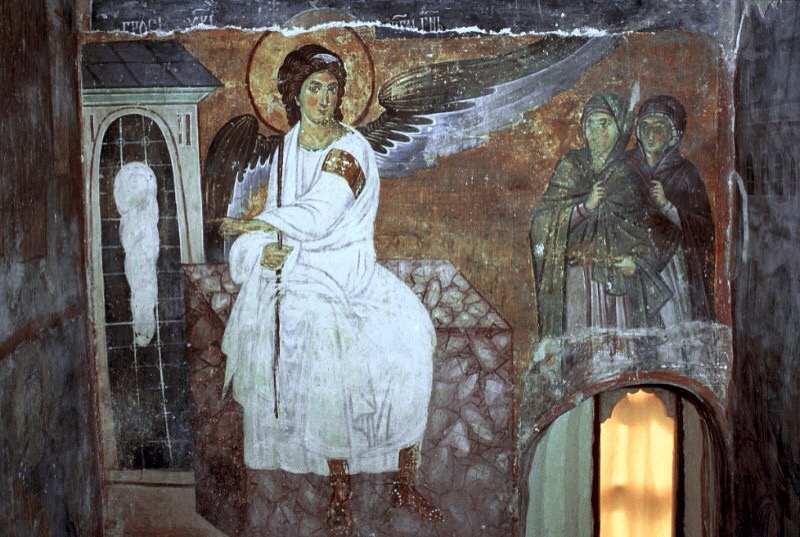
In my imagination we are walking into the tomb as they did. The tomb is limestone, white, a carved out cave, and there are ridges in the walls and ceiling. It reminds me of a brain, and I was aware that, as I  enter the tomb, I am entering into the depths of my mind. I and the women are entering Holy Space where symbols speak from the right side of the brain rather than the language of left side of the brain. We - the women and I, as the women were part of me – and you if you wish to be here, see that the ledge on the left, on which the body was placed when they ran out of time, is empty. There is no body. The left side of the brain, which logically processes the facts of life, does some linear thinking and comes up with the information that the body is gone. On the right side of the tomb, our “brain”, there is a seated man and, in dreams, the right side of the brain is used for mystical, intuitive metaphors, not facts. Dreams and visions are not linear but spiral, where the end is a beginning again: “Spirals beginning as endings must”. 

This man, is he an Angel? Angel means one who gives a message from God, and he is telling me, and them, and you, not to be afraid. The left side of the women’s brains, and mine, are processing the fact of the non-present body and can make no sense out of it, while the right side is listening to the non-logical good news from the Messenger of God that Jesus has risen and is telling the disciples to meet Jesus where they first met him in Galilee. 

I remember the beginning words of the Gospel of Mark
The beginning of the good news of Jesus Christ, As it is written in the prophets; “See, I am sending my messenger before your face who will prepare your way; the voice of one crying out in the wilderness: ‘Prepare the way of the Lord, make his paths straight.”

The messenger, in saying that we should go back to Galilee where we first met Jesus, is telling me to go back to the beginning.   The beginning of the Book, yes; but also maybe to the beginning of my life, before I was born and was in my mother’s womb - also a cave of no language – and God knew me and as the Psalmist says, “We were fearfully and wonderfully made.” The womb is the place of birth and the tomb is the place of rebirth. God knows and loves me in the tomb and in the womb.

Maybe to go before even my life but to the beginning of all life when the loving energy of God, the Christ, through whom all things came to be, set in motion all that brought me to this day. If Jesus is proclaimed as the Christ in the beginning and the body of Jesus is not there, then what has happened is that we go back to the beginning of time when all things were created through Christ. Jesus has returned to the beginning and has been absorbed back into the Christ energy of creation. So it will be when I live, or die, in Christ in resurrected life, in this life and the next.

Which side of the brain responds?  The left side cannot make sense of the notion, and the right side opens up to many options of alternate realities. So what do the women do? The women ran away in fear. The vision is at first glance a nightmare, but even nightmares are dreams that come for healing.

This ending is how the Gospel of Mark ends, with the empty tomb which is beyond all logical explanation calling us back to the beginning. In essence, Mark points us to the question of how will we, the receivers of this vision, this fantastic dream, respond? The people in Mark’s community in which his Gospel is written cannot explain it. What they do is to look at how lives have been changed. They try to use symbols as a way of encountering that which is beyond understanding. Using symbols, death in a vision is usually about change, and the community of followers, the body of Jesus, changed into who they were created to be and into who they were to more fully become - the body of Christ. Jesus is the human being and Christ is the energy of God through whom all was created.
Pierre Teilhard de Chardin, a 20th Century French philosopher, Jesuit priest, paleontologist, geologist, and mystic said that we are not human beings who have a spiritual experience, rather we are spiritual beings having a human experience.  Using symbols to encounter our spiritual beings, we are drawn as spirits of the Logos of God, the beginning, the Alpha Point of all creation, the Christ, to move with all creation into what Teihard calls the “Omega Point” where all things converge in Christ, in whom we live and move and have our being. In the Book of Revelation, the Risen Christ says, “I am the Alpha and Omega, the first and the last, the beginning and the end!” Our lives move spirally toward that Omega point and then back to the beginning so that we enter into each new day dedicating it to moving toward the Omega Point where the fullness of Christ dwells within us and we in Christ. 

So how do we approach the empty tomb? Is it to understand what happened twenty-one centuries ago or is it to encounter what happens each new day? We are free to understand it all we can, but perhaps the only way for me is to not use my brain to understand but to stand under it in faith and enter the empty Tomb and, as T. S Eliot ends Little Giddings, the last of his Four Quartets,
We shall not cease from exploration
And the end of all our exploring
Will be to arrive where we started
And know the place for the first time.
Through the unknown, remembered gate
When the last of earth left to discover
Is that which was the beginning;
At the source of the longest river
The voice of the hidden waterfall
And the children in the apple-tree
Not known, because not looked for
But heard, half heard, in the stillness
Between the two waves of the sea.
Quick now, here, now, always–
A condition of complete simplicity
(Costing not less than everything)
And all shall be well and
All manner of things shall be well
When the tongues of flame are in-folded
Into the crowned knot of fire
And the fire and the rose are one.

This Easter God issues an invitation to come back to the Empty Tomb after going to the beginning, to the source of the longest river, and know it for the first time.


Friday, April 3, 2015

Maundy Thursday


A Homily for Maundy Thursday                                All Saints’ Church, Southern Shores, N.C.  April 2, 2015                                                                 Thomas E. Wilson Rector
1 Corinthians 11:23-26                       John 13:1-17, 31b-35              Psalm 116:1, 10-17 


This is a Fresco by Ben Long  on the  wall behind the Altar at Holy Trinity Episcopal Church in Glendale Springs, NC. It is right off the Blue Ridge Parkway. I posed for one of the disciples before I went to seminary and later did a field placement there. Notice the basin, bowl and towel for foot washing near the bottom right of the fresco


Originally the early Jewish Christians took the Passover service and adapted that service to a remembrance of the institution of the Lord’s Supper. When the Gentile Christians started to outnumber the Jewish Christians, the Christian Passover services fell by the wayside. 

When Christianity became legal under Constantine in the 4th century, his mother Helen, a devout Christian, started a Public Works program for Holy Sites in Jerusalem, and a booming Pilgrimage business got going. People especially wanted to come for Easter, so in the manner of all Chambers of Commerce in places that benefit from the tourist trade, the local Christians decided to make it a week long event rather than just a one-day Easter celebration. There is an account by one Pilgrim in 381-384 of that week-long event, and she described how a Thursday Eucharist was celebrated at 2:00 PM, and afterward, the Pilgrims walked to the crucifixion site for a service.  Then they would have a meal and move to the Mount of Olives where the service continued until 11:00PM, then move on to Gethsemane and pray until dawn on Friday.  The hearty ones would go to the site where Jesus was whipped, while the less hearty would take a nap until it was time to walk the Way of the Cross at noon. Saturday would be a quiet day of reflection and then Sunday would come with all sorts of celebration. When the Pilgrims returned to their homes, they shared their experiences, and their local communities adapted their own Holy Week celebrations. 

When Lent was established as a season in the church when sinners would go through penance for 40 days, by the 7th Century the Roman Church developed a service of reconciliation for Thursday which sometimes included a washing of feet as an enactment of the Gospel lesson from John, and it developed into “Maundy” from the Latin “mandatum” meaning “commandment”. The Penitents would be welcomed back to have Communion and then the service would end with washing the altars for Good Friday. Later on Bishops, Priests, Abbots and Kings would use these services to show humility and wash the feet of a select number of beggars. 

The Protestant Reformation looked with scorn on these practices, and when the Anglican Church was established by Edward VI, the son of Henry VIII, the first Prayer Book did away with these practices in church. However, as Marion Hatchett notes, in 1590 Queen Elizabeth “kept her maundy” in Westminster by washing the feet of 20 poor women. Later Kings of England continued doing the “Royal Maundy” practice until the 18th Century when the more Protestant German House of Hanover came to the English throne with George I.

The Liturgical Movement in the 20th century gave the opportunity for this service to be experimented with in some churches and, in the 1979 Prayer Book, it came to its present form. I started participating in this service as a lay person long before going to seminary, and it helped to inform me about what the message of Jesus was in my ministry as a lay person and later as a Priest.My understanding was/is that I come as a servant.

In the Gospel lesson at the end of his earthly ministry with his disciples, Jesus has supper with them. Chances are that the disciples had already washed their own feet as they came into the house before they reclined down to supper. Jesus interrupts the meal by getting up and taking off his clothes. I don’t know about you, but if my host starts to take off his clothes, I start looking for an exit.  Jesus then takes a towel and wraps it about himself and offers to wash their feet. Remember the feet are already washed; there is no need for this activity unless Jesus is trying to make a point. 
It seems to me that there are two main points he wants to make. I think that Jesus is acting out a metaphor of his ministry. The Christ energy of God, through whom all creation was made, empties out to become the human Jesus, to do the work of showing us what being human is all about - to empty oneself in serving God and neighbor. At supper Jesus leaves his place of honor and, after emptying himself out to be a servant, he resumes his place of honor when his work is done.  Jesus invites people to follow his example and become vulnerable with each other. I think his second point is to show how we are to deal with our enemies. Jesus will wash the feet of the one who will betray him. He could have stopped Judas, but he chose to love him instead.

Feet are how we stand on the earth, our connection and orientation to the reality of life. Karl Jung said, “When you walk with naked feet, how can you ever forget the earth.” In the same way, when our naked feet are washed in love as a remembrance of Jesus’ love, how can we ever forget that we did not earn that love we have been given?

The purpose of the church is not to do rituals to remember the past but to help us to be transformed, and this church continues the ritual of emptying out oneself for neighbor and for enemy so that Christ might transform the world as we are transformed from rulers to servants.
This reflection seemed to miss the point so I added Frederick Buechner's  midrash which a friend sent to me and I pass it on to you.


Buechner's midrash:
The Lord's Supper is make-believe. You make believe that the one who breaks the bread and blesses the wine is not the plump parson who smells of Williams' Aqua Velva but Jesus of Nazareth. You make believe that the tasteless wafer and cheap port are his flesh and blood. You make believe that by swallowing them you are swallowing his life into your life and that there is nothing in earth or heaven more important for you to do than this.

It is a game you play because he said to play it.

"Do this in remembrance of me." Do this.

Play that it makes a difference. Play that it makes sense. If it seems a childish thing to do, do it in remembrance that you are a child.

Remember Max Beerbohm's Happy Hypocrite, in which a wicked man wore the mask of a saint to woo and win the saintly girl he loved. Years later, when a castoff girlfriend discovered the ruse, she challenged him to take off the mask in front of his beloved and show his face for the sorry thing it was. He did what he was told, only to discover that underneath the saint's mask, his face had become the face of a saint.

This same reenactment of the Last Supper is sometimes called the Eucharist, from a Greek word meaning "thanksgiving," that is, at the Last Supper itself Christ gave thanks, and on their part Christians have nothing for which to be more thankful.

It is also called the Mass, from missa, the word of dismissal used at the end of the Latin service. It is the end. It is over. All those long prayers and aching knees. Now back into the fresh air. Back home. Sunday dinner. Now life can begin again. Exactly.

It is also called Holy Communion because, when feeding at this implausible table, Christians believe that they are communing with the Holy One himself, his spirit enlivening their spirits, heating the blood, and gladdening the heart just the way wine, as spirits, can.

They are also, of course, communing with each other. To eat any meal together is to meet at the level of our most basic need. It is hard to preserve your dignity with butter on your chin, or to keep your distance when asking for the tomato ketchup.

To eat this particular meal together is to meet at the level of our most basic humanness, which involves our need not just for food but for each other. I need you to help fill my emptiness just as you need me to help fill yours. As for the emptiness that's still left over, well, we're in it together, or it in us. Maybe it's most of what makes us human and makes us brothers and sisters.

The next time you walk down the street, take a good look at every face you pass and in your mind say, "Christ died for thee." That girl. That slob. That phony. That crook. That saint. That damned fool. Christ died for thee. Take and eat this in remembrance that Christ died for thee.