Thursday, January 17, 2013

A reflection on Micah (the book and the girl)


Parson Tom’s Tomes
As I write this addition to the Tomes I am also preparing for the Vestry Retreat where we figure how what to do this year. Yet from the time I woke up this morning, my mind is stuck with a loop in a quote I memorized years before; Micah 6:8 “He has told you, O mortal, what is good;  and what does the Lord require of you  but to do justice, and to love mercy, and to walk humbly with your God?” 

What else should we be doing? The list seems to go on forever. We are in a building that is getting older and roofs and HVAC systems need to be replaced when the time comes. We need to get the finances of the institution in order. We need to get the Christian education program for our youth and children stabilized. We need to connect people closer to each other so they don’t feel as if they have fallen through the cracks. We need to put together Episcopal services that are faithful to the Episcopal tradition. We need to go through the process of finding a new Bishop for the diocese now that Bishop Daniel has resigned to go to Philadelphia. We need to do all the stuff that the religious institution of the church requires; but if we do all of that stuff for institutional maintenance and forget about doing justice, loving mercy, and walking humbly with our God, we sort of miss the point. 

I think we do justice when we, as a community of faith, speak out for, and minister to, the poor and marginalized in our community. I think we, as a community, act as if we really do love mercy when we minister to the hurting, sick, broken and dying. I think we walk humbly with our God when we stop our busy corporate and individual lives and gather together, as a community,  regularly to give worth (that is what the word worship means) to the power greater than ourselves, our individual agendas, and our institutions.

This last fall I attended a young girl’s Bat Mitzvah in New Jersey. She is a summer neighbor of ours and her name is Micah. On her wall she has a picture which her parents gave her when she was born and have hung in every bedroom in which she has slept of the verse of Micah 6:8 in calligraphy with an illustration of a group of dancing Rabbis around the verse. At the ceremony, this young 13 year old girl spoke movingly about how much that verse meant to her. She shared how her learning of Hebrew helped her to go deeper in her worship of God and she sang the entire chapter of Micah in Hebrew- there wasn’t a dry eye in the synagogue. Micah also related the volunteer work in school and community she has done to make the world a better place; one example is her volunteer work each summer at the Dare County Animal Shelter. When we adopted our dog, Yoda, and brought him home from the shelter, that day we walked Yoda around the neighborhood and Micah ran out of her house and there was a tearful reunion because she used to walk and play with him during the months he was waiting for a placement. 

Today read, mark, learn and inwardly digest Micah 6:8 “He has told you, O mortal, what is good;  and what does the Lord require of you  but to do justice, and to love mercy, and to walk humbly with your God?”  As we look forward to Lent this month ask yourself; how are you doing with Micah’s spiritual direction.

SHALOM

Monday, January 14, 2013

Reflection on an old letter


 Doing some thinking about the coming Sunday and went back to look at a document that, a little less than 50 years ago, started my love/hate relationship with the Episcopal Church. I was fond of the church because it was comfortable when I was a child, but in the junior year of high school I was disturbed by reading this letter and my relationship never stayed the same and it keeps working on me almost 50 years later. This was a response to some prominent church leaders urging King  to stop the disruptive boycotts and demonstrations . They wanted everything to be peaceful and not rock the boat.

Excerpt from Letter from a Birmingham Jail
Written by the Rev. Dr. Martin Luther King Jr.
16 April 1963
 My Dear Fellow Clergymen:
While confined here in the Birmingham city jail, I came across your recent statement calling my present activities “unwise and untimely.” Seldom do I pause to answer criticism of my work and ideas. If I sought to answer all the criticisms that cross my desk, my secretaries would have little time for anything other than such correspondence in the course of the day, and I would have no time for constructive work. But since I feel that you are men of genuine good will and that your criticisms are sincerely set forth, I want to try to answer your statement in what I hope will be patient and reasonable terms.


. . . .But despite these notable exceptions, I must honestly reiterate that I have been disappointed with the church. I do not say this as one of those negative critics who can always find something wrong with the church. I say this as a minister of the gospel, who loves the church; who was nurtured in its bosom; who has been sustained by its spiritual blessings and who will remain true to it as long as the cord of life shall lengthen.
When I was suddenly catapulted into the leadership of the bus protest in Montgomery, Alabama, a few years ago, I felt we would be supported by the white church. I felt that the white ministers, priests and rabbis of the South would be among our strongest allies. Instead, some have been outright opponents, refusing to understand the freedom movement and misrepresenting its leaders; all too many others have been more cautious than courageous and have remained silent behind the anesthetizing security of stained glass windows.

In spite of my shattered dreams, I came to Birmingham with the hope that the white religious leadership of this community would see the justice of our cause and, with deep moral concern, would serve as the channel through which our just grievances could reach the power structure. I had hoped that each of you would understand. But again I have been disappointed.

I have heard numerous southern religious leaders admonish their worshipers to comply with a desegregation decision because it is the law, but I have longed to hear white ministers declare: "Follow this decree because integration is morally right and because the Negro is your brother." In the midst of blatant injustices inflicted upon the Negro, I have watched white churchmen stand on the sideline and mouth pious irrelevancies and sanctimonious trivialities. In the midst of a mighty struggle to rid our nation of racial and economic injustice, I have heard many ministers say: "Those are social issues, with which the gospel has no real concern." And I have watched many churches commit themselves to a completely other worldly religion which makes a strange, un-Biblical distinction between body and soul, between the sacred and the secular.

I have traveled the length and breadth of Alabama, Mississippi and all the other southern states. On sweltering summer days and crisp autumn mornings I have looked at the South's beautiful churches with their lofty spires pointing heavenward. I have beheld the impressive outlines of her massive religious education buildings. Over and over I have found myself asking: "What kind of people worship here? Who is their God? Where were their voices when the lips of Governor Barnett dripped with words of interposition and nullification? Where were they when Governor Wallace gave a clarion call for defiance and hatred? Where were their voices of support when bruised and weary Negro men and women decided to rise from the dark dungeons of complacency to the bright hills of creative protest?"

Yes, these questions are still in my mind. In deep disappointment I have wept over the laxity of the church. But be assured that my tears have been tears of love. There can be no deep disappointment where there is not deep love. Yes, I love the church. How could I do otherwise? I am in the rather unique position of being the son, the grandson and the great grandson of preachers. Yes, I see the church as the body of Christ. But, oh! How we have blemished and scarred that body through social neglect and through fear of being nonconformists.

There was a time when the church was very powerful--in the time when the early Christians rejoiced at being deemed worthy to suffer for what they believed. In those days the church was not merely a thermometer that recorded the ideas and principles of popular opinion; it was a thermostat that transformed the mores of society. Whenever the early Christians entered a town, the people in power became disturbed and immediately sought to convict the Christians for being "disturbers of the peace" and "outside agitators."' But the Christians pressed on, in the conviction that they were "a colony of heaven," called to obey God rather than man. Small in number, they were big in commitment. They were too God-intoxicated to be "astronomically intimidated." By their effort and example they brought an end to such ancient evils as infanticide and gladiatorial contests. Things are different now. So often the contemporary church is a weak, ineffectual voice with an uncertain sound. So often it is an archdefender of the status quo. Far from being disturbed by the presence of the church, the power structure of the average community is consoled by the church's silent--and often even vocal--sanction of things as they are.

But the judgment of God is upon the church as never before. If today's church does not recapture the sacrificial spirit of the early church, it will lose its authenticity, forfeit the loyalty of millions, and be dismissed as an irrelevant social club with no meaning for the twentieth century. Every day I meet young people whose disappointment with the church has turned into outright disgust.

Perhaps I have once again been too optimistic. Is organized religion too inextricably bound to the status quo to save our nation and the world? Perhaps I must turn my faith to the inner spiritual church, the church within the church, as the true ekklesia and the hope of the world.

Sunday, January 13, 2013

reflection on baptism


A Sermon for the 1st Sunday after Epiphany                  All Saints’ Church, Southern Shores, N.C. January 13, 2013                                                    Thomas E. Wilson Rector
Isaiah 43:1-7                Psalm 29          Acts 8:14-17                Luke 3:15-17, 21-22
This is the first Sunday of Epiphany and which is also called the Baptism of Jesus. We have the opportunity to look at the nature of Baptism, and we see in the Acts’ lesson that there are two different kinds of Baptism. Now, I know that some of you are saying “Whoop-de-do! Just what I wanted to hear about - how theologians argue with each other! Maybe if I’m lucky, the Mayans will turn out to have been right, and the rapture will take place right now and spare me this.”

Well no, the Mayans were wrong, and yes, there is a difference between the two different ideas of Baptism. The first idea of Baptism is that it is all about me getting Baptized, where the person being baptized is the actor.  And the second idea is that it is all about God’s Holy Spirit Baptizing us, where the person being baptized is the re-actor.
In the first idea of Baptism, which we will call the “Baptism of John”, the point was to change a person’s life so that s/he will be a better person and a better religious person in the Kingdom of God on earth. People looked at their lives and were disappointed in their behavior and felt guilty and wanted to put the past behind them. In this case Baptism was a way to wash off one’s sins. John the Baptizer set up camp on the edge of the country on the border marked by the Jordan River. As the Hebrew children coming back from slavery in Egypt around 1200 BC and later the Jewish exiles coming back from Babylon in the 500-400’s BC did, they had to cross through the Jordan River to get back home. They went through the water, washing off all the dust from their wanderings. In the same way, sinners could symbolically leave their homeland and go outside Israel and start all over again by meeting John in the river and washing the past away. There is nothing wrong with that kind of ceremony if you want to lead a better life and be part of a better community and be a better person who is trusted and respected for one’s religious sensitivity. In essence, it is all about me, being a better me and about the rewards I might be able to get from being a better me. We see this view in popular culture when people say things like “S/He was a good wo/man and, God loves good people and s/he will get into heaven when s/he dies because s/he lived a good life.” In this view Baptism is about earning God’s love by living a good life.  In this view of Baptism where it is all about me, God's love can be marketed into benefits in this life - I can become rich, or score touchdowns, or be famous, or have a big church. This view runs into trouble when things go wrong in life, because when it is all about me, then bad things are a sign that I have failed, am not good enough, or God doesn't love me anymore.

Religious - Christian Wallpaper
The second view of Baptism, which we call the “Baptism of Christ”, is not about goodness at all but about dying to one’s self. The metaphor is not about washing away the past but about going through the breaking waters of birth. Before a person is born, they live in a womb and they are loved fully and completely by God, growing each day. Into this peaceful existence, suddenly there is a change in their lives, and the waters of the womb break, and they are thrust out into a new way of living. They have to see the new creation in a different way. They have to hear the world in a whole different way. They move from a place of comfort to a place of strife. They learn how to die to the old life so they can begin to live in a world which does not fully revolve around them. Their lives become a series of choices to try to return to a womb –something that is no longer possible - thereby trying to find ways to replicate the womb experience of safety without risk and change. In this attempt life becomes a fearful, alien space that must be manipulated and conquered so that it can be “mine”. The other option is to embrace this new life and go deeper into the new reality, accepting the death of the old life and seeing a full life as a dying to oneself on a daily basis so that a new creation can be fully known. In this view, all of life is a gift, and all of space is sacred space, which is not ours to own but ours of which to become faithful stewards and co-creators with a power greater than ourselves.
The early church combined the birth trauma with the death to self in the Baptism of Christ, asking God’s Holy Spirit to be the new breath in the new life, God’s vision to be the new sight in the new life, God’s passion to be the animating principle in the new life, God’s spirit to fill every moment as we join with God in being co-creators of the universe. They called it being born again as we were lifted out of the waters of birth.
When Jesus comes out of the water in the Jordan, he does not become a good person.  Rather he is filled with God’s Holy Spirit and begins to die to the old self and live in the new creation which he called the Kingdom of Heaven. For him heaven was not after one dies but right here and right now, where the space between and within people, friends, neighbors, even enemies, is holy space, filled with God’s animating spirit. He teaches his disciples a prayer where they live so that God’s heaven will come on earth, where not my will but God’s will is done, where we eat God’s bread lovingly, given on a daily basis.  We are nourished to die to our own egos on a daily basis, where forgiveness and love are the norms rather than revenge and hate, where God is the power, the Kingdom and the glory. He teaches them to stand up to the corrupt ways of this world and to die to this world so that we can better live together as sons and daughters of the divine in God’s creation.
It is not about us being masters of our own domain but being servants, where we do not own people, places, and things but we care for them. We are stewards who do not complain about having to give 10% of our earnings and time as rent, but are pleased to make 100% of all that we are and all that we have sacred.  We were not baptized to be good; we were baptized to live into being born into being God’s beloved children in whom God is well pleased. Paul says in Romans, “If we live, we live to the Lord, and if we die, we die to the Lord; so then, whether we live or whether we die, we are the Lord’s.” 
In this baptism where we learn how to die to our own egos, we no longer need to be afraid of what is called the “second death” at the end of our earthly life. From Isaiah’s prophecy is the promise “the God who made you in the first place, the One who got you started: “Don’t be afraid, I’ve redeemed you. I’ve called your name. You’re mine. When you’re in over your head, I’ll be there with you. When you’re in rough waters, you will not go down. When you’re between a rock and a hard place, it won’t be a dead end. The river of God’s love enveloped us in God’s womb before we were conceived, surrounded us in our mother’s womb, flowed with us into new life, swept us into deeper life, and brings us finally to the sea of God, where all streams find their source. 
Let us remember our own Baptismal covenant, turning to page 305 in the Book of Common Prayer.

Thursday, January 3, 2013

homily for Epiphany


A Homily for Epiphany                                              All Saints’ Church, Southern Shores, N.C. January 6, 2013                                                  Thomas E. Wilson, Rector
http://www.classicreader.com/book/593/1/    for  VanDyke :The Other Wise Man
http://www.youtube.com/watch?v=nX9oX37QW2A  for James Taylor Home by Another Way
On this feast of the Epiphany, we tell the story of the Magi, or Kings or Scholars, who came to honor the new born King of the Jews. Let’s look at this story like we would a diamond, from several different facets.   
When I was a child in El Salvador, we North Americans celebrated Christmas on December 25th but we also played the local custom for all it was worth so that we could get the presents that would be left in our slippers by our beds by the Magi who visited on January 6th. Here in the Outer Banks in Rodanthe, we have the tradition of celebrating Old Christmas on January 5th to protest the shift in England from the Julian calendar to the Gregorian calendar in 1752. On the 5th “Old Buck” is supposed to come out of the woods and dance with the children.
File:Magi-rembrandt.jpgI grew up with stories of the Wise Men. I watched the Menotti opera, Amahl and the Night Visitors, broadcast every year. They stopped airing it after I started college, but I have seen several amateur productions live and it is always a treat. 
After my daughter was born, I used to pull out the 1895 Henry Van Dyke story, “The Other Wise Man”, each year and read it to her at bedtime over a number of days. It is about a Zoroastrian Priest who tries to join the other Wise Men, but he keeps getting sidetracked by doing acts of kindness and selling his jewels to help people. In the end, he dies in Jerusalem on the day of the Crucifixion, and he has only one pearl left.  He is on the way to ransom Jesus when a young girl who has been sold into slavery asks for his help, and the pearl is used to ransom her. Then the earthquake hits:
What had he to fear? What had he to hope? He had given away the last remnant of his tribute for the King. He had parted with the last hope of finding him. The quest was over, and it had failed. But, even in that thought, accepted and embraced, there was peace. It was not resignation. It was not submission. It was something more profound and searching. He knew that all was well, because he had done the best that he could from day to day. He had been true to the light that had been given to him. He had looked for more. And if he had not found it, if a failure was all that came out of his life, doubtless that was the best that was possible. He had not seen the revelation of "life everlasting, incorruptible and immortal." But he knew that even if he could live his earthly life over again, it could not be otherwise than it had been.
One more lingering pulsation of the earthquake quivered through the ground. A heavy tile, shaken from the roof, fell and struck the old man on the temple. He lay breathless and pale, with his gray head resting on the young girl's shoulder, and the blood trickling from the wound. As she bent over him, fearing that he was dead, there came a voice through the twilight, very small and still, like music sounding from a distance, in which the notes are clear but the words are lost. The girl turned to see if some one had spoken from the window above them, but she saw no one.
Then the old man's lips began to move, as if in answer, and she heard him say in the Parthian tongue:
"Not so, my Lord! For when saw I thee hungered and fed thee? Or thirsty, and gave thee drink? When saw I thee a stranger, and took thee in? Or naked, and clothed thee? When saw I thee sick or in prison, and came unto thee? Three-and-- thirty years have I looked for thee; but I have never seen thy face, nor ministered to thee, my King."
He ceased, and the sweet voice came again. And again the maid heard it, very faint and far away. But now it seemed as though she understood the words:
"Verily I say unto thee, Inasmuch as thou hast done it unto one of the least of these my brethren, thou hast done it unto me."
A calm radiance of wonder and joy lighted the pale face of Artaban like the first ray of dawn, on a snowy mountain-peak. A long breath of relief exhaled gently from his lips.
His journey was ended. His treasures were accepted. The Other Wise Man had found the King.
James Taylor wrote a song about the Wise Men who went Home by Another Way:
Yes they went home by another way
Home by another way
Maybe me and you can be wise guys too
And go home by another way
We can make it another way
Safe home as they used to say
Keep a weather eye to the chart on high
And go home another way
One poem I am fond of is The Journey Of The Magi by T S Eliot which is printed in the bulletin;
'A cold coming we had of it,
Just the worst time of the year
For a journey, and such a long journey:
The ways deep and the weather sharp,
The very dead of winter.'
And the camels galled, sorefooted, refractory,
Lying down in the melting snow.
There were times we regretted
The summer palaces on slopes, the terraces,
And the silken girls bringing sherbet.
Then the camel men cursing and grumbling
and running away, and wanting their liquor and women,
And the night-fires going out, and the lack of shelters,
And the cities hostile and the towns unfriendly
And the villages dirty and charging high prices:
A hard time we had of it.
At the end we preferred to travel all night,
Sleeping in snatches,
With the voices singing in our ears, saying
That this was all folly.

Then at dawn we came down to a temperate valley,
Wet, below the snow line, smelling of vegetation;
With a running stream and a water-mill beating the darkness,
And three trees on the low sky,
And an old white horse galloped away in the meadow.
Then we came to a tavern with vine-leaves over the lintel,
Six hands at an open door dicing for pieces of silver,
And feet kicking the empty wine-skins.
But there was no information, and so we continued
And arriving at evening, not a moment too soon
Finding the place; it was (you might say) satisfactory.

All this was a long time ago, I remember,
And I would do it again, but set down
This set down
This: were we led all that way for
Birth or Death? There was a Birth, certainly
We had evidence and no doubt. I had seen birth and death,
But had thought they were different; this Birth was
Hard and bitter agony for us, like Death, our death.
We returned to our places, these Kingdoms,
But no longer at ease here, in the old dispensation,
With an alien people clutching their gods.
I should be glad of another death.
All of these stories have in common the fact that for the Magi, and for us, the journey is more important than the destination. It is leaving what we know, our comfort level, and going on a journey where we do not know if we will ever arrive. However, as we present the gifts we have, we find the old self-centered part of us dying in living in the light of the new birth as our lives change, and, no longer at ease here, we end up going home by another way.

Reflection of Gladys Aylward


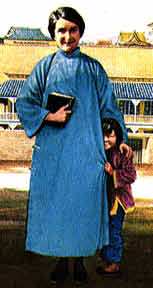
painting of Gladys Aylward with a small child

I got on my computer this morning before my work out and noted that the day listed for Morning Prayer today is in honor of Gladys Aylward and my first thought was who the heck is she and why should I pray for her? In the lessons on the  Mission St. Clare's website there was the picture of her and the story.written by James Kiefer. 
Gladys Aylward, Missionary to China 3 January 1970, which is the date she died. As I read her life- I thought I have heard this story before and when Kiefer refers to the  Chinese Mandarin of Yangchen- I could not get the image of Robert Donut out of my mind. It was his last role before he died and he played the Mandarin the in the Movie Inn of 6th Happiness and Ingrid Bergman played the inadequate woman who rises to the challenge in saving the children in that movie. Imagine my surprise when I found out that movie which I first saw back in the 50's with the orphans singing "This Old Man" was about her life.  I think I was 12 when I first saw it going with the EYC- Episcopal Young Churchmen (Youth Group) where we got an obligatory lecture of how bad the Chinese were treated by the Japanese and how the Godless communists  had not allowed the plucky missionary back into the country and how she was setting up an orphanage under the enlightened leadership of Chiang Kai Shek on Taiwan and we were to pray for the day when the Generalissimo and his American Educated wife would be unleashed to win back China for Christ..I loved the movie because it fed into my own racism about how we whites needed to help our little yellow brothers.


Later on I was to learn that our governments involvement was, shall we say, more complex. I tended to look back at this movie and in my new sophistication dismissed the movie as right wing fantasy. Except there is a truth buried in the movie about a woman of faith. The movie has a great many inaccuracies and Gladys Aylward herself was furious with the liberties taken.

 I will get the movie from Netflix and see it again and this time try to read the book on which it was based.. This is a gutsy woman who trusted  in a power greater than herself. She lived her life as if the "word becomes flesh" was true in her everyday life. She became a Chinese citizen because she wanted to share their lives. The movie tended to romanticize the story.  The movie does the same thing that the institutional church tends to do when we talk about Jesus and "saints", we tend to go with the cardboard cut-out  legend we create rather than inconvenient facts. There is a line from the John Ford movie The Man Who Shot Liberty Valance which I saw a couple years after The Inn of 6th Happiness "No, sir. This is the West, sir. When the legend becomes fact, print the legend." 

This is from the book on which the Bergman film was based :The Small Woman by Alan Burgess, 1957, revised addition, 1969]

 Gladys returned from China to England in the late 1940's an unknown missionary. Alan Burgess, who was producing a series on war heroes for the BBC radio, visited her in the hope a missionary could tell him about heroes she had heard about in China. Well, no, she said in her rusty English. She didn't actually know any heroes.
     "What about yourself?" he asked the little woman half-heartedly. "Did you have a scrape or two?"
     "I doubt people who listen to BBC would think I've done anything interesting."
     "Didn't you even come into contact with the Japanese invaders?" he pressed.

     "Yes," she answered cryptically. It wouldn't be very forgiving if she told Alan Burgess the Japanese had shot her down in a field outside Tsechow.  Bombed her too.  In Yangcheng.  Strafed her near Lingchuang too.  Smashed her on the noggin once with a rifle butt too.  Finally put a price on her head: dead or alive. "Some Japanese are very nice, you know," she volunteered.
     "Apparently your life in China was rather sheltered," he grunted dryly.
     Gladys had to offer the poor man something. "I did take some children to an orphanage near Sian."
     "You don't say?" he grumbled, not hiding disappointment. "Kids? To an orphanage?"
     "Yes, we had to cross some mountains."
     Burgess perked up.  "Real mountains?"
     "Yes, I believe you would call them real mountains. The journey was made more difficult because we couldn't walk on the main trails. Oh, and then we had to get across the Yellow River too."
     "Isn't that the notorious river that drowns so many it's called 'China's Sorrow'?"
     Burgess was more and more aghast as Gladys detailed her trek. His voice choked. "You ran out of food? You had no money? Just you and 100 kids - many of whom were toddlers - trekked for one month across mountains, across the Yellow River, ducking Japanese patrols and dive bombers? And at Sian you were diagnosed with typhus and pneumonia and malnutrition? Yes, Miss Aylward, I think people who listen to BBC would think you've done something interesting…"


Today is a good day to remember.