Tuesday, December 11, 2012

a reflection on the river home


A Homily for the 11th Annual Dare Hospice Memorial Service         Roanoke Island Festival Park December 9, 2012                                                                                    Thomas E. Wilson, Chaplain

We come together to re-member those whom we have loved and known. To remember does not just mean to go through a mental exercise like remembering the capital of South Dakota; but to call to our present moment a loved and important member of our lives. To re-member is to have time and space collapse on each other and to connect the member again with us one more time.

There is a book of stories by Ray Bradbury called Dandelion Wine about a summer in 1928.  In one chapter the young boys in this small town go to an old man’s house where he is a human time machine and he tells stories of his youth in the Civil War and the Old West, and as he tells the stories they hear the yelps of the coyotes, they smell the buffalo, they see the Indians and taste the dust from their ponies. When the old man dies, the buffalo start to disappear.  To remember means to place within the present stream of continuing memory of those we love as they live within us.

 Boaters in canoe on water body.My metaphor for life and death has been influenced by living close to water. When I was growing up in upstate New York, I lived on the banks of the Chenango River. Friends and I would swim and paddle around in it. The big adventures would be to canoe up river six miles and come to where the Tioughnioga River emptied into it, or canoe downstream about six miles where the combined rivers would empty into the Susquehanna. My dream, which I never found time to do, was to one day canoe down the Susquehanna, through Pennsylvania into Maryland where it empties into the Chesapeake Bay, and then follow that Bay to the Atlantic.  I took the easy way out and have driven those roads by the rivers often. I am no longer young, but I have ended up close to my destination at the intersection of waters returning to the sea.

I see life and death as part of a continuous stream of energy, the water of life that begins in the heart of God. My experience helps me resonate with the visions of the Prophet Ezekiel and the writer of the New Testament Book of Revelation of the River of the Waters of Life flowing from the Throne of God. 

We begin in the overflowing heart of God which allows our ancestors to be carried by love, and from their love we flow into the waters of the womb of a fellow swimmer in the waters of life. When the time comes for waters of the swimmer’s womb to break, we flow with all others and, as the old Gospel song states, “gather at the river, the beautiful, the beautiful river”. This River of Love flows to the sea and returns to the heart of God. We are moistened by the one current in different streams of experience. On our journey, we are helped by other swimmers as they teach us to love and to read and have awe for the River. Others may hinder us. Relationships are formed but the river continues to flow, and as the ancient Greek Philosopher, Heraclites, reminds, we “cannot step in the same river twice.” The River changes and we change; we do not have the power to not remain static in one place as everything changes. If we are lucky, we will thankfully hold on to memories of our time together. If we are lucky, we will allow the river’s forgiving cleansing to wash away all the debris from our memories that gets in the way of thankfulness. For the River changes and we change. Others will reach the great sea before we do, and we may want to hold on to them, but the river moves us and them, and we all empty into the sea where we flow back to the heart of God.

Today at the Intersection of the waters, I think of the people I knew who I carry still in my soul. I carry my father, the one who taught me how to canoe, and who entered the great sea 47 years ago. I carry my brother, with whom I paddled many miles before he returned to the place of the beginning.  I remember and treasure friends. I carry and continue to work on forgiving those I need to set free and turn them over to the power greater than myself, to give myself the strength to treasure and forgive so I may swim graciously uninhibited.


Courtney read a poem by Brandy Gregory, Our Homes, about how our homes are both far away and in our hearts at the same time. I am reminded of another poem by T. S. Eliot, at the end of East Coker, from Four Quartets.
Church
St Michael and All Angels’ Church in East Coker, where the ashes of poet TS Eliot are buried.
Home is where one starts from. As we grow older
The world becomes stranger, the pattern more complicated
Of dead and living. Not the intense moment
Isolated, with no before and after,
But a lifetime burning in every moment
And not the lifetime of one man only
But of old stones that cannot be deciphered.
There is a time for the evening under starlight,
A time for the evening under lamplight
(The evening with the photograph album).
Love is most nearly itself
When here and now cease to matter.
Old men ought to be explorers
Here or there does not matter
We must be still and still moving
Into another intensity
For a further union, a deeper communion
Through the dark cold and the empty desolation,
The wave cry, the wind cry, the vast waters
Of the petrel and the porpoise. In my end is my beginning.

May we honor. May we remember.

a reflection on love


A Sermon for II Advent                                                         All Saints’ Church, Southern Shores, NC  December 9, 2012                                                                Thomas E. Wilson, Rector
Malachi 3:1-4              Canticle 16                  Philippians 1:3-11                    Luke 3:1-6

There are four candles which form the outside circle of the Advent wreath which surrounds the center candle, the Christ Candle. The symbolism is that, in order to appreciate the birth of Christ in our daily lives, we need to first burn with these opportunities for grace. The candles represent Hope, Love, Joy, and Peace, and each one relates to a week of Advent, the preparation for Christmas.

Last week in my sermon on the first Sunday of Advent, I spoke of how we might find Hope in the middle of all hell breaking loose. This week, the second Sunday of Advent, I want to look at Love. Now, one of the problems we have in language is that we want to treat “Love” as something that one has: “Do I have enough love?” Or, we tend to see “Love” as the warm goosey feeling in response to someone liking you a lot. However, the Wilsonian definition of “Love” is a verb not a noun and is how we act: “Love is not what you think or feel but what you do.” Act first and then feel or think later. Harry Stack Sullivan, the founder of Interpersonal Psychoanalysis, reminded his patients and students: “It is easier to act yourself into a new way of feeling than to feel yourself into a new way of acting.”

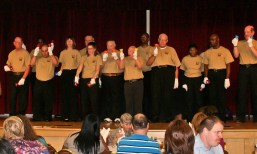
I saw a wonderful demonstration of love this last week. I agreed to give the invocation at the County Board of Commissioners meeting and on the agenda was a presentation by the Monarch Lighthouse Club Bell Ringers, a group of intellectually disabled adults who ring bells. These people have been told all of their lives by the larger society that they don't quite measure up. Yet here they come, armed with their sets of different colored bells and, under the direction of their leader who affirmed them in love, they ring their bells together to make a wonderful sound. As I looked in their eyes, I saw that, in thanksgiving, they give their best, joining with others as part of something greater than their own agendas, to create something beautiful for the benefit of somebody else. That is love as a living verb. I have invited them to come to this church to show you love in action.

Each of the stories in the lessons for today is about love as a living verb - people loving. Malachi, whose name may mean “Messenger of God”, probably lived in the 5th century BC when the Temple had been rebuilt by the exiles coming home from Babylon. However, it was a disappointment because they lacked the money for a first rate structure, and the priests seemed to display more than their fair share of corruption, offering damaged animals and rotten food for sacrifice and charging the full price.  It didn't look as if it was ever going to get better.  The avarice of the Priests and the shoddiness of the Temple were symptoms of the people's own lack of respect for God, family, and neighbor.  The bad news and the good news is that we get the Temple and Priests, and they resonate with our own actions. Malachi points out that the laypeople do the same thing when they withhold the wages of the laborer in the field, and when they rob God and neighbor by not paying the full tithe - instead of giving off the top, they only offer the leftovers. The “Messenger of God” points to another way of living. Instead of complaining about how bad is that thing there, the Temple, or that person there, the Priest, he suggests that we start to live as if the Temple were indeed a place where we can return to respectfully meet God with the best we have, and that Temple is found in the sacred space between us and our family and our neighbor. The Messenger of God hears God say, “Return to me and I will return to you.” Love is about returning even after disappointment.

Paul's letter to the Philippians shows how Paul decides to live his love by giving thanks for all things. He loves by imitating the example of Christ’s pouring himself out for him, and Paul pours himself out for others. We learn love by example of others. Paul has had some rough times, but he deems all of those events as meaningless when he compares them to the thanks he has for Christ and these friends he has in Philippi. If you want to be thankful to God, practice being thankful to the people you see. Love is not about giving approval for getting what you want; it is about loving the gift because it came in love.

The Song of Zechariah, which we used as our psalm for today, and the Gospel lesson are bookends of the same story in Luke. Zechariah is a Priest at the Temple, and he and his wife Elizabeth have no children in their old age.  One day Zechariah goes into the Sanctuary of the Temple as part of his shift to light up the incense and offer prayers. The worshippers wait patiently outside, and they wait and wait and wait. Inside, the Angel Gabriel has shown up unannounced to tell him that they will have a son whom they will name John who will prepare a way for the Messiah to come. Zechariah scoffs at  Gabriel saying they are too old, in the same way that Sarah had laughed at God for making the same promise to her and Abraham. He is so overwhelmed that he cannot say a word and finally, when the worshippers get tired of waiting for him, they find that he is mute. They send him for an extended rest cure or Sabbatical in the Hill Country of Judea, and during that time, Elizabeth gets pregnant. They will get a visit there from Mary, but here I am getting ahead of myself, for that visit is in two weeks when Mary sings about peace.

Zechariah, who had worked for years at the Temple dutifully doing his religious job, not thinking twice about how awesome it was to do what he was doing in that awesome place,  and now far away without the job to keep him busy, finally has time to see how God  is indeed awesome in daily life. During the naming ceremony, he follows the Angel’s instruction and writes that the child's name will be John, and Zechariah devotes the rest of his life to teaching his son John  about how to find God in the places of living life instead of in religious activities. Zechariah gave his best, joining with Elizabeth as part of something greater than their own agendas, to create something beautiful for the benefit of somebody else. That is love as a living verb.

John, in today's Gospel lesson, leaves the Hill Country and goes to the Jordan River valley where he preaches that faith is about how one lives one's life and not about religious duties. Luke introduces this part of the story by writing down all the leaders of the nation - “ In the fifteenth year of the rule of Caesar Tiberius—it was while Pontius Pilate was governor of Judea; Herod, ruler of Galilee; his brother Philip, ruler of Iturea and Trachonitis; Lysanias, ruler of Abilene; during the Chief-Priesthood of Annas and Caiaphas,” - not as a way of saying “Once upon a time”, but as a way of telling us that love comes inside history while we are living life, as when John meets Jesus and teaches him that love is lived.  But I get ahead of myself for that is for the lessons next month on the second Sunday of January.

At last week's confirmation service in this church, I saw love in the parents who brought their children up, giving their best, moving outside their own agendas to present their children for the service of something greater than themselves. I saw love in the teachers spending the time to give their best. I heard the choir give their best for something greater than themselves. I saw people sign up to give their best for helping our homeless guests this week. I saw people reach up to the Angel Tree to pick a name to whom to give their best for a child they will probably never meet. I saw the outpouring of food for the reception for the Bishop as people gave their best so that others would be honored. Love is the everyday verb of our lives as we live love with God and one another. Today, please don't hold on to your love as a noun but BE love and give it away.

Tuesday, December 4, 2012

Reflection of faith

 
 One of the problems we have in language is that we want to treat “Faith”as something that one has; “Do I have enough faith?” Or, we tend to see “Faith” as the acceptance of a group of theological propositions. However, the Wilsonian definition of “Faith” is a verb not a noun and is how we act; or “Faith is not what you think or feel but what you do.” Act first and then feel or think later. Harry Stack Sullivan, the founder of Interpersonal Psychoanalysis reminded his patients and students: “It is easier to act yourself into a new way of feeling than to feel yourself into a new way of acting.”

I saw a wonderful demonstration of faith this last week. I agreed to give the invocation at the County Board of Commissioners meeting and on the agenda was a presentation from the Monarch Lighthouse Club Bell Ringers, a group of Intellectually Disabled adults who ring bells. 

These people have been told all of their life by the larger society that they don't quite measure up. Yet here they come, armed with their sets of different colored bells and under the direction of their leader they ring their bells together to make a wonderful sound. As I looked in their eyes, I saw that in thanksgiving, they give their best, joining with others as part of something greater than their own agendas, to create something beautiful for the benefit of somebody else. That is faith as a living verb. I have invited them to come to my church to show faith in action.

This is an excerpt from their latest newsletter:

The Monarch Lighthouse Club Bell Choir performedLighthouse bell ringers during the 2012 Veteran’s Day Luncheon hosted by the American Legion Post 26 and the Unit 26 Ladies Auxiliary. The event was held to honor and celebrate local veterans for their service in the U.S. Armed Forces and was held at the Dare County Center in Manteo on Nov. 9. A photo of the group appeared in the Coastal Times, a local newspaper. The choir also performed at the Outer Banks Health and Wellness Expo 2012 this month. These recent performances are two of many public performances by the group. 
Thursday, November 29, 2012

A Relection on when "all hell is breaking loose"


A Sermon for I Advent                                  All Saints’ Episcopal Church, Southern Shores, NC December 2, 2012 (8:30)                           Thomas E. Wilson, Rector
Jeremiah 33:14-16      Psalm 25:1-9   1 Thessalonians 3:9-13                      Luke 21:25-36
Today we are using the Eugene Peterson’s translation of the Bible, The Message. We have 12 kids being confirmed when the Bishop shows up for the 10:30 service, and that is the version they have been using. The Bishop will preach at that service while the 8:30 crowd has to put up with me.

One of the reasons I like the Message is that it uses vivid language - street language - because the New Testament was written in Koine Greek, the street language of that time, instead of the more classical Greek of the Philosophers and Tragedians.  The King James Version of the Bible was slanted in translation to remind listeners of the Majesty of God and, by extension, of God’s representative on earth in England, King James. James was tired of being a Presbyterian over in Scotland, being told what to do by Presbyterian preachers using the Geneva Bible Translation, and he wanted the pomp and ceremony of the Anglican Church when he came south to England. Listen to the way his translators did the first two verses of the Gospel lesson for today:
And there shall be signs in the sun, and in the moon, and in the stars; and upon the earth distress of nations, with perplexity; the sea and the waves roaring; Men’s hearts failing them for fear, and for looking after those things which are coming on the earth: for the powers of heaven shall be shaken.
 http://l.yimg.com/bt/api/res/1.2/OpleMXiOtbRrlvgfwzJ5fg--/YXBwaWQ9eW5ld3M7cT04NQ--/http://mit.zenfs.com/1325/2012/04/Outrageous_End__DNY59.jpg
Majestic isn’t it? Yet, its beauty removes the immediacy. Now listen to how Peterson translates the same two verses: “It will seem like all hell has broken loose—sun, moon, stars, earth, sea, in an uproar and everyone all over the world in a panic, the wind knocked out of them by the threat of doom, the powers-that-be quaking.”

The King James Version has the beautiful language opening the Psalm, “Unto thee, O Lord, do I lift up my soul. O my God, I trust in thee: let me not be ashamed,” which is lovely and oh so religious. However, the Message has “My head is high, God, held high; I’m looking to you, God; No hangdog skulking for me”, which has to do with daily life.

All the lessons for today are set in times when ‘all hell is breaking loose” in daily life. Jeremiah is writing during the time when the Babylonian Empire is threatening to destroy the country he loves. The Psalmist sings of how his enemies are surrounding him. Paul is writing to the Thessalonians who he had to leave so suddenly years before because of persecution. Jesus is on his way to his death in Jerusalem. So, what is it like to be in a situation when it seems like all hell is breaking loose and so many of the things in which you trusted seemed to be letting you down?  Do you remember moments in your life when everything seemed to be falling apart? Let me prime your pump of remembrance.

Do you remember November 22, 1963? On that day I was a 16 year old senior in high school, and the announcement came over the PA system that President Kennedy had been shot and we were to go home. I remember crossing the bridge over the Chenango River with the freezing wind blowing down the valley, so that my tears and snot froze on my face. How could we possibly survive as a country? A few years later I was in Chapel Hill when I got the news that Bobby Kennedy and the Rev. Dr. Martin Luther King were gunned down by our love affair with violence. Then there was Watergate and so it goes through September 11, 2001 when we answered violence with violence and in which, eleven years later, we are still mired down. Yet, in the middle of human violence, I hold on to the strength of the Prince of Peace to work for peace, beginning with me. When “all hell breaks loose” is when we need glimpses of the presence of God, heaven; not the place in the sweet by and by, but the awareness of the presence of God on whom to hold. 

We trust a lot in money as a power to get us through. I remember in 1968 when I graduated from College and had a rough couple months while I was way ahead of the current trend by not being able to find a “real” job.  I worked in a restaurant for the time being, and then the manager of the restaurant skipped town with the money and we had to close down. I found work pumping gas, and then I ended up in the hospital with a bleeding ulcer.  So then I was married, out of work, and owing money to the hospital as well as the university. Years later, after that marriage fell apart and I was a Priest and Pat and I had a home, I took a job at a place where they had a Rectory. We finally sold the house and invested the money we made in the stock market, because the stock market was going great guns especially in dot-com stocks. I should have listened to Mark Twain and his advice on investing in the Stock Market - “October: This is one of the peculiarly dangerous months to speculate in stocks. The others are July, January, September, April, November, May, March, June, December, August and February.”

When the dot-com bubble burst in 2000, I took the remains of the investments and took a job here where I had to find a house when there was a real estate bubble in play, so housing was much more expensive, but, I thought, it was a fool-proof investment! That bubble burst in 2007 and helped usher in the financial crisis in which we still find ourselves.  It is real interesting to see your paper financial worth dwindle. Yet, in the middle of that loss, I know that my true worth is not dependent on my portfolio, or my performance, or my job, but on Christ’s love for me. I have made lots of bad choices, but I resonate with the opening of Psalm 25: “My head is high, God, held high; I’m looking to you, God; No hangdog skulking for me.” I continue on because I know that all things lost - be it security, money, jobs, reputation, health, even life itself - is redeemed in Christ. My prayer is always the same: “God, grant me the serenity to accept the things I cannot change, the courage to change the things I can, and the wisdom to know the difference. Just for today.”  

Today at 10:30 there are 12 kids being confirmed, a couple babies being baptized, and a few receptions and reaffirmations.  The thing is that they will all find moments in their life when “all hell is breaking loose”. I know all of you in this room have been through those moments, and your task, the task of the church, the parents, the friends, the neighbors is to remind them by witness of your life, by word and deed, that all things are redeemed. “God, grant them (and us) the serenity to accept the things they cannot change, the courage to change the things they (and us) can, and the wisdom to know the difference.”  Just for today.

Reflection of Moonlight in the pre-dawn


The last couple mornings have been generous with the setting moon so that as I would wake up, the moon just brightened up the time before the dawn. I walked across the grass and see my my footsteps in the white dew left by the cool night air. Not only then but last night before 9:00 the moon was paired with the planet Jupiter, and I marveled at the beauty - paired and yet independent. Diana and Jupiter conversing in the night sky as they passed by -- but we were the ones who were passing by- hurtling through space at  >69 K MPH! Doesn't that boggle the mind? It looks like we are standing still..


 I think if I had not been blessed with being raised as a Christian, I would have made a good moon worshiper; following something like the Virgin Artemis ( or Diana) of Ephesus. The experience of the worshipers of Ephesus helped to lay the ground work for the Virgin Mary Cult but the awe of nature was stripped form the pagan cult and replaced by the emphasis on purity by the male dominated  church leaders who had problems with  uppity women.

The Christianity that  Jesus followed was based on the prophetic strain of Judaism, especially the prophet Micah: "God has told you, O mortal, what is good; and what does the Lord require of you but to do justice, and to love kindness, and to walk humbly with your God?"  Part of the problem with Christianity is that the Establishment of the church as an "official" religion reduced worship to buildings, the medieval church focused in on sin and guilt rather than thanksgiving and awe, the Enlightenment reduced  faith to the acceptance of  intellectual propositions and modern times reduced commitment to mental and emotional cathexis to an institution. Through through those process we have domesticated God and removed the Divine from daily life.. 

We have forgotten about a commitment to justice, we have gotten used to a hardening of mercy as we develop a condemning stance on those who disagree with us and we have lost our capacity for humility by forgetting to be filled with awe. We have isolated praise of God to the Sunday morning hour as long as it doesn't take too much time from our own agendas. I think of the lines from Alice Walker's The Color Purple :
Shug: More than anything God love admiration.
Celie: You saying God is vain?
Shug: No, not vain, just wanting to share a good thing. I think it pisses God off when you walk by the colour purple in a field and don't notice it.
Celie: You saying it just wanna be loved like it say in the bible?
Shug: Yeah, Celie. Everything wanna be loved. Us sing and dance, and holla just wanting to be loved. Look at them trees. Notice how the trees do everything people do to get attention... except walk?
[they laugh]
Shug: Oh Miss Celie, I feels like singing!  

One of the joys of looking at the sky  and seeing the moon or walking on the beach is that I "feels like singing" in praise of God.