Thursday, August 8, 2013

Reflection on dreams


A Reflection for XII Pentecost (Proper 14) All Saints’ Church, Southern Shores, N.C. August 11, 2013 Thomas E. Wilson, Rector

From the Book of Genesis, the Hebrew Testament lesson for today: “The word of the LORD came to Abram in a vision, ‘Do not be afraid, Abram, I am your shield; your reward shall be very great.’" Abram lives his life paying close attention to his visions, and the Book of Hebrews lesson for today suggests that this is the way we can enter into faith: “Now faith is the assurance of things hoped for, the conviction of things not seen.”

Today we will be baptizing little Lillian Grace, welcoming her into the fellowship of Christ and inviting her to grow in faith. In scripture one of the ways people grow in faith is to pay attention to their visions and dreams. Our modern problem is that we think faith has to do with creeds and religious observances, but faith is the uniting with God and allowing God to enter our daily lives, hopes, and dreams. At the end of next week I will be starting a course of instruction to better prepare me to help people realize God’s connection to them through the pre-conscious world of dreams. The course is based on Jungian Psychology and deep spiritual exploration. It will last until 2015 and we are using the money set aside for the sabbatical that I should have taken after my sixth year here. There will be 8 weeks of intensive classes at Camp Kanuga in the Mountains of North Carolina spread out over many months and a bunch of books, papers, workshops and consultations. Pat and I will do this together, and we hope to continue to grow in mind and spirit and, as with all Sabbaticals, we hope to enrich the spiritual life of the parish as well.

 
one of the books we will be using
A vision is the dream we share with God and is given to us when we see beyond the surface and go deeper into the world of the ground of our being. Usually we walk around like we have blinders on because our minds are so filled with the detritus of our daily lives - “What does that person think about me?”, “What is the next task I need to do?”, “What am I going to eat?”, “How much more stuff can I get?”, “What show is going on?”, - and on and on, and we miss so much of what is really there. We are so concerned with our own agendas that there is no room for that which is outside our own ego needs and desires. A vision is what God grants us to really see the world as God sees it. 

However, most of us do not want to have visions because they can disrupt our lives, get in the way of our own agendas. There is nothing wrong with that. For instance, last week I was driving back from Oklahoma, going 75 miles an hour on an interstate, and that was not a time I needed to have visions. I needed to focus on what the clown ahead of me was doing and what was going on in my blind spots, etc. But if I live my life as if I am hurtling down a highway, as if my destination is the center of the universe, then I am not aware of the rest of the universe. For our own sanity, spiritual and otherwise, we need to get back in touch with a deeper reality. Jesus, in today’s Gospel lesson, uses the image of  the servant who focuses in on the true meaning of his existence when he  advises "Be dressed for action and have your lamps lit; be like those who are waiting for their master to return from the wedding banquet, so that they may open the door for him as soon as he comes and knocks.”

God comes and knocks, offering visions of the deeper reality all the time, but we are so busy that we refuse to hear. Another reason we refuse to hear is that we have been disappointed with God, and we refuse to put up with anyone who has let us down. I went through that period of sulking over God not doing what I wanted for several years and acted like that old Fats Domino Song:
You went away and left me long time ago
Now you come back knockin' on my do'
I hear you knockin' but you can't come in
I hear you knockin', go back where you been
I begged ya not to go but you said goodbye
Now you come back tellin' all those lies
I hear you knockin' but you can't come in
I hear you knockin', go back where you been
If you had a-listened long time ago
You wouldn't be goin' from do' to do'
I hear you knockin' but you can't come in
I hear you knockin', go back where you been 
 
Fortunately we have to sleep sometimes and what happens there is that, when we dream, we start to listen to the divine knocking and, if we are lucky, we get visions. Sometime we get reactions to the pastrami and rye we ate before we went to bed or the nightmare of the upcoming test in the morning, but as we go deeper, we send our ego, which tries to protect us from God because it doesn’t want anything to change, out for a smoke. In dreams we start to connect back to the ground of our being and hear God speaking to us in order to bring us into wholeness. The dreams are usually in symbols and archetypes to get around our ego defenses and it takes a lot of work to figure out what is being said. Take Abram’s dream in the first lesson for example. “The word of the LORD came to Abram in a vision, ‘Do not be afraid, Abram, I am your shield.” 


What is a “shield”? In the 21st century we would tend to say that a shield is some sort of protection we hide behind to keep us from harm. So if we only stayed on the surface we would say that God is promising to protect Abram from all harm, and Abram can go on with his life undisturbed. Except there are two things wrong with that idea - (1) God does not just visit us to tell us that everything is hunky-dory and then leaves us alone, but God comes to transform us so that we might more fully live and deeply, spiritually participate in the Kingdom of the Heavens right here and right now; and (2) Abram did not live in the 21st century and the story was not written down in the 21st Century, so we need to go deeper. For Abram a shield is not something to hide behind but something to increase one’s power. First of all, a shield usually has a decoration, a symbol of you or your family or tribe, saying who you are - like a coat of arms. A Shield was how you defined yourself. God is saying “I am your shield,” and by that he means that “The deeper definition of who you truly are is by your relationship with me. Your life has a center other than yourself for you are my beloved child, the brother of all that has been created.”

Second of all, a shield is not meant to be hidden behind for a shield huge enough to hide behind would be unwieldy. A shield needed to be light enough to carry and strong enough to be of some protection. A larger shield, about 43 inches long, was developed in the early Roman Empire to be used to deflect slings and arrows, but that was more than a thousand years after the Bronze Age of Abram’s time. At that time a shield was either a wood, wicker, metal or animal hide disk that was used on the left arm or left hand, which is the weaker arm or hand if one is right handed, to strengthen that arm and to deflect any blow by turning the shield at an angle so that the sword of the enemy would slide off the shield. No shield, or shield arm, is strong enough to absorb a direct overhead blow, but tilting the shield or using the shield to push away puts the enemy off balance and the energy of the enemy is dissipated. When the vision says that God will be Abram’s shield, God is offering to help overcome Abram’s weaknesses and be Abram’s strength as he deal with the blows, slings, and arrows of life. God is not promising to be the guarantor that nothing bad will happen to Abram, but that God will transform Abram, enabling him to stand and participate more fully in the presence of God. To enter into a deeper relationship with God is to enter into new territory and, as an outward sign of that change, Abram’s name will be changed to Abraham.

God speaks to us in so many different ways, if we would only just stop and pay attention. Last week when we were in Tulsa, Oklahoma to visit Pat’s daughter, son-in law, and grandson (Nate the Great), we had occasion to go on an art crawl through the Brady Art district which is a reclaimed warehouse area. There was some very challenging work in all of the art galleries and studios, but the most meaningful moment was when we walked past a park called the “John Hope Franklin Reconciliation Park”. Franklin was a noted author and historian who ended his career teaching history at Duke. He was born and raised in Tulsa and was 6 years old at the time of the Tulsa Race Riots of 1921. 
 
The Riots began when a 19 year old African-American bootblack needed to visit the only black restroom in the area located on the 6th floor of a building, and he entered the elevator operated by a 17 year old white girl. Apparently he tripped and the girl screamed and, in response to her cries, he was arrested for assault and taken to jail. The girl refused to press charges, but an armed Klan inspired mob gathered to take him out to lynch him. The sheriff refused to turn him over, and in the meantime, a group of blacks from the area known as Greenwood armed themselves and went to defend the young man. A battle ensued and both white and black bodies littered the ground. In retaliation the mob grew and marched on Greenwood and burned the place to the ground, beating and killing whoever got in their way. The mob was aided by the National Guard which helped by rounding up 6000 blacks for detention and by dropping incendiary bombs from biplanes on Greenwood, burning the black hospital, churches, schools and every house. Franklin’s father, a lawyer and leader of the Black Community, called the relatives with whom John was visiting and told him and his sister not to take the train back to town. As a result of the riots, the sheriff was fired, the bootblack kicked out of town, Greenwood was razed, and a warehouse district was set up in its place which enriched a man named Brady who was one of the Klan leaders. Money did not purchase his happiness, and Brady later killed himself. Years later the warehouses were empty, and the Brady Street Art District was created. Tulsa tried to erase all memory of the event in its history and put blinders on so that the past could be put behind it and get back to business as usual. The problem is that unless we allow the shadows of ourselves to be brought to light and be transformed by the light of Christ, we tend to unconsciously pass on the repressed part of ourselves. The truism is that “What is not transformed is transmitted.”


Franklin, in one of his books, The Color Line, wrote, “Perhaps the first thing we need to do as a nation and as individual members of society is confront our past and see it for what it is.” Franklin died in 2009 but his foundation, helped by a special commission, the 2001 Oklahoma Commission to Study the Tulsa Race Riot of 1921, set aside a section of the old Greenwood area as a Reconciliation park. In the center, next to a labyrinth to walk for contemplation, there is a 25 foot Tower of Reconciliation showing the struggles of Tulsa to deal with the past injustices against the Native-American and African-American parts of our society. It is not a guilt monument, for the vision is the working together to create a just society where the content of character rather than the color of skin define a person. As I stopped I realized that the park was a way to call us to a new vision of the world where, in the words of the baptismal covenant we will recite, together we “strive for justice and peace among all people, and respect the dignity of every human being”. The vision, like all visions, is not the wallowing in the past, but a call to change the present and work for a new unexplored future.


Pay attention to the dreams and visions which God provides us to knock on the door of our consciousness, assuring us of the presence of the power greater than ourselves who is our shield as we move into a new future.


Thursday, July 18, 2013

A Reflection on Mary, Martha and an Anniversary


A Reflection on IX Pentecost (Proper 11)                                            
 All Saints’ Church, Southern Shores, NC 
July 21, 2013                                                                          
Thomas E. Wilson, Rector
Amos 8:1-12            Colossians 1:15-28            Luke 10:38-42

When I first started this business of being a Priest I focused in on the externals of liturgy - am I doing it “right”?; of theology – am I teaching it “right”?; of budget, how much money was going out versus how much money was coming in; and of attendance, how many people were at the services or in classes or at functions because they were for me a sign of how I was doing as a Priest. In the testosterone-loaded clergy meetings, within the first five minutes of a conversation with a new clergy acquaintance, information about the size of each other’s parish would enter the conversation.  Under the surface of mutual support at the clergy meetings, we were always in competition with each other, and at the yearly convention we would check the numbers of the other churches of the diocese to see how we were doing in comparison. When I came here, I knew it was a smaller parish, and it freed me of the competition inside my soul. Instead of seeing myself in comparison to another, I got to see myself without comparisons. Not only are comparisons odious, but as the character Dogberry in Shakespeare’s Much Ado About Nothing expresses the malapropism, “Comparisons are odorous”.  And he was right - they smell to high heaven.

http://www.chinaoilpaintinggallery.com/oilpainting/Diego-Velazquez/Christ-in-the-House-of-Martha-and-Mary.jpgMary and Martha are in the process of comparing each other as to who serves Jesus better.  Is Mary’s quiet contemplation better or is Martha’s dedicated service better? The answer of course is “Yes”. Each is better for them, and they are different but each beloved. The differences are less important than the faithfulness as they work together and respect the different gifts they bring to the relationship. One of the things I keep pushing parishioners to do is to seriously ask themselves the question “What is my gift that I can give to the church?”, not “What is the job I should do in the church?”.  The gift we can give is ourselves, the thing that gives us energy when we do it. 
One of the things I do with couples as they enter into premarital counseling is to ask them to take a Myers-Briggs Type Indicator assessment, and I ask them to bring in the results as we look over their communication and fighting skills. The MBTI is a questionnaire that asks people to make choices on how they see reality, process information, and make lifestyle choices. Catherine Cook Briggs and her daughter, Isabel Briggs Myers, designed the tool using Carl Jung’s psychological insights on the personality in which Jung said that each of us lives with a dynamic tension of sets of opposites within ourselves. For instance, each of us live in a dynamic of male and female; I am a male and that is dominant, but since I am a product of a dynamic  genetic interaction between a male and female, a mother and father, I have both within me.  The female shadow of myself, what Jung called the “anima”, needs to be recognized and honored to give me depth, for something without a shadow is flat and one dimensional.

According to Jung, the dynamic tension of sets of opposites is given to us in attitude as well, which has as its opposites the Outward Turning or Extraversion (E) and the Inward Turning or Introversion (I). In the Mary and Martha story, Mary seems to be content to quietly listen and mull things over inside herself, while Martha is not content to mull things over but goes to Jesus to enlist his help about what to do with Mary. No one is 100 % one way or the other, but we tend to go to our strength and live out a preference.https://blogger.googleusercontent.com/img/b/R29vZ2xl/AVvXsEgAWF7an4v_XnZnoOLLS7KGNtwDKvTX0VtmJqN6OS0Xzm3rQcx7KgpitM1tdmch5rcJxmUXyoniwLUlEAs23RXhwwvES9nwymS-9VQxY1DgVfKfQtr_TEDoMSD1Z_CThhHHBp1WyKJB9hg/s1600/Myer-Briggs-Chart.jpg

The next three dynamic tensions of opposites are in the functions of how we see, judge, and respond to reality. The way we perceive reality is either sensing (S), through the use of sight, touch, taste, smell, and sound, or through intuition (N) which is based on hunches. The next function is how we judge the worth of what we see, the dynamic tension between thinking (T) and feeling (F). The last dynamic is the Lifestyle tension between perceiving (P) which wants to get a bigger picture and judging (J) which urges “get it done”. 

In the Mary and Martha story, Mary seems to see the world based on the intuition that Jesus is a man she can trust, and she judges her experience based on the deep feeling she has as she is listening to Jesus and she wants to hear more.  On the other hand, Martha’s view of reality is dominated by the way the dinner is being prepared as she touches the plates, tastes the food, sees how the tables are set, smells the food burning, etc.  She judges worth by the thoughts she has about the importance of this guest and the task that needs to be accomplished - and she wants it done now! In the MBTI Mary would be an INFP, an introverted, intuitive, feeling, perceiving personality, while Martha would be an ESTJ, an extroverted, sensing, thinking, judging personality.

They are different and yet they both need each other, for the dominance of one helps to re-enforce the shadow of the other. If both were introverts (I), they would not have invited Jesus; if they were both sensates (S), they would both be in the kitchen and no one would pay attention to their guest; if they were both feelers (F), the dinner would be a mess; and if they were both Perceiving (P), the dishes would never get done.

There are so many stories about Jesus.  Why did Luke include this one? I think Luke sees the house of Mary and Martha as the church in miniature, as different people come together, respecting and honoring their differences, to give the different gifts they each have to the guest who comes to dwell with, and within, them. All the divisions we want to think are so important, as in last week’s story of the “Good Samaritan” where the perceived enemy is really the true neighbor, fade away if we honor the differences. Luke will continue with that theme of having Jew and Gentile, men and women, saint and sinner, leper and healthy, coming together - for nothing separates us from the love of Christ. 

The problem of the institutional church is that we tend to divide over differences, wanting to be “right” rather than seeing the sacred ground that binds us together. The cross, the very symbol of our faith, is the dynamic tension between two opposites, the horizontal and the vertical - the horizontal holding east and west in tension, and the vertical holding heaven and earth in dynamic tension – and speaks to our unconscious mind, calling us to the deeper truth of who is this Christ within us. The church splinters over the unimportant stuff and neglects the deeper message.

The way I use the results of the MBTI with couples in the pre-marital process is to help them see that they were attracted to each other by the differences they saw in each other, intriguing the neglected side, as they risk becoming whole; the introvert (I) is attracted to the (E) extrovert’s ease in dealing with people, the (S) sensate is touched by the (N) intuitive’s ability to read the undercurrent of the world, the (F) feeler finds a fuller sense of reality by the (T) thinker’s use of facts, and the stuck-in-a-rut, nose-to- the-grindstone (J) judger is freed by the spontaneity of the (P) perceiver. The problems arise when challenges and outside stresses come into their lives, and each person anxiously wants to go to their own strength and is annoyed that the other person sees and reacts to reality in a different way. 

This is what is happening with Mary and Martha in the Gospel lesson.  Martha is so frustrated that she tries to triangulate Jesus into making Mary feel guilty as a way to change Mary. In marriages when stresses build up, the couple can get so frustrated that they want to make the other into their own image so that they can win the fight and be “right”. But the secret of marriage is not that one plus one equals one, where one person is dominant and the other gives in, nor one plus one equals two, as when marital partners become two roommates who share the same bed but have grown into strangers, but one plus one equals three, a trinity united by honor and respect of differences, living in the dynamic dance of a relationship. The difficulty is that sometimes we get so busy doing family and work stuff, Jesus in the story uses the word “distracted”, that we don’t spend the time to honor the differences as gifts rather than viewing them as hindrances.

View Picture 047.JPG in slide show

Today at the 10:30 service we will have a renewal of vows on the 50th anniversary of the wedding of Tom and Kay O’Brien. These are two different people who at times will disagree but who, at the same time, honor the differences - as the French say, “Vive la difference!” They see each other not as competitors for the same limited space in a universe of scarcity, but as two individuals who share the same sacred space together in a universe of abundance, connecting the Christ with and within them. The church does weddings not because we want to throw holy water on relationships but because healthy relationships remind us of who we were called to be as a church. They remind us of what the church can be if only we work out our differences with love and respect and honoring the Christ living within and with each of us.

Thank you, Tom and Kay, for helping us see in the way you treat each other the Christ reality in a different light.

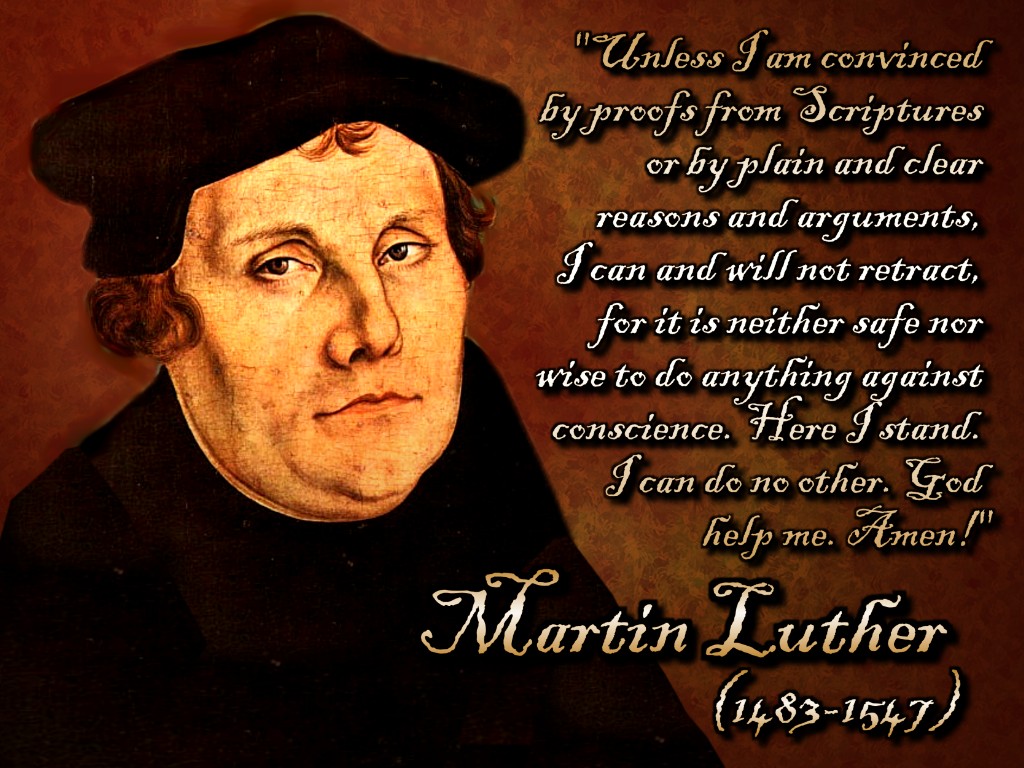
"Here I stand"

Parson Tom’s Tomes

“Here I stand I can do no other!” It is a good line attributed to Martin Luther during his trial at the Diet of Worms, even though historians can find no trace of it in the accounts of the trial itself at the time. Luther was “Standing his ground” against the accusations of heresy by the Roman church, in which he was an Augustinian friar. The church wanted to “Stand its own ground” from the assaults on its theology, and therefore declared Luther an outlaw which meant anyone could kill him with impunity. From Luther’s stand the ground shook under the feet of the comforting illusion of solid, unchangeable, united, Western Christendom and we get the Reformation and so began a series of religious wars that lasted for centuries and the blood of millions poured into the ground from the slaughter from both sides.

There is something appealing about “standing your ground” and I have a tendency to point to the times of “standing my ground” with more than a hint of pride. However, the recent events in Florida with the trial George Zimmerman slaying of Travon Martin in which Zimmerman was acquitted because the law allowed him to “stand his ground” with deadly force made me want to review my pride.

I remember a conversation in the early hours of the morning in the dormitory when I was a freshman- almost a half century ago. The boy/men (I was 17 the others were 18 and older) were discussing how it was legal to kill another person. It was proposed by a pre-law student, oh so wise in the ways of the world- as we all thought we were, and agreed by the group, that if one shot a burglar trying to break into their house, they would need to drag the body into the house and say that the burglar had made it into the house and say the shooter acted in self-defense in defense of his home, a man’s castle. I remember thinking at the time that I had nothing worth stealing that was worth the life of another human being.

Almost 40 years later, when I accumulated a bunch more “stuff” someone stole a set of porch furniture one dark night off the front porch of the Rectory, having used bolt cutters to cut the chains bolted into the floor as a theft deterrent. I was filled with red rage and wanted to catch the culprits and do major damage to them. After calming down and lots of prayers, I realized it was not that the stuff was that important, but it was ego, my pride, that had been assaulted. I did not want to live in a life in which the comforting illusion of in vulnerability was exposed.

The problem is that we do live in a world in which we are vulnerable. My pride invites me to “stand my ground” but my faith says it really is not my ground for that on which I stand is “holy ground” and the space between me and another person is sacred.  I can only speak for myself, but I invite you to ask yourselves on what it is that you “stand your ground”?

SHALOM     

Thursday, July 11, 2013

A Reflection on how we treat strangers

A Reflection for VIII Pentecost (Proper 10)                  All Saints’ Church, Southern Shores, N.C.  July 14, 2013                                                                     Thomas E. Wilson, Rector
Amos 7:7-17                       Colossians 1:1-14                             Luke 10:25-37
How do you treat a stranger who comes to town?

Jesus is on his way to Jerusalem; anybody with any brains knows that this is an up and coming prophet who is gaining a following. A prophet is one who sees, a seer, what God is saying to God’s people in their time and place. That is both good news and bad news. The good news is that some people who are hearing the good news are overjoyed because it challenges their view of the universe - that they are the isolated center of the universe - and they now understand that God is with them in their daily life.  They rejoice in thanksgiving of knowing God’s love in their lives. The bad news is that some people who are hearing the good news are threatened because it challenges their view of the universe - that they are the isolated center of the universe - and now they are in fear that that they have missed the point of their lives. As usually happens when people get defensive, they try to limit the damage by attacking the messenger.

I have spent a lot of years in academic settings - one undergraduate degree, working on two Masters’ degrees, most of a Doctorate, being on the faulty of a college, and being a chaplain at a university - and you can tell when an academic is threatened by a presenter or a visiting lecturer. It is called the time for questions after the lecture. The question goes something like this: “Professor, could you expound on the particular point you were making when you said . . . ?” But that question is not the real question because the real question is the follow up question, which contains a “gotcha”. In the case of today’s Gospel lesson, the lawyer asks the softball question about what must he do to have abundant life. Since he is a lawyer and not a Pharisee, he probably doesn’t believe in an afterlife as a reward, so  “abundant life” for him means having God pleased with him and God giving him his just reward of material prosperity in this life. The question is settled by the quoting of the law, and so he now asks Jesus the “gotcha” question, “But, who is my neighbor?” He wants to narrow the definition down so he can calm his anxiety and congratulate himself on being justified by God. The answer he wants is the literal definition which is “the people who live next door to you, your family, and close friends and partners.”

Except Jesus tells a story about the enemy, the stranger, the undocumented alien, the religious heretic, the half breed, all rolled into one as the neighbor, which we call the Good Samaritan story. The neighbor is the one who acts in love and how does it change you when your enemy is acting as your neighbor. How well did the answer go over? Well, the lesson ends on verse 37 and verse 38 begins with the words, “Now as they went their way they came to another village . . .” so the implication is that Jesus and his followers were given the bum’s rush out of town.

How do we treat the person who is different from us? I think that is one of the themes of the other two lessons as well. In the Hebrew Testament lesson from Amos, Amos is a visitor from the Southern Kingdom of Judah, and he is attending a sort of Bi-Centennial event in Bethel, the Spiritual Center of the Northern Kingdom of Israel.   The Kingdom’s elite are celebrating their material wealth and prosperity, rejoicing that it is God’s will that some have prospered. The Kingdom’s prosperity is high but narrow in that it is enjoyed by only a small portion of elite, the one percent of their time and place, and built on the exploitation of the poor, the use of a regressive tax system, corrupt government, and crony courts to cement their advantage. Amos is not a licensed prophet, a lapdog of the state bought and paid for by the rich. His profession is a shepherd and a dresser of the sycamore fig fruit, which is food for the poor, but Amos says that God called him to be a seer, one who sees what God might be saying to God’s people - in this case, good news for the poor and bad news for the corrupt.  How does the message go over?

Photo: Proof for the last post.If you read the paper you may have seen how the government in Raleigh is dealing with people who give that same kind of message, standing up for the poor against the rich and well connected, on what is called “Moral Mondays”, as of now over 700 hundred people have been arrested. Last week my daughter sent me a picture of  my ex-wife, her mother, being led away in plastic handcuffs by two burly policemen on that Moral Monday in Raleigh. They get arrested for disturbing the peace and since we live in a democracy, they submit to arrest as part of the faith in civil disobedience. Leonard Pitts wrote in his column last Wednesday: “Civil disobedience is, almost by definition, an act of faith. Not faith in government, nor even in law, but faith in vindication. It is an act that says, I am right, so I refuse to obey this law and will take my medicine until you see that I am right.”

Amos and Jesus as seers do not say they are right but how they see that God is right, and for that they were willing to pay the price in the hope of vindication. Vindication for Jesus is in the resurrection and for Amos that his words still resonate as he says: “But let justice roll down like waters, and righteousness like an ever-flowing stream.” Jesus lives in 1st century Judea and Amos faces 8th century Israel and both were not democracies.  Amaziah, the Master of Ceremonies at the Celebration, brings Amos to the attention of the authorities for disturbing the peace and says to Amos, "O seer, go, flee away to the land of Judah, earn your bread there, and prophesy there; but never again prophesy at Bethel, for it is the king's sanctuary, and it is a temple of the kingdom." Amos is declared an enemy of the status-quo and we don’t know what really happens to him. A legend written down seven centuries later says that he was tortured and killed by Amaziah’s son.  That is one way to treat people who are different from us - label them as outside agitators, enemies, strangers, undocumented aliens, and religious heretics all rolled into one.

In the letter to the Colossians, the writer is probably one of Paul’s followers using Paul’s thoughts, when Paul was the stranger, who was also the seer, the one who sees and proclaims God’s message.  How does he approach these strangers? He prays for them and gives thanks for them. He treats them as neighbors and is willing to help them and share their load and calls them brothers and sisters and fellow saints. “Saints” does not mean people who are good but people who are loved by God.

I remember 523 Sundays ago a stranger walked into this church called All Saints’. The search committee had vetted him and the vestry had hired him, but to most people, he was a stranger intent to be a seer, one who sees and proclaims what God sees and is doing. He wanted to go to work immediately and assume the role of Rector, proclaiming that the stranger indeed had a place here, but the vestry had said that he would assume the position at the beginning of August and not the second Sunday of July. So the stranger was nervous because he could not dazzle them or have the authority of preaching from the pulpit or officiating at the altar, and all he had for protection was the good will of the people, some of whom would probably not agree with all of his ideas. But the people, who all came to the Outer Banks from somewhere else, knew something about being a stranger themselves. Like Amos, you have stood up for the poor and for justice for the outsider. Like the writer of the letter to the Colossians, you prayed for and gave thanks for the stranger - me and my family - and treated us neighbors, agreed to disagree, and were willing to help us and share our loads and call us brother and sister and fellow saints of All Saints’. Like the Samaritan you have helped bind my wounds, and put me up. I thank you for that following of the Good News and for being neighbor to me and mine and so many others.


Come; let us continue to work on how we can see together what God sees and is doing.

A Reflection on Thoreau’s night in jail versus Psyche’s journey

Reflection on Thoreau’s night in jail versus Psyche’s journey

Two stories which are at war in my mind this morning. One is an anniversary this week of  an event on July 12, 1846 , when Henry David Thoreau was arrested and spent the night in the Concord Jail as an act of Civil Disobedience for refusing to pay the poll tax to protest the government’s policy of support of slavery, and/or another account against the imperialistic was on Mexico. The story goes that he was visited by his friend and neighbor the transcendental philosopher Ralph Waldo Emerson. Emerson, through the bars in exasperation asked, “Henry, what are you doing in there?” Thoreau replied, “Waldo, the question is what are you doing out there?”
thoreau swag

I always loved that story, which neither Emerson nor Thoreau record in their writings, because it calls to mind the duty of all of us to stand up for justice. My daughter sent me word that her mother, my ex-wife, had spent the night in jail in Raleigh for protesting the actions of the NC General Assembly in its cutting of benefits to the unemployed as a way to afford a tax cut to the wealthy and well connected. She has been one of 700 citizens arrested so far as part of the Moral Monday protests. The old activist in me is asking myself, why am I up in the woods in Maine when there is so much work to do?

Yesterday, as part of my quiet time by the bay, I was reading a book in preparation for the Dream Group Leaders Class starting next month. The book Natural Spirituality  by Joyce Rockwell Hudson. is an introduction to using the insights of C. G. Jung to explore the depths of the unconscious  in which dreams are a way to reconnect to the true Self, the Christ within us. Dreams, which use symbols as a way to communicate with us, are a way around the rational ego’s attempts to keep everything on the surface. Hudson retells an account of the old Greek myth of Psyche and Eros. One part of the is when Psyche (Greek means soul) out of her longing for the God, Eros (Greek for love), has to go into the underworld. She is armed with two coins which she keeps in her mouth so she cannot say anything and two barley cakes, one in each hand so she will not be tempted to use her hands to do work. The coins are to pay the ferryman who takes the dead souls across the River Styx, the way into Hades, one to get in and one to get out. The two barley cakes are to distract the fierce three headed dog guarding the gates of Hell, one to get in and the other to get out. An interpretation of that part of the myth is to let nothing get in the way of our journey into the depths of the unconscious where we find our true selves.

.
I hold these two stories in tension as in the same time I wrote a sermon for this Sunday when I return to work in the church on the Outer Banks. One of the lessons in the lectionary is Luke’s account of the parable of the Good Samaritan. In that story the Priest and Levite are so busy doing religious stuff that they pass by the injured person on the road; which brings us back to the question, “What are you doing out there Wilson?” 


 The Inner Journey is where my energy is at this time.

Monday, July 8, 2013

Reflection in Maine after a family reunion


It’s morning in Maine and it has started to rain and I have gone in to sit at Bob Stickland's computer to write down some thoughts. 

After a highway crowded with vacationers (like us) returning from or going to their destinations- highway I- 95 going in the opposite direction was bumper to bumper from Maine to Massachusetts.  We were coming from the family reunion in Pennsylvania and going to visit friends in Maine and we arrived road weary but strangely invigorated after the last 8 miles on a two lane road with no traffic and now going so slowly we could appreciate the rock formations on the curves, the people walking their dogs in the early evening. Our friends greeted us and apologized for the heat- they had been trying to cool down the upstairs all day- this is a house and area which are strangers to air conditioning. The upstairs- sleeping quarters for guests and children are rustic and besides why would anyone need air conditioning in Maine on the coast? But the world is changing and apologies are given for it not being a luxury suite in a hotel. But I came for the company and the simplicity of life in this summer cabin on the water outside of Friendship, Maine.

Not the dock but it sure looks like it
We went to bed early (9:00) and I got up late for me (5:00). It was cool in the evening and very cool in the morning waking up to the sound of lobster boats busy at work. I climbed down the narrow stairs and went out to the porch and watched the work of the lobstermen and listened to the birds sing and signal to each other from the trees in the forest to the gulls, ducks and mergansers in the water. My mind slowed down and instead of reading the books on Jung that I had packed to prepare for the course I was taking beginning in late August, I stopped and gave thanks for the honor of being alive and being with friends and family.

I thought over the last several days of being with the Farmer family reunion. I am not a Farmer by occupation or name but my father’s sister married Len Farmer and the six Farmers children and the four Wilson children shared two of the same grandparents. Three of the Farmer boy cousins, Len Jr., Joe, and Michael have died and we were placing Mike’s ashes into the family grotto on his “farm”. The family had gone on a dinner cruise on a paddle wheeler on the Susquehanna River and OH the noise of the children from two year olds to teenagers greeting their cousins and running up and down the two decks! It reminded me of the times when I was a child and the cousins would visit- yes it had been a year since we had last seen each other but the time evaporated and the renewing began. My father of course would never have allowed all that noise and would have to stop us numerous times- but this time there was no one who wanted the noise to stop. My cousin Susan and I were the only members of those cousin gatherings of long ago alive and attending this gathering. At the family picture taken Pat and I were put in the front row seats with the younger children at our feet and the younger members standing behind – about 50+ of us -because we were the part of the senior members- how a half century changes your place in a picture. But everybody was there. I looked at Len, Joe and Mike’s children and grandchildren and saw their fathers in how they laughed or got serious. Being right and wrong in matters did not seem to matter. It reminded me of a poem by Rumi: “Beyond the ideas of right doing and wrong doing there is a field. I will meet you there.”

One member of the clan got off by himself and downwind smoked a cigar. My grandfather used to smoke a cigar- heck all the adults used to smoke then - but now he was the only one of these new generations gathered to smoke. I was flooded by memories of how the grandchildren would go into his room and he would give us tootsie rolls and ask us how we were doing- and always the cigar smell of that room. I thought it was great! The me memories blossomed as I thought of riding in Little Len’s (that is what the cousins called Len Jr. in the southern fashion) new convertible with the wind blowing all around us and my grandmother had to put a scarf over her hair and act as if she was having fun. I remember Mike getting into trouble yet again and we thought he was so cool. I remembered Joe’s wedding to this absolutely gorgeous Italian-American girl in Scranton and how I was bowled over with her beauty and the fact that she had learned how fix food for Joe and his diabetes and nephritis because she loved him. That memory was even greater as I looked at his widow – still gorgeous and all of their straight from central casting darkly Italian looking children and grandchildren- so different from the Scotch-Irish, French and English pale skin types but now so much a part of the family – as she helped Mike’s widow Jan who had been cooking for weeks, and Len’s children and Susan children put all the home made food on the groaning tables for breakfast and dinner. I saw the original cousins’ boys gathered around the grills cooking the ribs, steaks, hot dogs, and chicken wings and sharing stories of their children and sharing advise about should you allow a 15 year old to go steady? , and about how some of them were doing at college.


Pat and I did not stay for the whole reunion- we are the old people now and we left early to go back to the motel to get rest for the long trip the next day. The reunion would continue for hours more as they would gather around the fire pit and tell stories of the past and hopes for the future. It was a blessed day and a blessed life.

Thursday, June 27, 2013

A Relection on Time Informed by the Grand Hotel, Richard Matheson and the Lessons for June 30, 2013

A Reflection for VI Pentecost (Proper 8)                   All Saints’ Episcopal, Southern Shores, N.C. June 30, 2013                                                             Thomas E. Wilson, Rector

2 Kings 2:1-2, 6-14         Galatians 5:1, 13-25       Luke 9:51-62

     The movie, a soapy “Romantic Science Fiction” piece with beautiful costumes, sets, and score, was about a man who wants to go back in time in order to have a love affair with an actress who died in the previous century but who has a man in her dreams. There is this line that the Jane Seymour character gives which is a three hanky soliloquy:I was reading the paper last Sunday and there was an article about the Grand Hotel at Mackinac Island, Michigan. Pat and I went to the UP (Upper Peninsula) of Michigan years ago and visited the island. When I saw the Hotel, I realized where I had seen it before; it was the


place where part of the movie, Somewhere in Time, a 1980 film starring Christopher Reeve and Jane Seymour, was shot. The movie was taken from a novel written by Richard Matheson, who died this last week, which had the scene set at the Hotel del Coronado in San Diego. 

The man of my dreams is almost faded now. The one I have created in my mind. The sort of man each woman dreams of in her most secret and deepest part of her heart. I could almost see him now before me. What would I say to him if he were really here? Forgive me, I've never known this feeling. I've lived without it all my life. Is it any wonder that I fail to recognize it? You brought it to me for the first time. Is there any way I can tell you how my life has changed? Anyway at all, to let you know what sweetness you have given me? There's so much to say-- and I can't find the words-- except for these... I love you. That is what I would say to him if he were really here.

The concept was based on the idea that many different dimensions of time are running at the same time, and you can jump from one time sequence into another. I liked the idea and can even find some talk about it from the Quantum physicists who theorize about space-time loops and warps. The movie didn’t do too well, but sales of the VHS tapes of it went through the roof and it got good ratings when it was shown on television as a chick flick weeper. However, there was enough interest in backward time travel to sustain a series on the tube in the early 90’s called “Quantum Leap”, where the Scott Bakula character, “Sam Beckett”, goes back and fixes the past.

I liked that series because there are things I wish I could do to fix the past. Wouldn’t that be neat? This time I would study as an undergraduate instead of waiting until grad school. This time I would pay attention to people, places, and things. This time I would not waste time. This time there would be no regrets. Maybe I am the only person in this room who has had moments where immediately after you say something, you realize that it was exactly the wrong thing to say, and you desperately look for the rewind button so that you can live the moment all over again and this time do it right. The problem with that kind of thinking is that I start to be haunted by the past of “what ifs” instead of living in the present of “what is”.

The lessons for today are about living in the “what is”. In the Hebrew Testament Lesson for today, Elijah and Elisha both know that they will be separated. They had been together since Elijah had come back from his encounter with the Sheer Silence of God, and he sees Elisha plowing and throws his mantle over his shoulders. Elisha had a moment of hesitation and wanted to go back and kiss his parents goodbye. But he leaves his past behind and slaughters the oxen he had been using for plowing, as a sacrifice, so he would not be tempted to go back into the past. His past is as dead as the oxen and the past, like the oxen, is offered up to God. He walks with Elijah into the present and, while being warned of the future, he stays in the present with Elijah until Elijah is carried off by the chariots of fire. He mourns and then he goes on, on the path that he was taking, so that he might continue the work in the present. He lives life not in the past or future but solidly in the present - and God is here, in the present, redeeming each moment as we live it in love.

In the Gospel lesson Jesus has that same determination to stay in the present as his face is set toward Jerusalem. He knows where he is going and will not allow himself silly thoughts about revenge on the Samaritan towns which did not receive him. The disciples want to waste time on revenge for the past slight, but Jesus is too busy in the present to hang on to the past. Some prospective disciples want to hold on to the past, and Jesus echoes the earlier admonition from Elijah that, if you are on a journey, you don’t need to waste time looking back.

Paul in the Epistle lesson warns about going back into the slavery of the past instead of living fully in the present life of the spirit in Christ. I wish he had not used the words “flesh” and Spirit” as dualities. What happens is that moralists have used that duality as a separation between being human and being sacraments of God. I think that Paul was saying the incarnation is about joining the divine and the human, and we are called to live into being fully human and being fully aware of the Risen Christ living within us. 

I do not see human flesh as bad or a burden; life is a blessing and meant to be good. I wish that Paul had used a word like “ego-centric” instead of “flesh”. I think Paul means “flesh” to mean something like the standard way we set up our social systems, the use and consumption of people, life, time and the world for our own agendas, and not about mere human failings. Look at his examples of what he calls “flesh” and what I would call ego-centric; “fornication, impurity, licentiousness, idolatry, sorcery, enmities, strife, jealousy, anger, quarrels, dissensions, factions, envy, drunkenness, carousing, and things like these.” 

The moralists want to equate “fornication” with the sexual expression of love, but it is a little like saying that playing “Chopsticks” is like playing Chopin’s Moonlight Sonata. Yes, both use the piano but there is a real difference in the playing; “Chopsticks” is a way of killing time whereas the Moonlight Sonata is a way of filling the time with something wonderfully special that has meaning outside of itself. Moralists would equate “drunkenness” with “drinking”; yes, both use alcohol, but drunkenness is about obliterating the present whereas having a drink with dinner or with a friend tastes the present.  The same would be said about the difference between gluttony and tasting good food. All of the examples Paul gives are wastes of time.  Why waste your time with “idolatry and sorcery”, which are wish-fulfillment fantasies, in attempt to get something to change the present so that the world is re-shaped to please your own ego. Down the list, “enmities, strife, jealousy, anger, quarrels, dissensions, factions, envy” - why waste your energy carrying the heavy load of “trying to be right”, as if being right in the past matters in a life where our faces are meant to be set on living a life of love in the present? 

There is an old Zen Buddhist saying: “Before enlightenment - chop wood, carry water.  After enlightenment - chop wood, carry water.”  The difference we have is that everyday life is lived fully in the spirit.  Or as C.S Lewis said in the Screwtape Letters, “For the Present is the point at which time touches eternity.”  Today is the only day we have, and eternity is here touching each moment and each moment is to be lived fully rather than consumed heedlessly.
 http://www.bibliofiloenmascarado.com/wp-content/uploads/2013/06/richard-matheson.jpg