Thursday, January 28, 2016

Whispers From A Lover

I will not be giving a sermon for 31 January but a wrote a poem based on my reflection of the readings especially Jeremiah: Before you were in the womb, and Paul in Corinthians 13, a chapter on love.


Whispers From A Lover
My lover whispered to my soul:
“The Love affair began before you knew it
before you knew anything
before you knew warmth
before your body was aware
before you connecting A to B.
before imagining it was due to you
before thinking you did not deserve it
Like Jeremiah, before you were in the womb
you were loved beyond all reason
beyond all excuse,
beyond all blame,
beyond all rejection.
There is nothing you can do to stop my love
until the end of time
from before and beyond all eternity.”

Thursday, January 21, 2016

St. Andrew's at All Saints


A Reflection for III Epiphany                                                St. Andrew’s Church, Nags Head, NC
January 17, 2016                                                         Thomas E. Wilson, Guest Preacher
St Andrew’s At All Saints’

St. Andrew's in the 1950s making a transition between being a Chapel of Ease to a Church on the Outer Banks

Now you are probably wondering why your Rector, Phil Glick, is not here and I, the Rector of All Saints, Southern Shores, Tom Wilson, am here today at St. Andrew’s by the Sea in Nags Head to make with the message - or as the Hebrew Testament lesson for today calls it “give interpretation to the Word”.  Phil is over at All Saints as part of our 20th Anniversary celebration, to underline that if it were not for St. Andrew’s and the Diocese of East Carolina and the Episcopal Church at large, there would be no church in Southern Shores. We are trying to live into Paul’s idea in the Epistle lesson that we are all parts of the one body - “If one member suffers, all suffer together with it; if one member is honored, all rejoice together with it.”

Please pray with me using the last verse from the Psalm for today: “Let the words of my mouth and the meditation of my heart be acceptable in your sight, *O Lord, my strength and my redeemer.” A-men

Both of our churches, St. Andrew’s and All Saints, started the same way, as Chapels of Ease. That is a perfectly good term in the Anglican tradition used when there is already a Parish in a geographic unit, but the difficulties of transportation make it problematic for some people to make it to the Parish church for regular Sunday services. Parishioners from St. Paul’s Edenton and Elizabeth City would come to the Outer Banks for the summer to get away from the hustle and bustle and heat and take advantage of the ocean breezes on these stretches of parcels of sand. The visitors would take the ferry across and bring all their stuff for their stay. They would hold Sunday services in summer cottages because it would be too great a trouble to get back to the parish church. Religious services were like a public utility for the benefit of the customers who paid for that utility. They came to services out of a sense of obligation to keep the Sabbath Day holy with a comfortably-remembered ritual, as a civilizing influence for their children, as a spiritual exercise to remember that there was a power greater than themselves from whom they could gather strength and, if there was a preacher, they could be enlightened on how to save their souls. 

Being religious is a good thing, but if we stop with being religious we miss the point of the incarnation where God enters into all of our human lives. William Temple, Archbishop of Canterbury during World War II, once said: “I think it is a great mistake to think that God is chiefly concerned with us being religious.”

Gradually the people chipped in and built a chapel to be a holy space, and clergy who were from the real parish or friends or relatives of the vacationers were invited to spend some time on the beach in exchange of doing the service the “right way”.  In Nags Head you had several attempts at a chapel - the All Saints chapel in 1850, destroyed by the Civil War; the 1916 (a hundred years ago) St. Andrew’s by the Sea, which was moved to its present location in 1937; and in 1954 as the year-round population grew, that structure made the move from being a Chapel of Ease to being year-round church.

Duck Methodist Church Gazebo Chapel
While the Outer Banks grew in population, it also grew in numbers of summer visitors and the ferries were replaced with bridges, but Saturday and Sunday traffic on two lane roads was a nightmare on the way to the Northern Beach areas. Your Rector at the time, Don Porcher, resurrected the idea of a Chapel of Ease in the Northern Beaches for the visitors and members of St. Andrew’s who found it very cumbersome to get here and back for services. He negotiated an agreement with the Duck Methodist Church for the use of their chapel for a 7:30 Sunday morning service before the traffic got insane.  This small gem of a gazebo structure could hold a maximum of 25 people. He called it the Gazebo Ministry, and he and assistants like Hilary West or visiting and vacationing clergy would preside at the services. 

Under the guidance of your former Rector, Charles Gill, the idea moved from a Chapel of Ease for the summer to a planted congregation of St. Andrew’s parishioners in Southern Shores, which started meeting at the Kitty Hawk School. When that congregation searched for a name, the All Saints Chapel history came alive and with the new building, the people had a gazebo built as a reminder of how they had begun the process of being a church.

What is the difference between being a church and a Chapel of Ease? The purpose of a Chapel of Ease is for us to be religious, and the purpose of a Church is to transform lives. Pope Francis said in his New Year’s Homily, “Without the Church, Jesus Christ ends up as an idea, a moral teaching, a feeling. Without the Church, our relationship with Christ would be at the mercy of our imagination, our interpretations, our moods.”

This brings us to the lessons for today from the Gospel of Luke, where Jesus returns to his hometown synagogue in Nazareth. He is invited to read the lesson and to teach from the lectionary lesson from the Book of the Prophet of Isaiah. This part of Isaiah is from the last part of that Scroll, sometimes called Third-Isaiah, written during the time when the exiles have come home from Babylon and they are wondering what else God is going to do for them. The writer says, "The Spirit of the Lord is upon me, because he has anointed me to bring good news to the poor. He has sent me to proclaim release to the captives and recovery of sight to the blind, to let the oppressed go free, to proclaim the year of the Lord's favor."

Third Isaiah is saying they once were empty of hope, while in Babylon, poor in the spirit, and they were now to claim the spirit of God to give hope, Good News to those who are poor. He says that the people have been brought back in order to do the work God’s spirit calls them to do. They once were captives and now they are to claim the Spirit of God and help other captives be released. They once had no vision; now they are to catch the vision and share it with others who are spiritually blind. They know what it is like to be oppressed, and it is now the time to set others free.

Jesus sits down and says that the Scripture has come to pass in their hearing. Most commentators suggest that Jesus is talking about his ministry that has already begun. I suggest that Jesus is inviting the people in the synagogue to live into the old adage “to hear is to obey.” Jesus as a good Jew would have started off prayer in the morning and ended prayer at night with the Shema Yisrael  “Hear O Israel” and then a listing of God’s commandments of loving and serving the one God with all  heart and mind and soul.

I think Jesus is saying that the hearing of Isaiah’s Spirit is the call to stop pretending to listen but to actually hear and to participate in the changing of the world into a clearer image of God’s Kingdom, on earth as it is in Heaven. I think that Jesus was looking at the Synagogue in his hometown as a place that had turned into a Chapel of Ease, where people looked at the religious ritual with the expectation that they were to get something out of it, consumers of God’s gifts for their own ends.

Yet, we are not called to consume mindlessly; we are called to be nourished and then to go out into the community and change the world as we are changed. If this is indeed “the year of the Lord’s favor”, a term for the Year of Jubilee when all debts are forgiven, then we are to forgive, not grudgingly, but with remembrance of how extravagantly we have been forgiven.

This action into the world is a gift that St. Andrew’s gives to this community and to our understanding at All Saints. Look at what you are doing right now - you are involved in Jail Ministry, in Interfaith Community Outreach, Room at the Inn, Food For Thought, Ruthie’s Kitchen, the Acolyte Festival for the youth of the diocese - you name it, you are doing it. This is what we do when we see God speaking to Isaiah and through Jesus in Nazareth, not just thousands of years ago but right here and right now. The Kingdom is coming into our hearing when we hear and obey by word and deed. It is then that we become a church.

The word Church derives from the Greek word Kyrie, meaning Lord, meaning that which belongs to the Lord. We don’t own the church to get what we need, but the Church belongs to God, the Lord, and we are to give our time, talent, and energy to work through God’s gracious strength to change the world. Again, going back to William Temple, “The Church is the only society that exists for the benefit of those who are not its members.”

Thank you St. Andrew’s for hearing with the ears of faith and for teaching us at All Saints those truths by word and deed.


St. Andrew’s At All Saints (Poem)
Once upon a time
dirt roads and ferries were enough
as visitors came and went,
staying to taste the Banks
summer sense of quiet.
The locals grumble but adapt,
renting out a room or two to those without  family
 connection cottage for isolation from rushing life.

Worships done at Chapels of Ease
official and not so much, as
 ritual obligations were met
 acknowledging deity besides oneself.

Visitor surges became torrents and St. Andrew’s
becomes community of solid ground faith
Yet, visitors keep coming and coming.
The community of the 1st disciple’s .Don Porcher
arranges for summer visitors unwilling
to swim against the incoming tide:
gazebo northern summer services began.

The returning visitors, lay and clergy,
return to new home building, replacing
chapels of ease with communities of worship,
celebrating sacred space between God and neighbor
as living scripture is fulfilled in our hearing
living into what we hear as spirits nourish
giving strength to \become what we eat.

Saturday, January 16, 2016

Interim Healing


 This is a poem for the 2nd Sunday of Epiphany 2016  as All Saints is celebrating the 20th Anniversary. In this 3rd week we have asked the Rev. Edwin L. (Ted) Bishop, who was our interim Minister from 2002- 2003. Ted was a Navy Chaplain and an Episcopal Priest  who now lives in retirement in Richmond. Ted was very interesed in the Healing Ministry and when he finished being interim at All Saints. He asked if he could retire here and help out. He stayed for 12 years until he and his wife Joan retired to Richmond


Isaiah 62:1-5               1 Corinthians 12:1-11             John 2:1-11                 Psalm 36:5-10
Interim Healing
No bodies are perfect; either individual or corporate,
nor are those bodies wrapped in shiny bubble wrap
keeping us perfectly safe from one another’s passions.
“Sick” or “well”, all will need healing and realignment
in those empty moments feeling living wine has gone.
On Maundy Thursday the Chaplain showed up to pray
for wholeness and to walk the path being open for the
interim Balm of Gilead to heal the sin-sick soul;
to forgive and be forgiven,
to call to mind and to forget
to empty and to fill
to mourn and to hope
to wake and to dream
to work and to rest
to listen and to speak
            to give and accept love
            to find and share strength
Bringing with him a structure of ship-shape expectation,
surrounding parishioners with a comforting of routine
of no surprises, giving a rest from those hectic changes.
Understanding that momentary flashes of irritation are
not love’s opposite; that space reserved for indifference,
he reminded that all are treasured parts of the one body.
As are all broken; realization’s but first step of healing paths,
so that mere waters may find again being changed into wine.

Sunday, January 10, 2016

All Saints First Rector

The Rev. Dr. Margaret S. Shepard was the first Rector of All Saints as the congregation moved from worshiping in the elementary school cafeteria and gym to building a new worship space two blocks away. They also moved from having the center of their time together being familiar Episcopal Liturgy to emphasis on Servant Ministry.


All Saints First Rector  (Luke 23: 15-17, 21-22)
By The Reverend Thomas E. Wilson


They once gathered on a piece of earth,
            boundaried by water,
                        to hear someone speak
                                    of yet another, a more powerful
                                    one who is still to come,
                        of whose sandals
            they were not fit to untie,
yet who is part of every breath we take.
They, five  less two millennium later, continue gathering and
    sacrificing, measured not with large showy weight and
            number as to rival Poseidon on far
                        lands end shore where benefactors
                        flatter with lavish hecatomb of kine.
            Rather tithing mites of energy, faith, sweat and time,
      running lengthy kindness marathons with neighbor and
the Divine family, be they strangers, friends or enemies.
They, on lands end begin cocooning in rented childs school
            gyms, cafeterias with gum encrusted small chairs,
                        boxing in all the books and
                                    makeshift religious paraphernalia,
                                    It was a porous Chrysalis for services
                        with much setting it up and
            taking it down and adapting when the school's
Halloween decorations counterpointed All Saints Day.
They, real churching, gathering around kitchen tables
            and Hospital beds, over coffee klatches
                        and house blessings with meals
                                    when two or three togethering,
                                    mourning over  their losses,
                        and celebrating with their joys,
            asking questions, sharing their hopes
giving and exchanging peace passing understanding.
They, in 97, calling Margaret who tabernacling with them
            in their community presiding in the school
                        and offered sheparding for their souls, and in
                                    sparse spare time, help plan for  new
                                    future not  camping by moving to new
                        structure; not a refurbished cocoon,
            but a different garden to plant roots of faith
growing well pleasing blossoms of  God’s daughters and sons.
They marching, on Y2K before Ashes Holy, down the street
       from school to new pile of building arrives continue
            singing, praying, meeting, crying
                        working for the larger community,
                        fighting and loving together as lovers do,
            until on that Beethoven’s day she left
       blessing all beloved daughters and sons,
for all they had done together, and called to do apart.
They, passing on spirit, part of every faithful breath we take.
            for there is still more to come in already and not yet.

Friday, January 1, 2016

The Affair At The Beach


From Sun Realty


This January we celebrate the 20th Anniversary of All Saints Church on the Outer Banks. For the first four Sundays we have invited clergy who were connected to the church to share the history. The first, on January 3, 2016, is the Rev. Robert Moriseau of the Diocese of New York, retired, who for more than 20 years ago vacationed in Duck and for three Sundays gathered with a groups of curious and determined vacationers and some full time residents and retirees to do a 7:30 AM Sunday morning Eucharist service at a Methodist Chapel. Other vacationing clergy also helped out on other Sundays or a lay person might lead morning prayer. He will share what it was to be before the beginning of this process. of building this church.  I will not be preaching but I have written a poem about this stage in the church's life.

The Affair At The Beach
It begins with play, imagination asking, “Why not?”
To which a response retorts; “But think really why?
It is so much effort; can't we just stay where we are,
not putting all that work; besides who really cares?”
After a silence comes a voice: “But I care!”
        Another says, “And I care”
             A tentative “So do I.”, chimes.
                “As do I.”, asserts yet again.
Space between the two or three becoming sacred,
Holy Ground, where passing fancies morph into
Ideas of starting on a road to . . . where?
One foot in front of another, but to what purpose?
After all this is only a summer fling, not real life;
Yet, life seems more real, the water more bracing,
       the sand richer between the toes,
          the shells tell more stories
             the laughs deeper in the play . . .
                  YET?
Lighting the fire for passing warmth lights a fear
that this can consume and burn us unless we stop.
Yet, not wanting an ending, against all wisdom, we
bank the ashes together letting flames rest until the
next breath blowing gently at next time of meeting.

Saturday, December 26, 2015

Prologue Beginnings


A Reflection for 1st Sunday After Christmas                 All Saints’ Church, Southern Shores, NC 
December 27, 2015                                                         Thomas E. Wilson, Rector
Prologue Beginnings
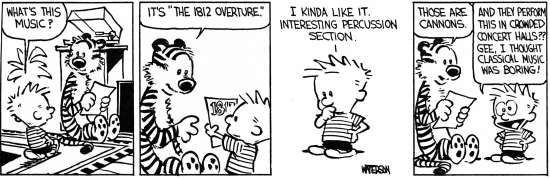
An p;d Calvin and Hobbes strip
I want to focus today on the Prologue to the Gospel of John, that part of the first chapter of John’s Gospel which is a poetic introduction to the themes of the Gospel. Introductions… some of my first introductions to music as a child were to simple tunes and I was invited to sing along with them, to take them into my life. Then I started to see that the music could tell a story, as in a musical or operetta, where the songs were mileposts of the relationships between the characters in the story. Unfortunately, I saw overtures as inconvenient noise until the real show began - until I realized that overtures were actually the show in miniature, with the themes bouncing off of each other as they told the story that was to follow. I remember when I realized that the 1812 Overture was more than a bunch of music thrown together but a reflective re-telling of the story of the Battle of Borodino during the Napoleonic Invasion of Russia. That explained why the French National Anthem, La Marseillaise, was playing against the Russian Imperial Anthem, God Save the Tsar. Tchaikovsky took those two pieces (neither of which would have used by the armies at the time - Napoleon had banned the use of La Marseillaise because it was a battle cry to overthrow tyrants, and God Save the Tsar had yet to be composed in 1812) and creates this tension in the listeners’ minds decades later in 1880 Russia.

The Gospel lesson for today, the Prologue to the Gospel of John, is not just an introduction but is a kind of overture to the Gospel of John. The writer of the Community of the Beloved Disciple, sixty years after the life, death, and resurrection of Jesus, expands on a favorite hymn that the community uses in their worship and uses phrases and themes in dynamic tension that will be repeated throughout the Gospel. The Community of the Beloved Disciple is not at all interested in telling a standard history of facts, but in the creation of a work of art which reaches back to the beginning and beyond to give meaning to the present and hope for the future.

The experience in the Community of the Beloved Disciple was based on the Jewish thought that God was unseen, unknowable, and beyond our imagination, so far beyond the ability of humans to understand, but somehow the very heart of God became known through the person of the Christ Jesus. However, there is some confusion. The writer of John is a poet who uses words that mean two to three things at a time as a way to say that we cannot fully understand. There are times the Gospel reads like a version of the old vaudeville routine, “Who’s on First, What’s on Second, and I Don’t Know’s on Third”, to show that in this life the very words we use and trust without thinking are shaken from their moorings unless we use the Christ experience to come to a new vision of the world. The Greek word Logos was a word that meant that which one said out loud in the past (e.g. “He said the word.”), or the plan on which one bases all action (e.g. “That’s the word coming down from the top.”), or the promise that one gives as assurance for the future (e.g. “You have my word on this.”), or an audit of continuing action (e.g. “The word on the street is good on this project.”), or a philosophical discourse (e.g. “We shared some words.”) 
 
The poet does not say that “The Word” has only one meaning, but when it is used, it contains all the possibilities at the same time. God is before there is a past, before the beginning into the past, present, and future, and is the freedom to enter into dialogue with us for a deeper life. The Prologue reminds us of all of that. For centuries the Roman Catholic Rite of the Mass ended with the Priest giving a blessing to the people and then facing the Altar again and saying the Prologue to John, in Latin, as part of the blessing - a way of saying that God is present in the church, but the God of past, present and future continues with us wherever we may go as we leave this place and enter fully into the overture of life.

Prologue Beginnings (poem)
Before there was the beginning, there is Being
in relationship within the dynamic of Being Self
Energy flowing, moving, receiving and freeing
Complete satisfying, solely within the one self.
But Love’s community making risky expansions
reaching within Oneself imagining an invention,
a new art, stirring up building of new mansions
of same being but free in new creative tension
with an ability of being able to say to love, “No”.
Knowing hurts may happen; Love spoke a “Yes”
Which shuddered into a wind; a hovering blow
of banging Spirit, growing and bringing a Bless
evolving into lives when we, returning to Word,
finding new freedom when Love’s Being heard.

Friday, December 25, 2015

Pondering in Our Hearts


A Reflection for Christmas Day                                 All Saints Church, Southern Shores, NC December 25, 2015                                                            Thomas E Wilson, Rector
Isaiah 52:7-10                         Luke 2:8-20
Pondering in Our Hearts
Isaiah sings “How beautiful on the Mountains are the feet of the messenger bringing Good News!  There is a painting by 17th Century Michelangelo Caravaggio Death of the Virgin that was meant for an Chapel in Rome and is now in the Louvre in Paris; it was rejected by the clergy of the chapel because the Virgin's feet were depicted as swollen and dirty. Chaucer in The Canterbury Tales has the Wife of Bath’s Tale where one of the themes is that Beauty is as beauty does. I am always embarrassed by my feet when we do a foot washing on Maundy Thursdays; I don’t have beautiful feet and I bet you the shepherds hearing the angels didn’t either but what we do with our feet is beautiful. 

From Luke’s Gospel passage for today; “The Shepherds said to one another, ‘Let us go to Bethlehem and see this thing that has taken place which the Lord has made know to us.’  . . .  Mary treasured all these words in her heart and pondered them.”

The shepherds pondered in their hearts what they had seen and heard and then, placing one non-beautiful foot in front of another, they made a pilgrimage to see what God had done. When they arrived they told Mary all that they had seen and heard, and Mary listened and took all the words into her very self. Did you ever wonder what Joseph pondered in his heart?

This story is the archetype of how the early church connected with each other; people had spiritual experiences and shared them with each other.. It is a four part process of ponderings of the heart;
(            1)    Be open to experience God’s presence
(            2)    Move out of comfort zone
(            3)    Share that experience
(           4 )    Listen and reflect in order to live into a changed life..

That four part process we have seen in the Advent lessons leading up to this visit of the shepherds It begins with the story of the vision given to Zechariah. He is a Priest in the Temple and is used to doing all sorts of religious work but he can’t be open to an experience of talking with an Angel. He can talk to God but he does not feel open enough to hear God’s messages outside of the tradition. Therefore, he does not share the Good News he has received. He ponders them in his heart and only when the birth of John becomes fully evident does he have the courage to go outside his comfort zone and sing the Song of Zechariah and raises his son John the Baptizer in a different way to prepare him to be open to experience God’s presence in the Wilderness 

The Story of Mary’s visit from the Angel Gabriel is a bit different from the Zechariah’s encounter with Gabriel because Mary is open and says “Here I am, the servant of the Lord, let it be to me according to your word.” Mary then moves out of her comfort zone to visit her cousin Elizabeth, the wife of Zechariah. There the two women share their experiences and they become the church; people sharing spiritual experiences. Notice there is no checking out of theology; only two or more coming together to share their experience. They are called to listen to each other and begin leading a new life.

In the Hebrew Testament lesson from Isaiah, the Prophet is singing a song starting with the ponderings of his heart about the time when the exiles in Babylonia have just received the good news that they will be free to return to Jerusalem after decades of waiting to return. He sings that they will follow that four part process; to be open enough to hear the good news, move out of the old way of being, sharing it with others and to reflect on how life is to change for them.

I would suggest that today is a day of Good News; Are we open to hear it? This last week I have heard a lot of both Good and bad news and that is the way of life and I take them into my heart and ponder them and I keep making a decision that I will search for something over which to give thanks. I’m lucky in that today is Christmas and all I have to do is look at faces of people and I see their Good News.

 Thank you for coming here, coming out of your comfort zone, putting one beautiful or non-beautiful foot in front of another, to share your Good News, pondering them in your heart and announcing that all Our God Reigns.

Joseph’s Ponderings
“Unlovely your feet, but love you anyway”,
she says in half laugh. But I will take one
half laugh rather than no laugh as I may
for when all of the love words are done
and said it is “Beauty is as beauty does.”
The feet walk on pilgrimage proclaiming
that peace that passes understanding twas
found in moments when love is claiming
all of me, not just one or two parts but all
of the depth to march through all nights
of dark and days of light. These poor feet
will walk one step at time until last rites
are said, treading not again on earth street
with you but holding you in a soul’s heart
which never ending Divine’s work of art.