Wednesday, March 12, 2014

Angels and Judy Engelken


A Reflection of the Occasion of a
Service of Celebration of the Life and Death of
JudyEngelken
March 8, 2014
All Saints Church, Southern Shores, NC
Tom Wilson
Judy and her family
How do I describe Judy’s faith? It is something like she is all for for the concept of God but organized religion is a trial for her. All the doctrines and creeds are seemingly like a waste of energy to her. She is not afraid of dying but is curious about the afterlife. The numinous, the sense of the Divine is very real and she sees God in every place and is frustrated when people try to corral God’s Holy Space into  one particular creed or building.  She reminds me of part of the poem Aurora Leigh by Elizabeth Barrett Browning:
And truly, I reiterate, nothing’s small!
No lily-muffled hum of a summer-bee,
But finds some coupling with the spinning stars;
No pebble at your foot, but proves a sphere;
No chaffinch, but implies the cherubim;
And (glancing on my own thin, veinèd wrist),
In such a little tremor of the blood
The whole strong clamour of a vehement soul
Doth utter itself distinct. Earth’s crammed with heaven,
And every common bush afire with God;
But only he who sees, takes off his shoes,
The rest sit round it and pluck blackberries,
And daub their natural faces unaware
More and more from the first similitude.


There are some people who worry about “getting into heaven” as if heaven is the reward for saints who do good things and avoid bad things. The problem with that is that means we turn people into reward seekers who, as the old saying goes “are so obsessed with heaven that they are no earthly good”. For Judy Heaven is not found above the highest star or at the end of the world but in the Holy space of the flower opening up in the well-kept garden.

The strength of heaven is found in the patience that Judy shows in dealing with each development in the treatment of the cancer.  

The presence of the Holy is in the family gathered together around a holiday table. When members of the family, like her mother and brother, were not there she missed them terribly. One of the things we have to learn now is to see her every time we gather around the table; just because we do not see them does not mean they are not there. That is what we do with communion service when people ask me how many attended the service- I usually say well there were the angels and arch angels and all the company of heaven- so the place was packed; just most of them are on the other side of the table. 

For Judy the sacred is when a loved person is held in her arms to wipe away the tears. Our task is to feel her arms when there is no body to hold onto and to feel the tears being wiped away. I asked Blair what attracted him to Judy in the first place. He answered;
“Besides the physical attraction Judy worked at a pre school and I was very impressed with how she cared for the children patient and loving and made her time with them fun too. I was very interested in having a family and I was sure she would make a great Mother. She also had a quiet strength.

Judy’s body may have changed form but the love, patience and fun remain; we just have to be open to hear them in the midst of our sadness. 

When my father died almost a half century ago; I was really ticked with God because I needed his strength and I thought I would not have him to walk with me. Yet after I spent a lot of years being angry and sorry for myself; I continue to find him walking with me. He is very silent but his strength is there. A week ago we were on our way to a dream conference in Western North Carolina and stopped for the night with my sister at Chapel Hill and she had unpacked an old box of my grandmother, my father’s mother, and it contained all my father’s old report cards from school. He was an “A” student every year until his senior year and then his grades nose-dived; even in Math. Now you have to know that my father became an engineer and used Math all the time and when he was in the Marines in World War II, he was an artillery officer and used math to figure out sines and cosines to plot a trajectory for the shelling. But in his senior year he seemed to be interested in something other than math.  I laughed at the humanity of the old man and soon after I felt his shared laughter. He was there around my sister’s kitchen table in the space between us to remind us that failure is not a measure of one’s worth but an opportunity for a new beginning. Judy’s death is not a failure of medicine or of Judy but a chance for a new beginning for her and for all of those she loves, not loved but loves.

It seems redundant to commend Judy to Heaven for she knows it well; for heaven is the place where God’s angels pass through and have their home. 
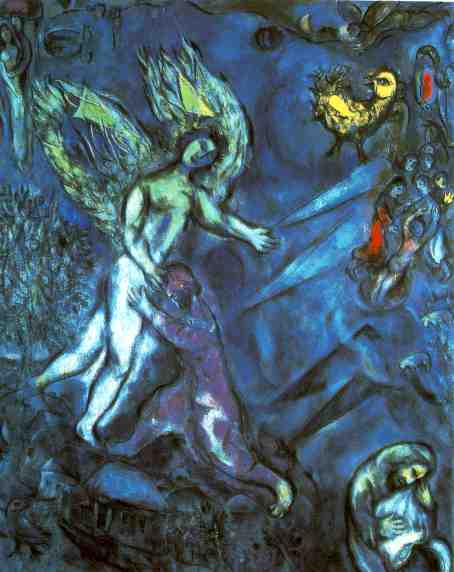
Chagal: Jacob and Angel

The word “Angel” comes from the Greek word meaning messenger, specifically a messenger from God, something which contains within itself God’s message to people who are open enough to hear. What form does an angel” take? It depends on the form that the message is accepted and recognized for it is a part of the Spirit spiraling to those who are in need of love and strength. The form takes the shape necessary for the listener to the message. The old Medieval struggle to find the answer to the question: “How many Angels dance on the head of a pin?”, ends with the answer “As many as want to.”

Judy saw and had encounters with angels and that defines who she was; a person who encountered angels. She is stubborn and strong which invites people to be around her to gather some strength from her. Judy is not going to Heaven she is just passing through the door from one part of the Holy into another part.

You may have noticed that I use the present tense to speak of Judy and that is appropriate but part of the reason for this service we do today is to claim both the present and the past at the same time as well as hope for the future. Her body, in the shape we know, is not here but her angels are here and her spirit is carried by those divine angels who bring her to her rest.


Saturday, March 8, 2014

Tempting Shadows


A Sermon for I Lent                                                   All Saints’ Church, Southern Shores, N.C. 
March 9, 2014                                                                Thomas E. Wilson, Rector
Genesis 2:15-17; 3:1-7            Romans 5:12-19          Matthew 4:1-11
Spoiler alert: I just got back from another Dream Intensive where we focused on Shadows and how we can identify them in our dreams. 
Also today we start using the Rite I service.  When we are so used to flying through the language of Rite II, we now enter into more unfamiliar territory which, we hope, will lead us to pay more attention to what we are saying.
Why does Jesus go out in the Wilderness as related in Matthew’s Gospel lesson for today? Matthew says that Jesus was led by the Spirit after Jesus was baptized. So, Jesus is beginning his new ministry and he wants to get ready.  How does anyone get ready for anything? For instance, I expect a carpenter to get all of his tools together and to see if they still work or are sharp enough.  Jesus was a carpenter and he knew those tools well, but since his new task is not carpentry, what does he have to do to prepare? The only thing he has is the fullness of his being - his body, mind, and spirit. He wants to become whole and complete for his ministry. He begins fasting, the discipline of doing without the usual food of nourishment in order to be hungry for being fed by God. 
Episcopalians are not that anxious to fast because we have a hard time denying ourselves anything. We might go on a diet to lose weight, but do we ever complain when we are on it! The purpose of fasting is not to lose weight but to feed a different kind of hunger. The life that Jesus is entering is going to be difficult, and Jesus knows that he will have to have a passion for the hunger for God, to feast on the Spirit.
He is also there to get rid of so much stuff that has cluttered his life - all the fears, hurts, prejudices, and assumptions that are part of his life. We dump things in the wilderness away from people, and this is where Jesus goes.
He is also there to claim his whole being, and he will go into his very self to struggle with the shadow within, the unconscious side of himself.  We all have shadows that are part of ourselves; as John Sanford defines it, “The Shadow is the dumping ground for all those characteristics of our personality that we disown.”
Shadows are always at the places and times of greatest light. Jung noted that the “most religious places in the world have the darkest shadows.”  Think of Jerusalem, Rome, Ireland, and Spain, and reflect on the fact that much of the bloodshed and violence in the world have had elements of religion as the cause.  The attempt of humans to have harmony with God somehow often devolves into disharmony between fellow human beings. Jesus has just had his baptismal experience and he was in the light of the Spirit, but he knew he had to go deeper into the shadow in order to make sure he would not fall into that trap.  
Our shadows dwell in the darkness of our own unconscious. We need to be aware of all those things that we have pushed down out of our consciousness but that have this nasty habit of coming to us in our dreams and visions or spring up when we project the shadow onto another person. We need to bring these shadows to light so that we are aware of them. Jesus will later warn of this inability to see our own shadows when he says: “First take the log out of your own eye and then you will see clearly how to take the speck out of your neighbor’s eye,”
The journey into one’s very self is where we encounter the shadows, and it is here where we meet some of our demons. Carl Jung said, “One does not become enlightened by imagining figures of light but by making the darkness conscious. The latter procedure, however, is disagreeable and therefore not popular.” This disagreeable task of naming, meeting, struggling with, and claiming our demons is what Jesus is doing. As he fasts, he starts to have visions of meeting with the darkness that dwells within each one of us. Matthew gives this dream-like encounter a physical name- “the Devil”.
In the Bible, we first run into the idea of the Devil as the “accuser”, the one who points out our faults before God. He is the one who suggests to God in the Book of Job that Job may not be as pure as he seemed. Later on his role develops, and he is identified as the “Tempter” who we saw in the serpent in the first lesson from Genesis. We know him as the one who dwells within us as our dark shadows.
For instance, I, for a time, was a pacifist because I thought that war was not a profitable way of resolving differences.  Wars simply set the stage for the next war. I became passionate about my hatred of war and the passion was more than a logical argument. I came to realize that I had tried to push down all my anger and my innate love of violence into my unconscious, and it would come to the fore whenever I saw someone who had been a warrior. I was projecting the hatred of all my own deep violence onto another person and hated him for being that object. It was only when I brought my violence and anger to my own consciousness that I was able to claim it as my own. I had to claim it, honor it, and deal with it instead of trying to hide from it and risk it coming out in inappropriate way. When I saw the shadow within me, I had to withdraw my projections from those who reminded me of that part I did not want to claim.
That is the Spiritual journey we are on in Lent - to look at our shadows. Shadows can be identified by the emotion we have toward another person which we cannot fully explain (there are bright shadows as well as dark shadows, but that is for another sermon), and as people of the same gender as the dreamer in a dream. Looking at our dreams is one of the ways we can discover our shadows. This is one of the reasons that we will take a look at Dreams as a spiritual help in the Lenten Programs as God helps us down into the true self for wholeness and healing. We begin this Thursday evening over soup and salad and a hunger for God.
Jesus deals with three shadows in the Temptations story. The first Temptation, or Shadow, was the desire to do without God. Jesus had entered into fasting to get in touch with his hunger for God, and the dark shadow suggested that he could only be himself when he took care of himself first and put all this God foolishness on the back burner.
At a deeper level in this temptation was the lure to deal with things of God’s creation as objects to be used for our own purposes instead of being seen, first and foremost, as gifts of God’s love, carrying the very essence of God within their being. To go deeper into one’s true self is to have a reverence and awe of all creation. The purpose of a retreat is to find that the very ground on which we walk is holy ground. If our own agenda is the only thing we pay attention to, then a stone is a stumbling block, but if we look at the stone and contemplate how many millions of years it took this stone to develop, then we enter into wonder as it tells us of the mystery of God. In the wilderness without the distraction of our everyday life, we can see the tenacity of a weed to survive instead of seeing it as an invader of our garden. In a wilderness, we walk on the ground and feel every step as our foot takes its time to pay attention to every ridge and depression. As we slow down we do not step on “pests”, but we acknowledge their right to be there. In a wilderness we are able to be part of the oneness of all creation and to deal with our shadow which whispers and tempts us to act as if our desires are the center of the universe.
The second temptation is the Shadow that whispers that the best way to deal with people is to manipulate them. Satan, the accuser, our shadow, hisses that Jesus could be successful if only he would impress them with the fantastic trick of throwing himself off the Temple. The third temptation is the Shadow hissing that the best way to deal with people is to control them: “I will place the Kingdoms of the Earth into your hands; if you will only follow me.”
These three shadows are the dreams of Jesus as he encounters them and brings them into consciousness. These are the universal shadows of being the center of our own universe and our desires for manipulation and control.  However, as the infomercial on television tells us, “But wait, there’s more!” This Lent, as part of your Spiritual growth into the depths of your true being, I invite you to explore your dreams and your shadows.

Wednesday, March 5, 2014

Rain pace life-


A Sermon for Ash Wednesday                         All Saints’ Church, Southern Shores, NC 
 March 5, 2014                                                                     Thomas E. Wilson, Rector
2 Corinthians 5:20b-6:10                               Matthew 6:1-6,16-21
My daughter and I before I went to Seminary  

Years ago I did about six seasons of Outdoor Drama in a couple different places. They are done outside during the summer when rain is not unheard of. In Outdoor Drama there was this thing called “Rain Pace”.  This was when you knew a rainstorm was coming, but you didn’t want to cancel the show because if you didn’t get through the first act, you had to give the ticket holders their money back. On the other hand, if you made it through the first act and started the second act, then you would give them a “rain check”, which meant that they could come back another night free. Outdoor Dramas run on shoestrings, and too many rainy nights mean a difficult time opening next year. Performing at rain pace meant that you would do every line and hit all your blocking, but you would say your lines fast and move into your blocking fast. The difference is like this “Well (thoughtful pause)… Jack, I hate to admit it (small laugh), Jack- you are right!” In rain pace it would be “WellJackIhatetoadmitit (half chuckle) Jackyou’reright!” 

The difference between a good performance and one done at rain pace is that in rain pace, you do all the lines and the blocking, but the soul of the performance is missing. In a good - a righteous - performance, the actor is in the character, he understands the character; in fact, the character is part of him. He knows what the character feels, how he acts when no one is looking.  He knows what is in his pockets. He knows the backstory of the character, and the emotion conveyed in the performance comes out of the things the audience does not know but the actor does. The actor lives in the awe-filled mystery of the character. In rain pace, the actor is exhausted because all he has done is earn some money and sell himself out.  After a “righteous” performance, however, the actor is exhilarated for he has lived into another life, and while he might be tired, his soul is refreshed and alive and he looks at the world and his fellow actors in Thanksgiving. In that space he really doesn’t care what the critics say for he  has entered into the mind of the playwright, to live fully into the character that he and the playwright have created.

There is a line from T.S. Eliot’s play Murder in the Cathedral: “What is the greatest treason? To do the right thing for the wrong reason.” That is what Jesus is talking about in the lesson from Matthew for today - doing the right thing for the wrong reason. His audience knew what the right things were - “to do justice, love mercy and walk humbly with your God.” The outward and visible signs of this were to fast, to enter into a hunger for God; to give alms as a way of giving thanks for your blessings and helping to create a just society; and to worship and give God the worth of your time and love. He points to some who perform the outward signs but who have missed the point because they want to impress people with their piety rather than grow closer to God.  They exhibit a  “What do I get out of it?” mentality. The difference is that doing the right thing only for the purpose of impressing others or getting a tax advantage will get you rewards, but they are short-lived rewards because they fade away over time. Jesus calls these “earthly rewards” where moth and rust consume and thieves break in and steal. These are to be compared to what he calls a “Heavenly reward” which is entering into a full relationship with God, and he calls that “Righteousness”. The reward of that relationship is here and now, and he calls that relationship the Kingdom of the Heavens, and it continues long after we die.

Does that mean that, if you do all the right stuff and do it in “righteousness”, everything will turn out rosy for you? Not necessarily. Paul talks about it in the lesson from 2nd Corinthians where he lists a long, very long list of the things that have gone wrong in his life. Yet he sees that, even in his defeats, he is more than a conqueror. Like Jacob in the Genesis story, it is in the defeats, as we wrestle with God, that we become blessed and live into a whole new way of being. 

If we live a life in which our focus is to impress people, the victories are so small, but if we are defeated by God’s love, then we grow in faith. There is a poem by Rilke which sums that up:
The Man Watching 
By Rainer Maria Rilke
I can tell by the way the trees beat, after
so many dull days, on my worried windowpanes
that a storm is coming,
and I hear the far-off fields say things
I can't bear without a friend,
I can't love without a sister.
The storm, the shifter of shapes, drives on 
across the woods and across time, and the world looks as if it had no age:
the landscape, like a line in the psalm book, 
is seriousness and weight and eternity.
What we choose to fight is so tiny! 
What fights with us is so great. 
If only we would let ourselves be dominated as things do by some immense storm, 
we would become strong too, and not need names.
When we win it's with small things, 
and the triumph itself makes us small. 
What is extraordinary and eternal does not want to be bent by us. 
I mean the Angel who appeared to the wrestlers of the Old Testament:
when the wrestlers' sinews 
grew long like metal strings, 
he felt them under his fingers 
like chords of deep music.
Whoever was beaten by this Angel 
(who often simply declined the fight) 
went away proud and strengthened
and great from that harsh hand, 
that kneaded him as if to change his shape. 
Winning does not tempt that man. 
This is how he grows: by being defeated, decisively, 
by constantly greater beings. 

This Lent we invite you to not strive for small victories, but to enter into a struggle with God’s love and forgiveness, where defeat brings you life.

Tuesday, March 4, 2014

Twilight Zone Zombies: reflection on a dream

 
Twilight Zone Zombies

In the dream, I with friends glanced at the big set
where I am frozen in the credits of episode of Zone,
the Twilight Zone, which I had not seen, where I am chased
by Zombies, those creatures who still having blood,
yet whose eyes are dead and devoid of life,
look for others, hapless others, making them turn

into ones like them. I running, running and turn
this way and that to avoid forever aspic like set
in this life of deadness, of paces walking as if life
was still there but missing the point of the zone
of living with passion boiling in my blood.
But, in the dream all of them are me; not chaste,

YET with impure thoughts playing of undead chases
through my heart. My years are moving to the turn
of retirement and who am I without the hot blood
of work flowing in my days running with full schedule set
for each new day? Visiting with joy people in the zone
and ideas of Spirit and children full of fun and life.

YET, there are so many moments at desk where life
has fled and bureaucrat roles and functions chase
away the reason for the profession. Find it hard that zone
to find and to be where I really care if numbers turn
from good to worse and where I am Zombie like set
in routine and the slow cooling of my spirit’s blood.

YET, I see the geritol starved with tired blood
cooling as they watch the tube for shade of life
sparkling the routine of sup, shit, sit, stare at sets,
now bigger and brighter, but with all life chased
away. Where the only choice is the button to turn,
no knob for them, and me, who watch old Twilight Zone

episodes to recapture surprise. Twilight indeed the zone
on the tube and me. How I long for a new day and blood
burning of new lands. Now I move to dream lands to turn
inward to come to peace with foundations of my second life
integrating the honored ruins of first with all that was chased
away as I chased after honored goals, but now new to set.

Twilight is my zone as dark and light of new life
blend in my blood. Dreams of my Zombies chased
and being chased in turn until the channel changes on the set.