Friday, July 11, 2014

Despising Birthrights Sermon for July 13, 2014


A Reflection for V Pentecost (Proper 10) All Saints’ Episcopal, Southern Shores, N.C. July 13, 2014 Thomas E. Wilson, Rector
Despising birthrights”
(a video of this sermon is on http://youtu.be/vWTCj3f16QI )
Last week I finished a trilogy (a three part series) of reflections on Abraham and this week I am beginning a tetralogy (a four part series) on Jacob. One of the problems with being a Parish Priest is that I always have next Sunday’s service hanging over me. This Sunday’s story from Genesis has to do with the “birthright”, that which we inherit from our parents. I did a reflection for Martha Middleton’s Celebration of Life last week that grew out of a discussion I had with the family about what was their birthright from Martha. What we tend to think about is the “stuff” we inherit; for instance, I have a couple of silver pitchers and silver tea set and a couple pictures from my mother. When my father died, I got some Veteran’s and Social Security help in paying for college, some books and I got one of my father’s old suits, re tailored, which I wore to my graduation, wedding, work, the baptism of my daughter, and Grad School, until it just wore out. Whenever I saw the books or wore that suit, I was reminded that my father was living within me, urging me to live into who I was created to be. 
 
Martha Middleton inherited from her parents the value of hard work and caring for others. In a way she lived into who she was named for – Martha, the hard working friend of Jesus who took care of others. The name Martha itself comes from the Greek for the Mistress of the household, the one who is in charge of taking care. Martha lived into her name and passed on her birthright to her children. 
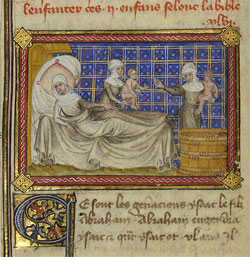
 
In the same way the “birthright” in Genesis is more than just stuff; it is a blessing which carries with it the power of cementing the personality of the receiver so that that person might become who he or she was created by God to be. In this story from Genesis, we have the birth stories of Esau and Jacob in which the first blessing is the given name. The name carried power to shape the individual as they lived into their name, and the blessing, birthright, is believed to confirm that fullness of personality.

Jacob’s name has its roots in a saying like “May God protect”, and it was appropriate since he was the younger brother of the hairy and ruddy Esau who was bigger and stronger than Jacob and, God knows, Jacob was going to need all the help he could get. Later in this part of the story there will be a connection of the name Esau to the color red. Just stop for a minute and think about what kind of person you would think of if I gave you three adjectives - big, hairy, and red. The color red resonates with the color of danger - vital, alive, aggressive and forceful. Jacob has to be the one who is able to think on his feet and to rely on God to get him out of trouble. Later in the story he will have his name changed to Israel, which means the one who struggles, wrestles, with God.

We get our names from our parents, and our parents help us live into our names as we go through the journey of life. Let me give you an example of a modern myth to demonstrate how we live into our names. As you may be aware, this is the 75th anniversary of the 1939 movie “Wizard of Oz”. The name of the main character, Dorothy, comes from the Greek Dorothea - Doron = gift and theos = God; she is a gift from God. In the story, Dorothy’s parents have died and she has not inherited anything except the name, so she must make a journey to live into her name. In order to live into her name, she is going to have to develop her brain, she is going to have to learn to love, and she is going to have to develop courage. In the dream she has, she meets these three attributes in the scarecrow who wants a brain, a tin man who wants a heart, and a lion who wants courage. The dream is the incorporation of these three elements into herself and the defeat of her shadow side of selfishness, e.g. the wicked witch, which she has inside her. The movie’s core is a “Hero’s journey” mythic archetype where the journey is how the hero is changed and comes to a new understanding of how he or she belongs in the world, how to live into who that person was created to be.

The Jacob saga, the mythic structure of a public dream for the descendants of Jacob/Israel, is a “Hero’s Journey” archetype where Jacob comes into who he was created to be. They were twins so they were created to be connected and relate to each other. As they were conceived in love, formed in love and united in love; they are to live in love. However, they end up estranged from each other and thereby from themselves, from the core of who they are. The journey they are to take in these next four weeks of reflections is a journey of reconciliation to themselves and to God. In this part of the story, Esau does not want to live into who he was created to be and he squanders his birthright. Later Jacob will outright steal it from him. The birthright is invaluable, but Esau throws it away for a bowl of beans to feed a temporary hunger, as the story says, “Thus Esau despised his birthright.” 
 
We will see that theme of “despising birthright” in the parable that Jesus tells in the passage from Matthew about the “Sower and the Seed”. As you probably remember, a parable is a story that has a single point, usually as an unexpected surprise at the end; while an allegory is a teaching tool in which all the details of the story stand for something and the point of the story is in the collection of the different parts. Jesus told parables to show us what life in the Kingdom of the Heavens was like in this world as we are given opportunities to live into who we were created to be. The writer of Matthew wants to teach later generations, so the editor turns the parable into an extended allegory which domesticates it into a teaching about other people and an explanation as to why the church is unable to grow. I believe that it is a story, a dream, a myth, a “Hero’s Journey”, told in miniature about the seed, which is you and me, and how we grow into who God created us to be. You and I can fill in the blanks about the times we decided to be stony, or dried up, or encumbered with weeds in our lives, or that we just ignored. All are ways that we despise the birthright of who we really are. The punchline is how the “seed”, when it decides to live into being the creation of God, grows into thirty to sixty to 100 times more of the person that God created that “seed” to be. 
 
We see this theme of “despising birthright” in Paul’s letter to the Romans as he tells them that, when we enter into the new birth of Christ’s Spirit and then ignore the fact that we were created to be full spirit-filled human beings, we are focusing only on a sleepwalking, self-centered existence, what Paul calls the flesh. We are not living fully into this new, resurrected life - in this life and the next.

Homework for this coming week is to reflect on what is your birthright. What did you inherit from your parents? What did you inherit from your God? How are you honoring that birthright? How are you despising it? Where are you on your hero’s journey of living into your true being?

Tuesday, July 8, 2014

Martha Middleton


A Reflection on the Occasion of the
Celebration of the Life and Death of
Martha Darden Middleton.
All Saints Church, July 8, 2014
Thomas E Wilson, Rector
One of the problems with being a Parish Priest is that I always have next Sunday’s lessons and service hanging over me. This coming Sunday has one of the lessons having to do with “birthright” on what do we inherit from our parents.  So I am thinking about this when I talked with the family about who Martha Darden Middleton, born on September 13, 1936 in Washington, DC and died July 3rd, 2014 on these Outer Banks, passed on as her birthright.  

The family and I had a good discussion and Blair wrote down some thoughts which he wanted to share.
“Today we mourn the loss of but more importantly celebrate the life of Martha.

Martha, Mar, Mom, Grandma,

She was all things to everyone that knew her.

In this self serving, ME ME ME world, She was the epitome of generous.

Whether you walked on two legs or four, if she thought you needed it, she'd get it for you.  If she didn't have it, she'd order it from LL Bean and have it shipped to your door.

Several times I told my Mom that she looked through life with rose colored glasses.  She simply told me, very politely and gently, that I'd learn in time.

Now I realize.  They were not rose colored glasses.  She chose to see the positive side of life, the joy of life.  The other side simply did not matter. 

The first thing I got from my Mom is perspective.  There is more to life than work.  There is more to life than money.

Sometimes, the greatest joys of life come from sitting at the dining room table sharing a meal with friends and family.

And yet, sometimes the greatest joys come from sitting on the beach with a good book, with family close by.

Going forward, I hope I'll be able to see the world more through her Rose Colored glasses.

The second thing I got from my Mom, I hope, is her strength. 

When my wife was in the delivery room with my first child, and I was beside myself with emotion as I waited in the Father's changing room,  I called her. 

Her words were delivered in the perfectly calming, quiet tone that I needed.  "Blair, it will be alright.  I'm right there beside you, even if I'm not with you.". And she was right, as she usually was.
Strength when needed.
She was loved by all that knew her, and will be truly missed.
I will miss her every day.
Let's celebrate the joy that she brought to all of us.”

It is my theology that God is the giver of Gifts and all of creation is a gift given by a loving Creator to us. Since we are in the image of God; we join as co-creators of the universe in which we live. As God shaped us with the divine hand from the humus of the earth and made us humans, we are also to take each gift that is given to us and treasure them and pass them on to others. That is what Martha did as a teacher- she took the children she received and she tried to pass on to them the love of God for them, she tried to pass on the concern of another person for the wellbeing of each child, she tried to pass on a treasure of learning, she tried to pass on they were part of something much greater than themselves, she tried to pass on how to love others and how to love God.

She got paid to be a teacher and to do lesson plans, but what she did was to pass on to them the soul of Martha Darden Middleton. Our life is about passing on our souls to a world that is desperately in need of souls connecting. We live in a broken world in which we made a big deal of pointing out differences. Looking at the news for today, we see Congress and the Administration facing off on differences, we see Muslins Sunni and Shia facing off, we see Christians facing off, we see Russians and Ukrainians facing off, we see the North Carolina legislature facing off, we see Conservatives and Progressives facing off, you name it we can find differences and yet there is a deeper connection if we can understand that the person with whom we disagree is a gift from God.

That is why Martha is important not for what she did as a job but for who she is in her daily life. What did I inherit from Martha? She taught me by how she lived her life, compassion- that ability to feel the pain and joy in another person. She taught me that work is a gift and we are to work hard to bring about completion of that gift. She taught me that there is never a time when we were not to continue to grow in mind and spirit; no matter how young or old you are; we continue to grow deeper. She taught me that you don’t have to show off and impress people with what you do, but you quietly show up and radiate who you are. She taught me that when everything is going wrong in your life; you face it one day at a time with courage and appreciation. She taught me that being  a friend meant that you can be counted on . She taught me that being a member of a family meant that you belonged to something other than yourself. These are the lessons we need to be taught over and over again and Martha taught us, not with words but by her sharing of herself.

When we live into these lessons we become what the writer of the Book of Revelation sees when he announces that he “Saw a new heaven and a new earth because the old one is passing away.” The outline of the Book of Revelation is a series of dreams by a community about the world in which they lived. These are dreams and visions of the world of the past, present and future and how it is changed when the Spirit of the Risen Lord comes and lives within us.

Martha died but her soul, the essence of who she was created to be by the Lord who loved her, now lives fully in this new creation now. In this life, Martha quietly shared her soul and was part of the changing of the world. If you want to remember Martha; then quietly be part of that new creation.


Thursday, July 3, 2014

On "Our lives, our fortunes and our sacred honor"


A Reflection for the Sunday following the 4th of July           All Saints’, Southern Shores, N.C. July 6, 2014                                                                                 Thomas E. Wilson, Rector
Deuteronomy 10:17-21                       Hebrews 11:8-16         Matthew 5:43-48        Psalm 145:1-9
On “Lives, fortunes and sacred honor”

A video version of thei sermon is on You tube:       http://youtu.be/Fqw6Zc-q0OQ 

Today we have moved the lessons for the 4th of July to take the place of the lessons for this Sunday. The Episcopal Church has had an ambivalent history with the 4th of July, that day in 1776 in which people pledged “with a firm reliance on the protection of divine Providence, we mutually pledge to each other our Lives, our Fortunes and our sacred Honor,” for this dream of a nation in which all are created equal. Not all the people who make up the Episcopal Church pledged their “lives, their fortunes and their sacred honor” for the cause of Independence. In 1775, when the Revolution began, there were about 300 congregations of The Church of England in the thirteen colonies. The Church of England was the established church in six of the thirteen colonies: Virginia, Maryland, North Carolina, South Carolina, Georgia and New York. 

Establishment meant that they were supported by taxes of all citizens; indeed, one of the contributing causes of the Revolution was the idea that that taxes were going to pay for the Bishop of London’s palace in England. We still have a remnant of the idea of the state as controlling religious thought in Article VI, section 8, of our state constitution which denies the ability to hold elected office to “any person who shall deny the being of Almighty God.”  


Samuel Seabury
The title “Episcopal” means having Bishops, and we started off as a church with three Bishops. 
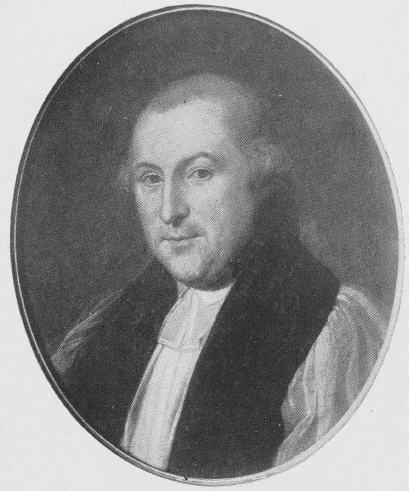
The first, by order of consecration, the Bishop of the American Episcopal Church, was Samuel Seabury who, as a loyal Priest in the town of Jamaica, New York, a part of Queens, had written pamphlets opposing disloyalty to the British Crown. When the war began, he was jailed by the patriots for a while, and then when the British drove Washington’s Army out of the New York City area, he was appointed Chaplain to a British regiment. After the war he got out of town, moving to Connecticut, and finally swore loyalty to the American side. 

William White


The second Bishop was William White of Philadelphia, who was the only Anglican Priest in Pennsylvania to support the Patriots’ side, and he served as Chaplain to the Continental Congress. 


The third was Samuel Provoost of New York, who decided that he could not remain as Assistant at Trinity, Wall Street, and continue to pray for the King, so he stepped down for the duration of the war. While he did not join the Patriot army, he did join an armed group that chased a retreating British troop in retaliation when the British burned down a town in which he was staying. 

During the war, some states confiscated Church of England buildings, turned them into state property, and sold off church lands, and it took a while for them to be returned to use as worship spaces after the Revolutionary War. By the end of the war, 40% of the Anglican ministers left for Canada. The battered and divided remnants of the Church of England in His Majesty’s Colonies under the authority of the Bishop of London, the Anglican church, started making a slow and painful transition to the Protestant Episcopal Church in the United States with a move to celebrate the 4th of July in the lead up to the first Book of Common Prayer. The three Bishops decided against this move since many of the Priests had been on the loyalist side, and this would only rub salt in the wounds. So the Episcopal Church begins by binding former enemies together. We can assume that the Priests, and parishioners, didn’t always like each other, but they decided to love each other because they believed as the lesson from the Book of Hebrews for today tells us, that “they confessed that they were strangers and foreigners on the earth”; our true homeland is not of this earth. However much we love this land in which we live, no matter how long this earthly life, we are only passing through, and our allegiance, our deepest commitment, our highest passion is to a higher law than the Constitution and a higher Judge than the Supreme Court. 

We may, some should, none must, have a passion for our earthly country. Passion comes from the Latin “patere” which means “to suffer” and means having a very strong commitment to a person, place, or thing and being willing to undergo suffering for the commitment to that person, place, or thing. That suffering of the heart and soul and mind in devotion to God’s Kingdom was the basis of Jesus’ earthly mission and ministry, and it culminates in his last days during what we call Passion Week.

There are two levels of passion - one for God and the other for those people, places, and things that are in our lives. I remember a conversation over our family supper table almost 50 years ago. I was home from college and my older brother, Paul, was home from Marine Boot Camp. Paul was talking about being a real “Gyrene” and going to Vietnam and “kill some Cong”. I opined that I could never kill another human being. My father, who had been a Major in the Marine Corps during World War II fighting in the South Pacific turned to me and, pointing his finger at me, said, “If you don’t want to kill someone - aim high; you don’t owe your country someone else’s life, but you do owe your country your life.” Then turning and pointing to Paul he said, “You owe your country your life, but not your mind.”

My father passed on that kind of passion where you accept the person, place, or thing as the gift that they are, but then look deeper than just the outside persona and see the potential in who or what they are created to be. The saying is true - the opposite of love is not hate, it is indifference. We can love someone but hate the things they do, whereas indifference means that they are not worth expending the energy to feel anything toward them.  Love is the way I look at my family, my country, my friends, my church, and myself. I love my family, my country, my friends, my church and myself, but I do not see them as perfect with a “My country right or wrong, love it or leave it” kind of mindless mentality. I love these all, faults and all, as works in progress, and I love them enough to stay and help. Our task for our country is to have passion and spend time, energy, and money to help it grow into the dream which called it into being. It means being honest about its failings when we as a nation fall so short of the divine vision for us.  

Today we remember this nation and, as we give thanks for it, we also commit ourselves to be in the image of God who, as the reading of Deuteronomy reflects, “is not partial and takes no bribe” (which suggests that we may need to do better work about tax breaks, lobbying, and funding of elections), “who executes justice for the orphan and the widow” (which suggests that we have work to do on caring for the poor), “and who loves the strangers, providing them food and clothing” (which suggests that we may need to do more work on how we deal with immigrants). “You shall also love the stranger, for you were strangers in the land of Egypt” (we here on the Outer Banks know more than a little about being from somewhere else). 

When I was growing up in the Episcopal Church, after we shook people down for money with the offering plates, we would all sing the doxology and then the organ would crank up for the last verse of “America”. I used to harrumph about it because it seemed a response to the McCarthy era, but it seems appropriate for us to go to the past and proclaim our passion for our country with the greater passion for our God. Our country has a past and is always in transition to the future, and while we are on this passionate road committing “our lives, fortunes and sacred honor” to our country, we also are in transition to a different homeland. Let’s sing the last verse of Hymn 717 as a sung closing prayer, to be followed by a spoken prayer:
Our fathers' God to Thee,
Author of liberty,
To Thee we sing.
Long may our land be bright,
With freedom's holy light,
Protect us by Thy might,
Great God our King.

The spoken prayer was given to me by one of our members who used it to open a meeting of the Worship Focus Committee. It is by the Reverend Canon Kristi Philip of the Diocese of Spokane, and it is called “A Prayer for Transition”:
Ever-present God,
You call us on a journey to a place we do not know.
We are not where we started.
We have not reached our destination.
We are not sure where we are or who we are.
This is not a comfortable place.
Be among us, we pray.
Calm our fears, save us from discouragement,
And help us to stay on course.
Open our hearts to your guidance so that our journey to this
Unknown place continues as a journey of trust.
Amen
 

Thursday, June 26, 2014

All Are Created Equal (Part two and three)

All Are Created Equal


For the You Tube Video of this  go to:
http://youtu.be/PvSWfd74ymg


A Reflection for III Pentecost (Proper 8)       All Saints’ Episcopal Church, Southern Shores, NC    June 29, 2014                                                    Thomas E. Wilson, Rector
Genesis 22:1-14                      Psalm 13         Romans 6:12-23          Matthew 10:40-42
           
All Are Created Equal (part two)
Today we continue the reflection from last week looking at the myths in the Genesis stories. A reminder that a myth is not a lie, but a story which may or may not be factually correct and which people tell in order to understand the way things are. Myths are usually about speaking a deeper truth about relationships between God and humans, humans with other humans, and humans with their own true self. They are like dreams in that they are more meant to shed light and understanding than they are to pass on facts. Dreams and myths give meaning not about surface events in the dream/myth but about the symbolic interaction within the dream.

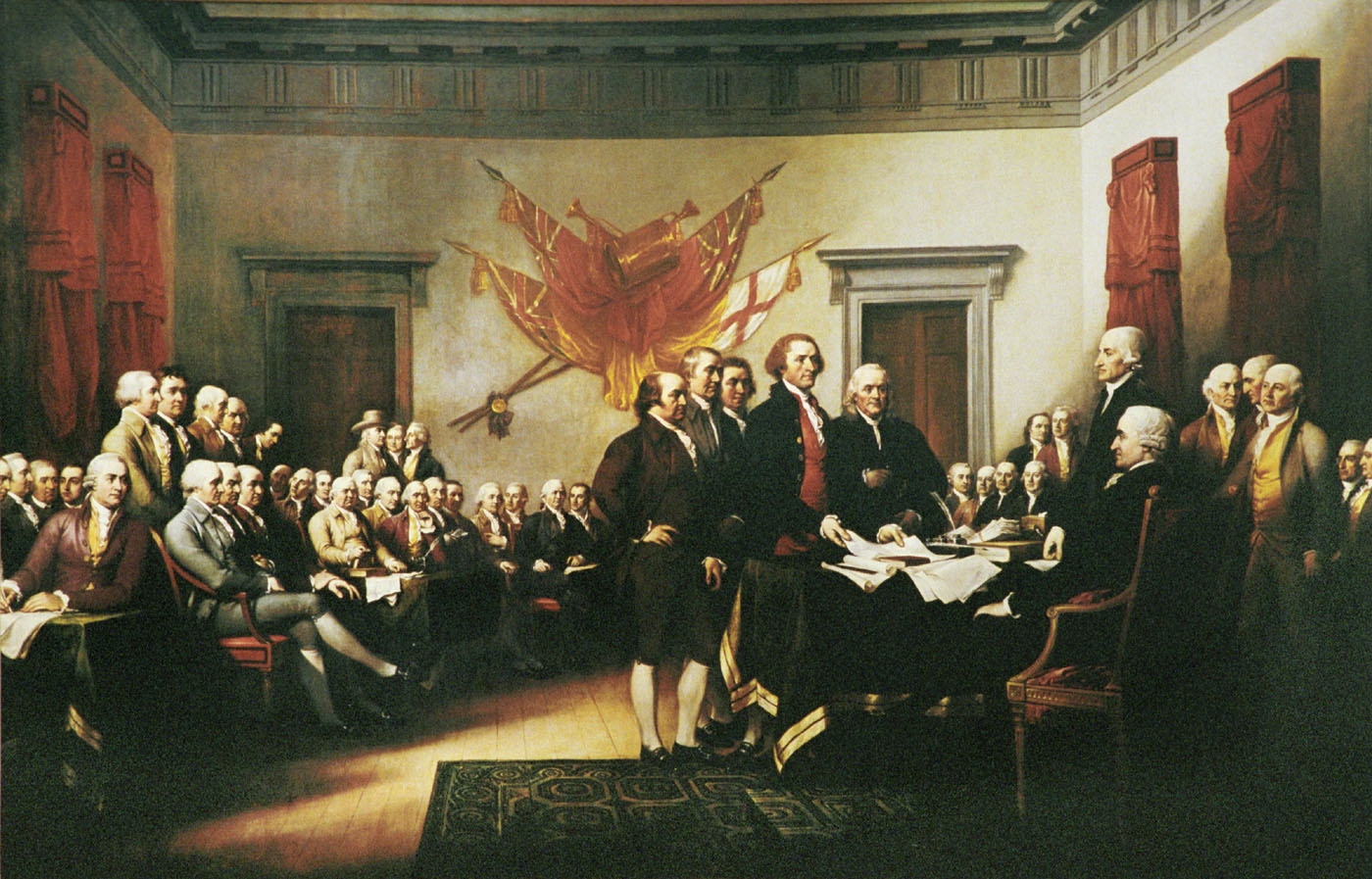
John Trumbull's painting 40 years after the event
Let me give you an example about myths using the commemoration of the 4th of July coming up next week. These are the facts:  representatives from the colonies met and, on the 2nd of July, they came up with a Declaration of Independence from England. The myths that came forth out of that meeting have been told many different ways, including elements about John Hancock’s signature, the mass signing on the fourth, the cracked Liberty Bell, and other details which are based on the belief systems of the people looking back at the event over the passage of time. Since it has been only 238 years since that day in 1776, the myth has not yet fully developed or reached its final form. This American myth is told, retold, and re-interpreted based on the needs of the later generations to remember who we really are. 

Here are the facts of the Abraham story of the binding of Isaac: in ancient times, there were many deities that required parental sacrifice of a child in order to thank those gods as a quid pro quo for good things happening or to influence the deity to a future course of action.  That is all we know, and scripture has stories of Israelite rulers and warriors sacrificing their children and prophets denouncing the practice, as well as many stories of the slaughter of innocent women and children to their God. I think this is a myth about who God is and who we are in relation with God and others by writers at least a thousand years after the Abraham/Isaac stories were first told. There is a remnant of sacrifice in the offering at the Temple as a payment for the acknowledgement of blood being shed during the birth of a child, which could be a left-over from the earlier sacrificial practice.  Jesus’ parents went of Jerusalem to pay a sacrifice of thanksgiving for his birth.

The Rabbis in the Talmud used to embroider this myth with some extra dialogue.  For instance, in one variation, God asks for a volunteer angel to go down to Abraham to tell him to kill Isaac. All the angels refuse and tell God that if God wants to have this horrible deed done, God alone is going to have to do it. Apparently the Rabbis wanted to pass on the myth with another dimension - that even angels don’t use the “I was only following orders” excuse, and we are all responsible for our actions.

While both the Bible and the Muslim Quran agree that the sacrifice was to be done on Mount Moriah, which they also agree is the present site of the Temple Mount and Dome of the Rock in Jerusalem, the Quran tells this myth with Ishmael taking the place of Isaac.

However, I don’t think the myth is about child sacrifice once upon a time. Rather, I think that the public dream that is the myth goes deeper, speaking to our conscious and unconscious tendencies to treat people as objects for our own agendas. What does the myth tell us?
 Two things: (1) God is the giver, not the taker and 
                   (2) we are to treat God’s gifts as subjects of awe, not as objects of malice. 

In this myth God indeed is the giver of all things, even the child Isaac. While Isaac is a gift, he is still created equal with Abraham, and God loves and cares for them both equally. God still owns the gift, but we are asked to be stewards of that gift. The responsibility of Stewardship means any gift is given by God and is to be honored for the betterment of the community of faith. Our children do not belong to us to do what we want to meet our needs; they are to be loved for who they are and helped to grow into who they were created to be. Our spouse is not an object to be used for our needs but to be loved and helped to grow into who s/he was created to be and for the mutual creation by the couple of an icon of forgiveness, respect, honor and self-giving care. Our neighbors are gifts from God and are not to be manipulated or exploited for our profit, but we are to work together to create a community of grace. As the Gospel lesson for today reminds us, we are to be welcoming of all gifts from God.  Even our enemies are gifts from God in order to grow in that love which overcomes all differences, creating a commonwealth of peace and justice - “thy will be done on earth as in heaven.”

I think that the myth tells us that the God who continues creating the universe, who continues to walk beside us and live within us, this God sees no real purpose in answering petitions for taking sides about national boundaries or in religious squabbles or in party affiliations or in financial schemes or in generational power struggles whose main purpose is to take advantage of another person. This God laments the divisions we tend to engender between the gifts God has given us. We were not created to consume people, places, and things for our own selfish gains. We are the equal gifts of God given to the world. When we live into that truth, we are able to love the giver of the gifts, we are able to love ourselves as precious gifts from the divine, and we are able to be in awe and wonder over all the other gifts given to us in this world that are placed in our collective stewardship.

Part three is in the Tomes in the July Trumpeter.

Which I am including now : Parson Tom’s Tomes
“All People Are Created Equal” (Part 3)
This continues the reflections in the sermons for June 22 and 29. It starts with a dream. When God created the entire universe, God gave a dream to all of creation which became part of our collective unconscious as human being. The dream said that we, all the atoms of creations, are all connected to each other and all persons are created equal.

From the beginning of written though all peoples have written this dream for their communities. From Ancient China Confucius said; “"Never impose on others what you would not choose for yourself.".
In India, the Hindu centered their moral laws on Dharma; “One should never do that to another which one regards as injurious to one’s own self. This, in brief, is the rule of dharma. Other behavior is due to selfish desires.”  

In Ancient Egypt the Goddess Maat weighted the souls of the dead so they might enter the afterlife and at the center of the Code of Maat was “"Now this is the command: Do to the doer to cause that he do thus to you.”  

The Hebrew people enshrined in their law about the treatment of strangers: “But treat them just as you treat your own citizens. Love foreigners as you love yourselves, because you were foreigners one time in Egypt. I am the Lord your God.” 
 
The Buddha spoke against violence of any kind: “Hurt not others in ways that you yourself would find hurtful.”

Jesus took the whole of the law and summarized it in his encounter with a lawyer: “And one day an authority on the law stood up to put Jesus to the test. “Teacher,” he asked, “what must I do to receive eternal life? ‘What is written in the Law?” Jesus replied. “How do you understand it?” He answered, “Love the Lord your God with all your heart and with all your soul. Love him with all your strength and with all your mind.’ And, ‘Love your neighbor as you love yourself.’ “You have answered correctly,” Jesus replied. “Do that, and you will live.”

And so it goes, as people in every land have encountered the dream and either followed it or shaped it to their culture, or ignored it.

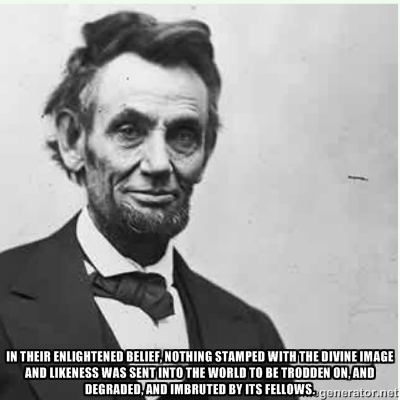
Lincoln 80 + years after the event
On July we remember the events in Philadelphia 1776 when it was written in the Declaration of Independence:  “We hold these truths to be self-evident, that all men are created equal, that they are endowed by their Creator with certain unalienable Rights, that among these are Life, Liberty and the pursuit of Happiness “  Again they encountered the dream and shaped it to their culture because their interpretation meant men and not women, they meant adults not children, they meant allies not enemies, they meant men with property and not men without property, they meant white men and not black nor native American, they meant English speaking who were already there  and not Hispanic, nor Eastern and  Southern European, nor Asiatic who would come “yearning to be free”, they  meant straight men and not gay men.

Our History show that  in the 238 years since that  day in Philadelphia  we continue to encounter the dream anew in every generation and re-interpret it as “All People are Created Equal” This month let us dream the dream again.

Shalom